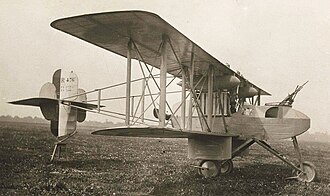
Bréguet 5: The Unusual French Biplane of the First World War
The Bréguet 5, also known by the French designation Bréguet Bre.5, was a distinctive French military aircraft developed during the First World War. Designed as a development of the earlier Bréguet 4 and initially conceived as an escort fighter, the aircraft eventually served in several roles, including bomber, escort aircraft, and later night fighter and night bomber. Its unusual pusher configuration, large biplane wings, powerful armament for its time, and long endurance made it an interesting example of the experimentation that characterized military aviation during the middle years of the First World War.
The Bréguet 5 first flew in 1915 and entered service around 1916. It was developed from the earlier Bréguet-Michelin BUC, an aircraft created around the idea of a heavily armed escort fighter capable of protecting bombers. The new aircraft retained many of the earlier design’s characteristics while introducing a more practical arrangement of armament and a Renault engine. Several related versions followed, most notably the Bréguet 6 and Bréguet 12, demonstrating how the basic design continued to evolve as French military aviation requirements changed.
Although the Bréguet 5 never achieved the fame of aircraft such as the SPAD XIII or the Sopwith Camel, it deserves attention because it represents a fascinating transitional stage in the development of military aircraft. It was conceived at a time when designers were still trying to determine what a successful bomber, fighter, and escort aircraft should look like. The result was an imposing machine that combined the structural traditions of early biplanes with increasingly sophisticated ideas about aerial warfare.
Development of the Bréguet 5
From the Bréguet 4 to a New Escort Aircraft
The origins of the Bréguet 5 can be traced directly to the earlier Bréguet 4 and its experimental escort-fighter derivatives. The Bréguet company had already explored the use of a pusher configuration for military aircraft, placing the engine and propeller behind the crew rather than ahead of them. This arrangement had an important advantage for armed aircraft: the forward part of the fuselage could remain unobstructed by a tractor propeller.
The Bréguet-Michelin BUC had taken this idea particularly far by installing a 37 mm Hotchkiss cannon. The concept was ambitious. Instead of relying upon a conventional machine gun, the aircraft would approach enemy aircraft and use a large-calibre weapon to deliver a potentially devastating single shot. The French Army, however, requested changes to the armament arrangement, leading to the development of the Bréguet 5. The aircraft was initially intended to retain the heavy cannon but was also associated with a Lewis machine gun mounted above the upper wing and firing rearward.
This evolution illustrates an important problem facing aircraft designers during the war. A weapon that looked extremely powerful on paper could introduce considerable weight and handling penalties. Aircraft were still relatively slow and lightly powered, so adding hundreds of kilograms of equipment could have a dramatic effect on performance. Designers consequently had to balance firepower against speed, range, climb, and maneuverability.
A Family Rather Than a Single Aircraft
The name Bréguet 5 is best understood as part of a small family of related aircraft. The Renault-powered Bre.5 was followed by the Bre.6, which used a Canton-Unné radial engine, while some Bréguet 5 aircraft were later rebuilt into the Bre.12 night-fighting and night-bombing configuration. The Bre.5 itself existed in bomber and escort-fighter forms, generally identified as B.2 and Ca.2 respectively.
This development pattern was typical of wartime aviation. Rather than designing an entirely new aircraft whenever a requirement changed, manufacturers frequently modified existing airframes. An aircraft originally designed as an escort fighter could be adapted for bombing, while an older airframe could later be equipped for night operations. The resulting aircraft were often visually similar but could have substantially different engines, weapons, equipment, and performance.
Design and Configuration
The Pusher Biplane Layout
The Bréguet 5 had a highly recognizable pusher configuration. Its engine was positioned behind the crew compartment and drove a propeller at the rear. The pilot and gunner/observer were seated toward the front of the aircraft, giving the crew a relatively unobstructed forward field of view.
The aircraft was a large two-seat biplane with a wingspan of roughly 17.5 metres. Its structure incorporated the characteristic external bracing and struts of early biplanes, while the fuselage had a relatively open and utilitarian appearance. Contemporary descriptions and surviving illustrations emphasize how substantial the aircraft looked compared with many of the lighter fighters of the same period.
The pusher layout offered an obvious advantage for the gunner. Because the propeller was behind the crew rather than in front of them, a forward-mounted cannon could be used without having to fire through the propeller arc. This was particularly important for the Ca.2 escort-fighter variant, which carried a 37 mm Hotchkiss cannon in the forward cockpit.
The same configuration, however, came with compromises. The aircraft’s large wings and extensive bracing produced substantial aerodynamic drag, while the pusher arrangement could create challenges in engine cooling, propeller efficiency, and structural integration. These were common difficulties for early pusher aircraft, and the rapid development of tractor-configured fighters eventually made the layout increasingly uncommon.
Construction and Undercarriage
The Bréguet 5 had a relatively conventional structural philosophy for its period, combining a large braced biplane wing with an open framework toward the rear of the fuselage. Its fixed landing gear was arranged in a distinctive configuration that suited the aircraft’s relatively large size and weight.
The aircraft’s dimensions underline just how substantial it was. Published specifications for the Ca.2 variant give a length of approximately 9.90 metres, a wingspan of 17.50 metres, a height of approximately 3.90 metres, and a wing area of around 57.7 square metres. Its empty weight was approximately 1,347 kilograms, while loaded weight was around 1,886 kilograms in one commonly cited specification set.
Such dimensions were necessary because the aircraft was expected to carry two crew members, fuel for long missions, weapons, and potentially bombs. The large wing area helped generate the lift required to get such a heavily loaded machine into the air.
Engine and Performance
The Renault 12Fb
The principal powerplant of the Bréguet 5 was the Renault 12Fb, a liquid-cooled V-12 engine producing approximately 220 horsepower. The engine was mounted behind the crew compartment in the pusher arrangement and drove a two-bladed propeller.
For an aircraft of the Bréguet 5’s size, 220 horsepower was useful but hardly excessive. The machine’s considerable structural weight and large airframe meant that performance was inevitably modest when compared with the increasingly specialized fighters that appeared later in the war.
Published figures give the Bréguet 5 Ca.2 a maximum speed of approximately 136 km/h, with a service ceiling around 4,300 metres. The same data gives a range of roughly 700 kilometres and an endurance of approximately six hours and fifteen minutes.
These numbers reveal the aircraft’s real strength. The Bréguet 5 was not particularly fast, but it could remain airborne for a considerable period. That characteristic was valuable for escort, reconnaissance, bombing, and particularly night operations. Endurance could be more important than speed when an aircraft had to patrol an area or accompany another formation over a relatively long distance.
Different published sources give slightly different figures for dimensions and maximum speed, reflecting differences between variants and historical specifications. One French-language source, for example, lists a maximum speed of 142 km/h and a maximum weight of 1,840 kilograms, while other references give slightly lower speed and higher loaded-weight figures for the Ca.2.
Armament and the Escort-Fighter Concept
The 37 mm Hotchkiss Cannon
Perhaps the most remarkable feature of the Bréguet 5 was its potential armament. The Ca.2 escort-fighter version could carry a 37 mm Hotchkiss cannon in the forward cockpit. For an aircraft of the period, this was an enormous weapon compared with the rifle-calibre machine guns normally fitted to fighters.
The purpose was not necessarily to engage enemy aircraft in prolonged dogfights. Instead, the aircraft was intended to attack bombers or hostile aircraft with powerful individual shots. A large-calibre projectile could potentially inflict severe damage with a single hit, allowing the Bréguet 5 to operate as a kind of aerial artillery platform.
The pusher configuration made the concept technically feasible because the cannon could be mounted forward without a tractor propeller occupying the same space. Yet the disadvantages of such a weapon were substantial. The cannon was heavy, ammunition capacity was limited, and the aircraft’s relatively low speed made it difficult to dictate the circumstances of an engagement.
The Bréguet 5 therefore represents an interesting dead end in fighter development. The idea of heavily armed aircraft would certainly survive, but the successful fighters of the later war generally relied on lighter, faster-firing machine guns and much greater maneuverability.
Machine-Gun Armament
The aircraft was also associated with machine-gun armament. Sources describe versions equipped with a Lewis gun, while some summaries list combinations of cannon and machine guns. The exact armament depended on the particular configuration and mission.
This flexibility reflected the aircraft’s multipurpose nature. A bomber did not necessarily require exactly the same weapons as an escort fighter, and night operations created yet another set of requirements. The Bréguet 5 family consequently became a useful platform for experimentation with different forms of armament.
The Bréguet 5 as a Bomber
A Change in Military Priorities
Although the Bréguet 5 was closely associated with the escort-fighter concept, it was also produced in bomber form as the Bre.5 B.2. This was a natural evolution as the French military gained experience with aerial warfare.
By 1915 and 1916, bombing was becoming an increasingly important military role. Aircraft were being used not only to observe enemy positions but also to attack railways, supply depots, artillery positions, airfields, and other targets behind the front lines. A large, stable aircraft with substantial endurance could be useful for such missions even if it lacked the performance required of a modern fighter.
The Bréguet 5’s spacious structure and relatively long endurance made it suitable for this purpose. Its two crew members could divide responsibilities between flying, navigation, observation, and defensive duties, while the aircraft carried the fuel and weapons necessary for extended missions.
The bomber configuration also demonstrates why aircraft classification during the First World War can sometimes be misleading. The distinction between “bomber,” “fighter,” “escort,” and “reconnaissance aircraft” was still developing. A single airframe could be modified for several roles because military aviation doctrine had not yet settled into the highly specialized categories familiar from later decades.
British Service
The Royal Naval Air Service
The Bréguet 5 also saw service outside France. The Royal Naval Air Service (RNAS) operated 35 examples, with ten supplied directly by Bréguet and another 25 built in Britain by Grahame-White as the G.W.19.
The British-built version was adapted to use a Rolls-Royce Falcon engine. This was another illustration of how wartime aircraft production could cross national and industrial boundaries. Britain required large numbers of aircraft, France was developing useful designs, and British manufacturers were able to produce locally adapted versions.
The RNAS had broad responsibilities during the war, including coastal patrol, reconnaissance, bombing, and operations in support of ground and naval forces. An aircraft with the Bréguet 5’s endurance and payload characteristics could therefore fill several useful roles.
The British use of the type also reinforces the point that the Bréguet 5 was valued less as a high-performance fighter than as a flexible military platform.
The Bréguet 6 and Bréguet 12
Continued Development
The Bréguet 5 did not represent the end of the design’s development. The Bréguet 6 was a closely related aircraft powered by a Canton-Unné radial engine. It was developed partly as an alternative in case Renault engine production could not meet demand. Like the Bréguet 5, it could be produced in bomber and escort-fighter configurations.
Even more interesting was the Bréguet 12. As the Bréguet 5 became obsolete in its original roles, some aircraft were rebuilt for night operations. These aircraft became night bombers and night fighters, with the fighter version incorporating a cannon and searchlight. The night-fighter conversion also had a distinctive double nosewheel arrangement.
This extended career demonstrates the adaptability of the basic airframe. An aircraft that was no longer competitive during daylight operations could still be useful at night, when speed and maneuverability were less decisive and endurance and equipment-carrying capacity became more important.
Operational Significance and Limitations
The Bréguet 5 was ultimately constrained by the same fundamental problem that affected many early military aircraft: aviation technology was advancing faster than existing designs could be updated. By the later stages of the First World War, aircraft were becoming significantly faster and more maneuverable. More powerful engines, improved aerodynamics, synchronized machine guns, and increasingly refined fighter tactics transformed aerial combat.
Against this background, the large and relatively slow Bréguet 5 was increasingly vulnerable in daylight operations. Its strength was its ability to carry equipment and remain airborne for long periods, not its ability to turn tightly or outrun enemy fighters.
Nevertheless, dismissing the aircraft as obsolete would overlook its historical importance. It represents an important stage in the development of escort aviation and bomber operations. The Bréguet 5 emerged during a period when aircraft designers were actively experimenting with the relationship between firepower, endurance, crew position, and aircraft configuration.
Its most unusual characteristic—the pusher layout—was also its most significant historical feature. The configuration allowed the aircraft to carry heavy forward armament without the interference of a tractor propeller, but the same design philosophy became increasingly difficult to justify as fighter performance improved.
Legacy of the Bréguet 5
The Bréguet 5 is best remembered as an aircraft of transition. It belonged to the generation that followed the earliest wartime machines but preceded the highly specialized aircraft of the final years of the First World War. It was large, relatively slow, heavily armed for its era, and capable of operating over long distances.
Its development into the Bréguet 6 and Bréguet 12 demonstrates the value of evolutionary aircraft design. Instead of abandoning the airframe when requirements changed, engineers adapted it to new engines and missions. The resulting machines served as bombers, escort fighters, night fighters, and night bombers.
The aircraft’s history also illustrates the increasingly international character of wartime aviation. French-designed Bréguet 5s were operated by France, Britain, and Romania, while British industry produced its own version.
Although it never achieved the iconic status of the great fighters of the First World War, the Bréguet 5 remains a fascinating example of how military aviation developed through experimentation rather than through a single straightforward path. Its designers were attempting to answer questions that had barely existed a few years earlier: How should bombers be protected? How large should an aerial weapon be? How much endurance was necessary? Could one aircraft perform several military roles? And could a slow but heavily armed machine compensate for its lack of speed with firepower?
The answers eventually led aviation toward very different aircraft, but the Bréguet 5 formed part of that learning process.
Bréguet 5 Technical Specifications
The following table uses commonly published specifications for the Bréguet 5 Ca.2 escort-fighter variant. Historical sources differ slightly on certain dimensions, weights, and performance figures, and other Bréguet 5 variants had different equipment and characteristics.
| Specification | Bréguet 5 Ca.2 |
|---|---|
| Country of origin | France |
| Manufacturer | Bréguet |
| First flight | 1915 |
| Introduction | 1916 |
| Type | Two-seat escort fighter / bomber |
| Crew | 2 |
| Configuration | Single-engine pusher biplane |
| Engine | Renault 12Fb |
| Engine type | Liquid-cooled V-12 |
| Power | 220 hp (164 kW) |
| Length | 9.90 m (32 ft 6 in) |
| Wingspan | 17.50 m (57 ft 5 in) |
| Height | 3.90 m (12 ft 10 in) |
| Wing area | 57.7 m² (621 sq ft) |
| Empty weight | 1,347 kg (2,970 lb) |
| Loaded weight | 1,886 kg (4,158 lb) |
| Maximum speed | Approximately 136 km/h (84 mph) |
| Range | Approximately 700 km (435 mi) |
| Endurance | Approximately 6 hr 15 min |
| Service ceiling | Approximately 4,300 m (14,110 ft) |
| Rate of climb | Approximately 1.2 m/s (236 ft/min) |
| Main armament | 37 mm Hotchkiss cannon |
| Crew armament on some versions | Lewis machine gun(s) |
| Principal operators | France, United Kingdom, Romania |
| British-built version | Grahame-White G.W.19 |
| Related aircraft | Bréguet 6 and Bréguet 12 |
Conclusion
The Bréguet 5 was an unusual but important aircraft in the history of First World War aviation. Conceived from the experience of the Bréguet 4 and the Bréguet-Michelin BUC, it represented an ambitious attempt to create a heavily armed aircraft capable of escorting bombers while retaining the flexibility to perform other military duties.
Its pusher configuration, 37 mm cannon, two-seat layout, and impressive endurance made it markedly different from the lightweight single-seat fighters that would dominate the later war. Yet those same characteristics reveal why aircraft design was evolving so quickly. The Bréguet 5 sacrificed speed and maneuverability in exchange for payload, endurance, and firepower, and changing aerial combat eventually made that compromise less attractive.
Its later use as a bomber and its conversion into Bréguet 12 night aircraft nevertheless extended its useful life. In this respect, the Bréguet 5 was more than simply an unsuccessful escort fighter. It was a versatile wartime platform whose designers and operators repeatedly adapted it to changing circumstances.
Today, the aircraft provides an intriguing glimpse into an era when the fundamental rules of aerial warfare were still being written. The Bréguet 5 did not become one of the war’s legendary fighters, but its unconventional design, international service, and evolution through several roles make it a valuable and memorable part of aviation history.
.jpg)