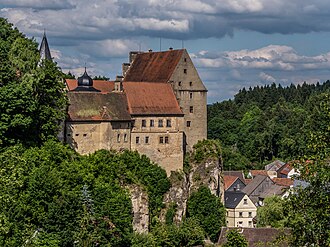
Rising Above the Valley – Introduction to Burg Wiesentfels
Perched high on a rugged Dolomite rock spire above the serene Wiesent River valley in Bavaria’s Franconian Switzerland region, Burg Wiesentfels stands as a testament to centuries of human aspiration, conflict, and continuity. Its walls and towers cut a striking silhouette against the sky, and even without entering its gates, the castle announces itself as a guardian of a landscape shaped by both nature and history. The setting is nothing short of cinematic: deep green woods climb the surrounding hillsides, fields stretch into soft horizons marked by distant villages, and the river’s gentle waters reflect an ever‑changing sky. This unique blend of architectural presence and natural grandeur is what makes Wiesentfels such a compelling subject for anyone who loves medieval history and the romantic allure of old fortresses.
But Wiesentfels is more than just a dramatic backdrop. It embodies layers of story and struggle that mirror the broader sweep of German history — from feudal politics and ecclesiastical rule to peasant uprisings and the transformations of the early modern era. In this article, we’ll explore not only the chronological history of the castle but also what it means as a living landscape, as a site of myth and memory, and as a place where past and present continually intersect.
The Strategic Heart of a Valley – The Founding of Wiesentfels
Long before stone walls rose above the Wiesent Valley, that landscape was already woven with ancient trails, winding waterways, and early settlements. Although the precise moment of Burg Wiesentfels’s founding is lost in the haze of the distant past, historical records point to the early 14th century — around 1333 — as a key date when a knightly figure named Albert von Giech was granted the castle as a fief by the influential Prince‑Bishopric of Bamberg. This was an era when the Holy Roman Empire’s patchwork of power was constantly shifting, and strongholds like Wiesentfels were not just homes but statements of control, protection, and authority over the surrounding lands.
From its earliest days, the castle’s location was its greatest strength. Set nearly 40 meters above the valley floor, it commanded views of every road and field below, giving its occupants the ability to see danger long before it arrived and to control the movement of goods and people through the region. In a time when geography could determine the fate of kingdoms, a castle like Wiesentfels was more than architecture — it was a strategic advantage, a symbol of feudal jurisdiction, and a beacon of territorial identity in the rugged terrain of Upper Franconia.
Lords and Leases – Medieval Politics and Possession
The early political life of Wiesentfels was bound up with the complex feudal structures of medieval Germany. The castle was held on behalf of the Prince‑Bishopric of Bamberg, one of the most powerful ecclesiastical principalities in the region, and over the decades it passed through various hands — sometimes as a reward for loyalty, sometimes as part of disputes or negotiation between noble families and church authorities.
Those noble families, most notably the von Giech lineage, were central players in the castle’s story. The Giechs emerged as significant figures in Franconian affairs, and for several centuries they maintained a presence at Wiesentfels, interrupted only by occasional upheavals and realignments. The balance between noble independence and ecclesiastical authority was a delicate one, and castles like Wiesentfels became the focal point for negotiations over that balance, with walls and watchtowers serving as both defense and statement.
Through Fire and War – Devastations and Rebuilding
The long history of Burg Wiesentfels was not without dramatic ruptures. The medieval era wasn’t a storybook tapestry of knights and banquets; it was often a time of violence, shifting allegiances, and societal tension. These realities reached Wiesentfels most pointedly in the upheavals of the early 15th century. During the Hussite Wars, widespread unrest and military incursions swept through parts of central Europe, and nearby branches of the Wiesentfels fortifications were ravaged. One nearby site, Oberwiesentfels, was described as “wüst” — a term meaning deserted or devastated — after attacks during this period. Those ruins were later incorporated into the rebuilding efforts of the late 15th century, essentially folding the remnants of one legacy into another.
Then came the German Peasants’ War in 1525, a massive uprising fueled by economic hardship, religious tensions, and demands for greater rights among rural populations. Castles throughout the region became targets of peasant forces, and Wiesentfels was no exception — it was burned down by armed rebels. What followed was not abandonment but renewal. The castle was rebuilt in its previous style under the direction of Count Achaz von Giech, showing the resilience of its owners and the enduring importance of the site.
Renaissance and Early Modern Life – The Castle in Transition
By the time the 16th century gave way to the early modern era, Wiesentfels had transformed from a pure military stronghold to a residence with more complex functions. It was during this period that many German castles began incorporating elements of comfort and administration alongside their defensive features. Lords who once lived in austere keeps adapted to changing expectations of status and lifestyle, adding structures for living, entertaining, and governance. Although the fortifications remained important, the castle’s identity expanded to include aristocratic residence, local administration, and cultural hub.
In some ways, this evolution reflects a broader European movement: the Renaissance and Reformation shifted values toward individualism, intellectual curiosity, and social restructuring. Private living spaces became more elaborate, castle interiors were adorned with art and furnishings, and the experience of residence gradually took on elements of comfort alongside utility. While Wiesentfels never became a lavish palace, its adaptations during these centuries illustrate how the castle sustained its relevance by evolving with the times rather than resisting change.
A Seat of Power and Its Wider Influence
What makes Wiesentfels particularly fascinating is not only its individual history but also its role within the broader dynamics of regional power in Franconia. Castles like Wiesentfels were interconnected in both conflict and cooperation with neighboring strongholds, noble families, and ecclesiastical authorities. They served as administrative centers from which justice was administered, taxes collected, and local disputes settled. They were also theaters of diplomacy, where alliances were forged and disputes mitigated — often in the shadow of a fortified tower or behind the heavy oak of a great hall door.
Furthermore, the castle’s presence helped shape the settlement pattern around it. The nearby village of Wiesentfels grew in its shadow, becoming both service community and strategic partner. Markets, farms, and local crafts took root in the safety and economic pull of the castle’s jurisdiction. Roads connecting this valley to others grew busier as trade flowed through the heartland of Franconia, and Wiesentfels — perched high yet intimately connected — became part of the lifeline that sustained the region’s communities.
Architecture and Stones – The Fabric of the Castle
Wiesentfels is not a single architectural style frozen in time; it is a palimpsest of materials and design choices that represent centuries of construction, destruction, and renewal. Its fortifications are remnants of medieval defensive logic: thick stone walls, narrow embrasures for archers, and a commanding presence meant to deter advancing forces. The castle’s core — effectively its heart — is a living record, where elements of medieval stonework meet later additions that hint at greater residential comfort and evolving aesthetic sensibilities.
One of the most distinctive features is the broad rock foundation itself. Rather than rising from a gentle hill, the castle clings to a dramatic natural pedestal, creating over centuries a striking interplay between geological forces and human engineering. Over time, builders added a range of features: from a four‑story main building with gabled roofs to a hexagonal tower that accentuates the site’s irregular geometry. Each stone tells a story — of sieges survived, of families that lived and died within these walls, and of craftsmen who laid each block centuries apart yet somehow in enduring harmony.
Hidden Corners and the Lives They Housed
The true soul of any castle lies not just in its defensive walls but in the unrecorded lives that passed through its corridors — the servants who prepared meals in quiet kitchens, the children who ran along its courtyards, the scholars or clerics who might have studied within its halls, and the soldiers who drilled at dawn. These domestic rhythms form an undercurrent beneath the grand narratives of kings and battles.
In Wiesentfels, those quieter stories are echoed by traces — footprints of daily life that linger in mental rather than physical form. Rooms that once echoed with chatter now lie silent; corridors that held resonant footsteps now only remember echoes of the past. The castle chapel, though less grand than those in well‑funded cathedrals, would have been a place of reflection, celebration, and mourning for its inhabitants. Its walls would have witnessed whispered prayers for safe return from war, solemn vows, and whispered hopes for peace and prosperity.
Private Property and Public Desire
Today, Burg Wiesentfels is privately owned, a status that both preserves its integrity and restricts general public access. While onsite events and guided visits have occasionally opened the castle to visitors, its private status means that most of its interior remains closed to casual exploration. This dual reality creates an interesting tension: on the one hand, the castle is preserved as a living property; on the other, public curiosity about its interior and personal stories remains high, especially among history enthusiasts who imagine wandering through rooms filled with centuries of memory.
Despite this, many travelers come to experience its presence from the outside, treat the surrounding paths and forests as inviting routes into reflection, and capture photographs that attempt to freeze the beauty of light on stone. Occasional seasonal openings, events from regional cultural organizations, or summer performances again invite people to step inside and experience the castle’s interior atmosphere — if only briefly — thus weaving a fragile but enduring connection between this private monument and the public imagination that surrounds it.
The Castle and Its Landscape – Nature Meeting History
Perhaps one of the most compelling experiences associated with the castle is not within its walls but beyond them — in the valley below, across fields and beneath the canopy of trees that stretch toward the horizon. The Wiesent River, a ribbon of silver in the sunlight, weaves through a landscape that has supported humans for centuries, shaping settlement, agriculture, and travel routes through winding paths carved over generations.
Nature does not merely serve as a backdrop for the castle but actively participates in the castle’s aura. Weather patterns sculpt the light and shadow that ripple across its stone, seasonal shifts bring bursts of bloom or blankets of snow, and distant bird calls echo against silent fortifications. Locals and visitors alike speak of the mystical quality of this landscape — how the air seems to carry layers of memory, and how walking around the castle grounds feels like stepping into a dialogue between centuries and moments, human ambition and the unending patience of the natural world.
Legends, Whispered Stories, and the Unseen Castle Life
Like many ancient sites, Burg Wiesentfels is surrounded by whispers of folk tales and legends — stories that modern historians might not document but which nevertheless enrich the castle’s cultural presence. These tales trickle through generations like oral traditions passed from pilgrim to child, from hiker to storyteller gathered around crackling fires. In such stories, the castle becomes more than stone and history; it becomes a character — sometimes benevolent, sometimes stern — within a landscape that invites wonder.
These legends speak to the resonance that old fortresses often hold in the human imagination: echoes of lost lovers waiting at high towers, of hidden passages leading to secret treasures, of shadowy figures glimpsed at moonlight. Whether such stories have any basis in fact is immaterial; they are part of the psychological landscape that human beings create around places that seem to transcend ordinary time. In this way, Burg Wiesentfels matches not just the historical categories of politics and warfare, but the mythic categories of legend and dream.
A Castle of Memory – Looking to the Future
As we look to the future, Burg Wiesentfels stands not as a relic but as a living archive — a place where history settles like dust on old stone yet simultaneously invites new stories to be written. Those who approach its walls today may do so as tourists, artists, scholars, or simply curious travelers who feel drawn by the aura of antiquity combined with the vibrant life of the Franconian countryside. The castle continues to be part of an evolving narrative, where heritage preservation, private ownership, and public curiosity intertwine.
Every blade of grass at its base and every bird winging overhead contribute to the sense that this castle lives in the present as much as it existed in the past. In a world where so much changes with dizzying speed, places like Wiesentfels remind us of continuity, of roots that extend deep into time, and of the beauty and complexity of human history etched into stone. Whether seen from afar as a dramatic silhouette or approached with the intention of entering its inner courtyards, Burg Wiesentfels remains a shining thread in the tapestry of European historical heritage.
