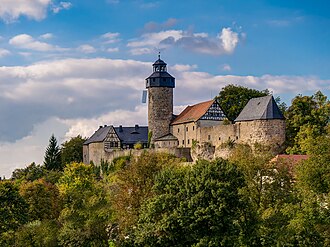
Burg Zwernitz: An Introduction to a Timeless Medieval Fortress
Perched dramatically atop a narrow Dolomite rock in the heart of the tranquil German countryside, Burg Zwernitz stands as both a relic of medieval enterprise and a witness to centuries of regional transformation. This castle, first mentioned in historical documents as early as 1156, embodies the power, prestige, and architectural ingenuity of Middle Ages Europe. For the modern visitor, Zacernitz represents not just stone and ruin—but a place where stories of knights, princes, hunts, and evolving cultural ideals converge in tangible form.
The dramatic posture of Burg Zwernitz—on high ground with sweeping views across the forests and rolling hills of upper Franconia—reflects both its original defensive purpose and its continued role as a cultural and historical anchor for the region. It emerged in an era in which fortresses symbolized political strength and military readiness, standing guard over territories vulnerable to conflict and change. As with many such structures, Burg Zwernitz evolved alongside the shifting tides of power in Europe, becoming much more than a military outpost over time; it became a living testament to the layered narrative of German and European history.
Today, Burg Zwernitz offers visitors an immersive window into this long arc of influence, from medieval fortification to Baroque spectacle, and into the present day as a cherished heritage site. Its walls resonate with the voices of centuries past, and its presence in the landscape invites reflection on the enduring legacy of castles in European cultural consciousness.
The Early Days: Medieval Origins and the Walpoten Lineage
The story of Burg Zwernitz begins in a world far removed from modern sensibilities. In the mid-12th century, Europe was a patchwork of feudal territories, and the erection of strongholds like Zwernitz served both practical and symbolic functions. It was first documented in 1156 as the ancestral seat of the Walpoten, an edelfreie (free noble) family, marking its initial importance in the high medieval social order.
During this period, castles were more than private residences—they were centers of local governance, administration, and defense. The Walpoten were part of the noble class that formed the foundation of feudal power structures. Their decision to establish themselves at Zwernitz was strategic: the elevation and natural strength of the site offered a defensive advantage, while proximity to woodlands and fertile lands ensured economic viability for their domain.
Architecturally, early sections of the castle, including parts of its bergfried (keep) and vaulted storerooms, reflect Romanesque design features prevalent in the era. These stone constructions, characterized by their massive forms and the use of rusticated ashlar (humpback ashlars), projected durability and strength, essential qualities when territorial disputes and warfare were commonplace.
In its early centuries, the castle’s occupants would have balanced life between martial preparedness and the day-to-day responsibilities of rule. Life within Zwernitz was likely arranged around a tight-knit community of knights, retainers, servants, and tradespeople whose collective efforts supported the operations of the estate.
The Hohenzollerns and the Evolution of Power
By the early 14th century, Burg Zwernitz passed into the hands of one of Europe’s most influential dynasties: the House of Hohenzollern began its stewardship of the site in 1338, a period that would see the castle grow in both administrative function and symbolic resonance.
The Hohenzollerns, whose prominence would eventually span from regional rulers to kings and emperors of larger European territories, utilized Zwernitz not merely as a defensive stronghold but as an administrative center. Around this time, it became an official seat for the Burgraves of Nuremberg and later for the Kulmbach–Bayreuth line, integrating it into a much wider network of governance.
During this era, the strategic importance of Burg Zwernitz was enhanced by its inclusion in a system of early warning and communication stations. From the heights of its bergfried, smoke or fire signals could be relayed through a series of towers and outposts stretching toward other key fortresses such as the Plassenburg in Kulmbach. This visual telegraph system, remarkable in its effectiveness for the time, underscores just how interconnected and militarily aware regions were even in centuries before electronic communication.
Life under the Hohenzollerns would have been an interplay of political maneuvering and local governance. As administrators and host to judicial functions like the district court (Halsgericht), the castle’s role was to administer justice, collect dues, maintain order, and represent the reach of its ruling family.
Transformation Through the Ages: Post-Medieval Use and Baroque Revival
Following the destructive turmoil of the Thirty Years’ War in the 17th century, many medieval fortifications across Europe lost their military relevance. Burg Zwernitz was no exception; its defensive role diminished as centralized state forces and modern warfare tactics made isolated fortresses less critical to regional defense.
Instead, Zwernitz transitioned into a symbolic and recreational site. Parts of the castle, no longer necessary for defense, fell into disuse, but under the patronage of enlightened nobility—especially during the reigns of the Kulmbach–Bayreuth margraves—its presence was preserved and repurposed. One of the most significant chapters in this transformation came in the mid-18th century.
Markgraf Friedrich of Brandenburg‑Bayreuth and his wife, Markgräfin Wilhelmine (sister of Frederick the Great), were central figures in the cultural reinvention of the castle and its surroundings. Their vision transformed not only the castle but its landscape as well. Wilhelmine, who appreciated artistic expression and the aesthetic potential of the natural environment, was instrumental in the creation of the Felsengarten Sanspareil, a dramatic and imaginative rock garden that fused nature’s raw forms with artistic intention.
To complement this new cultural environment, the castle underwent restoration and enhancement. While its martial function was now largely ceremonial, Burg Zwernitz became part of a broader landscape aesthetic, standing as a romantic anchor within a garden designed for reflection and inspiration. Its imposing silhouette contrasted beautifully with the whimsical rock formations and formal garden elements that surrounded it.
This shift from fortress to cultural landmark mirrors broader European patterns during the Baroque age, when many castles were repurposed as symbols of heritage, leisure, and artistic expression rather than defensive strongholds.
A Living Museum: Exhibitions and Cultural Engagement
Today, Burg Zwernitz serves as a living museum and heritage site that offers a nuanced view of its multifaceted history. Within its walls, visitors can explore exhibitions focused especially on the markgräfliche Jagd—courtly hunting traditions that were a pivotal element of aristocratic life in the 17th and 18th centuries.
Hunting, far more than a pastime, was a political and social institution. At courts throughout Europe, elaborate hunts were staged not simply for sport but as demonstrations of skill, wealth, and control over nature. These events could involve large entourages, specialized equipment, and ceremonial protocols that rivaled formal court events in complexity and prestige. The exhibition at Zwernitz highlights this tradition through artifacts such as hunting weapons, paintings, and interactive displays that illustrate how integral hunting was to aristocratic identity.
This focus on experiential engagement transforms the castle from a static relic into an educational environment. Elements like student-created audio guides and interactive stations bring history to life, inviting visitors—especially younger ones—to immerse themselves in the realities of medieval life, feudal hierarchies, and courtly rituals.
The castle’s bergfried remains one of its most compelling features, both architecturally and experientially. Climbing its steep steps offers not only a sense of physical accomplishment but also a metaphorical journey through time, culminating in panoramic views that once served as a critical vantage point for early warning signals centuries ago.
The Surrounding Natural and Cultural Landscape
Burg Zwernitz does not exist in isolation; its presence is deeply connected with the surrounding Natural Park Fränkische Schweiz–Veldensteiner Forst—a region defined by wooded hills, limestone cliffs, forest paths, and pastoral valleys.
The park offers a striking counterpoint to the castle’s stone silhouette. Where the fortress evokes human ambition and historical continuity, the surrounding forests evoke the timeless rhythms of nature. Many visitors arrive not only for the castle itself but for the opportunity to explore this lush landscape, enriched with hiking trails, geological curiosities, and scenic overlooks. In this way, Zwernitz becomes both a cultural destination and a gateway to natural exploration, revealing how historical sites can integrate seamlessly into broader ecological experiences.
Additionally, nearby attractions such as the Felsengarten Sanspareil provide a unique blend of art and nature. The rock garden’s bizarre formations and curated views reflect a historical moment in which European aristocrats sought to cultivate natural landscapes into expressions of aesthetic philosophy—a precursor to more modern concepts of landscape design.
Burg Zwernitz in the Modern Era: Preservation and Cultural Relevance
The preservation of Burg Zwernitz in the 20th century reflects a growing European commitment to safeguarding cultural heritage. After long centuries of changing political landscapes—including the transition to Bavarian control in 1810 and periods of military and civil use in the 20th century—formal conservation efforts helped secure the castle’s future. It is now under the care of the Bayerische Verwaltung der staatlichen Schlösser, Gärten und Seen (Bavarian Administration of State-Owned Palaces, Gardens, and Lakes), ensuring that this historical site remains accessible and well-maintained for future generations.
Modern restoration efforts have focused not only on structural integrity but also on interpretive clarity. Through exhibitions, guided tours, educational materials, and cultural programming, Burg Zwernitz becomes a space not merely for passive viewing but for active engagement and learning. These initiatives reinforce an understanding that heritage preservation is about connecting people to stories, values, and shared histories rather than simply conserving stone and mortar.
The Enduring Legacy of Burg Zwernitz
In contemplating Burg Zwernitz, one encounters more than a medieval ruin—it is a repository of lived experiences, a testament to the evolution of European culture, and a powerful symbol of how history can be preserved, interpreted, and celebrated. From its medieval foundation as a noble family’s seat, through its administrative role under the Hohenzollerns, its cultural rebirth amid Baroque landscape design, and into its modern incarnation as a museum and educational landmark, the castle exemplifies the rich tapestry of European heritage. (Wikipedia)
Visiting Burg Zwernitz is to step into a chronicle of continuity and change. One stands on the same stone floors that once echoed with armored footsteps and hears the faint resonance of centuries past. For those who appreciate history, architecture, nature, or simply the romance of ancient places, Burg Zwernitz offers an experience that is at once reflective, informative, and deeply rooted in the enduring human fascination with our collective past.
