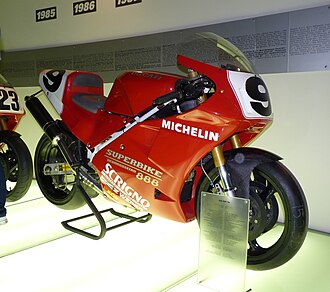
Ducati 888: The V-Twin Superbike That Turned Ducati Into a World Champion
The Ducati 888 is one of the most important motorcycles in the history of the Italian manufacturer, not only because it was an exceptionally capable superbike, but because it transformed the success of the Ducati 851 into sustained domination on the international racing scene. Developed from the Desmoquattro engine introduced with the 851, the 888 represented a crucial step in Ducati’s evolution toward the legendary 916. Its 90-degree L-twin, liquid cooling, desmodromic four-valve cylinder heads, electronic fuel injection and tubular steel trellis frame formed a package that was technologically advanced for its era while remaining unmistakably Ducati. On the racetrack, the 888 proved that a relatively compact two-cylinder engine could compete against much larger four-cylinder machines, while on the road it became one of the most desirable Italian superbikes of the early 1990s.
The name “888” refers to the engine’s displacement, which was increased from the 851 cc configuration used in Ducati’s earlier four-valve superbikes. The increase in capacity was accompanied by continual improvements in fueling, chassis setup, suspension and engine internals. The racing 888 F91 was particularly spectacular: Ducati’s official heritage archive records that it won 23 of the 26 World Superbike races scheduled in 1991, with Doug Polen taking the riders’ championship and Ducati securing its first manufacturers’ title in the championship. The 888 F92 continued that dominance, winning 20 races and giving Ducati another manufacturers’ championship in 1992.
The road-going 888 was less extreme than the factory race bike, but it shared the same fundamental engineering philosophy. Versions such as the Strada, SPO and SP5 gave customers increasingly sophisticated interpretations of the Desmoquattro formula. The 888 therefore stands at a fascinating point in Ducati history: advanced enough to demonstrate the company’s modern engineering direction, yet still visually and mechanically connected to the superbikes that preceded it. It was the bridge between the 851 and the 916, but it was also a formidable motorcycle in its own right.
The Origins of the Ducati 888
Building on the 851
The story of the 888 begins with the Ducati 851. Introduced in the late 1980s, the 851 had created Ducati’s modern four-valve superbike formula by combining liquid cooling, electronic fuel injection and desmodromic valve control. That motorcycle gave Ducati a competitive weapon for the newly established World Superbike Championship, but racing development quickly demonstrated that more displacement and greater breathing capacity could provide a valuable advantage.
Ducati responded by increasing the engine’s capacity to 888 cc. The resulting motorcycle retained the 851’s basic 90-degree L-twin architecture but offered greater torque and increased potential for racing development. The larger engine was particularly valuable because World Superbike regulations of the period gave two-cylinder motorcycles an opportunity to compete with larger four-cylinder machines. Ducati’s engineers could therefore extract substantial performance from a relatively compact engine while benefiting from the advantages of the L-twin configuration.
The 888 was not simply an enlarged 851. It became a continually evolving platform. Ducati developed different road and competition versions, each with different engine specifications, suspension components and equipment. This constant development was essential because World Superbike racing was rapidly becoming one of the most competitive forms of motorcycle racing in the world.
A Motorcycle Designed Around Racing
The relationship between the 888 and racing was unusually close. The road motorcycles existed partly to satisfy the homologation requirements necessary to compete internationally, while the racing program provided a testing ground for new ideas that could eventually find their way into production machines.
This was a period when Ducati’s motorcycles were not covered by the extensive electronic rider aids found on modern superbikes. There was no traction control, no selectable engine maps, no cornering ABS and no sophisticated inertial measurement unit managing the motorcycle. Performance came from the engine, chassis, brakes, suspension, tires and rider. That makes the achievements of the 888 racing motorcycles even more remarkable.
Ducati’s official history identifies the 888 F91 as one of the first motorcycles to make significant use of carbon fiber and composite materials for weight reduction. The factory racer weighed only 142 kg dry and was rated at 140 horsepower at 11,000 rpm, with Ducati quoting a maximum speed of 280 km/h.
The 888 Desmoquattro Engine
90 Degrees of Ducati Character
The heart of the 888 was its 90-degree L-twin engine. The cylinders were arranged at right angles, with the front cylinder projecting almost horizontally from the crankcase. This layout became one of Ducati’s most recognizable engineering signatures and offered excellent primary balance.
The road-going 888 used a bore of 94 mm and a stroke of 64 mm, producing 888 cc. The relatively large bore allowed the four-valve cylinder heads to breathe effectively, while the 64 mm stroke allowed the engine to operate at substantially higher revolutions than a long-stroke touring twin. The result was an engine that retained the muscular character of a V-twin while behaving much more like a high-performance racing engine.
The cylinder heads featured four valves per cylinder and desmodromic valve actuation. Rather than relying entirely on valve springs to close the valves, Ducati’s desmodromic system mechanically controlled both opening and closing. This was a crucial part of the Desmoquattro concept and allowed the engine to operate at high engine speeds while maintaining accurate valve control.
Electronic Fuel Injection
The 888’s electronic fuel injection was another major component of its performance. Later road versions used a Weber-Marelli electronic system with two 50 mm throttle bodies, giving the engine precise control over fuel delivery. Contemporary specifications for the 1993 Strada list approximately 104 horsepower at 10,500 rpm and 78.5 Nm of torque at 7,000 rpm.
The exact output figures vary between versions, markets and test methods. The standard Strada was considerably less powerful than the factory racing motorcycle, while the homologation-focused SP5 produced around 118 horsepower at 10,500 rpm according to period specifications.
These differences are important because the name “888” covered a family of motorcycles rather than one single specification. A road Strada and an SP5 may share the same displacement and basic architecture, but their engines, suspension, weight and intended use were substantially different.
The Desmodromic Valve System
Ducati’s Mechanical Signature
The desmodromic valve system is one of the defining characteristics of the 888. In a conventional four-stroke engine, the camshaft opens the valve and a spring closes it. Ducati instead used separate cam mechanisms to control both movements.
This approach allowed the engineers to avoid relying solely on valve springs at high engine speeds. For a racing engine designed to produce significant power from a relatively small displacement, precise valve control was extremely important.
The system also gave Ducati’s engines a distinctive mechanical character. The Desmoquattro engine was not merely powerful; it sounded and behaved differently from the four-cylinder engines that dominated much of the superbike market. Its combination of induction noise, exhaust pulse and mechanical valvetrain created an experience that became closely associated with Ducati.
The 888 therefore represented the mature development of the Desmoquattro idea. The 851 had introduced the architecture, but the 888 demonstrated how effective it could become when developed specifically for World Superbike competition.
A Trellis Frame Built for the Track
Steel Rather Than Aluminum
The Ducati 888 retained a tubular steel trellis frame rather than following the aluminum twin-spar trend that was becoming increasingly common among Japanese superbikes. The trellis frame wrapped around the engine and created a rigid, lightweight structure while keeping the mechanical components visually prominent.
This design was both functional and symbolic. Ducati’s trellis frame became one of the visual signatures of the company, and the 888 displayed it beneath its aerodynamic bodywork in a way that made the motorcycle’s mechanical architecture part of its identity.
The road-going 888 had a wheelbase of approximately 1,430 mm and a steering-head angle around 24.5 degrees, depending on version. These dimensions contributed to a sharp but stable handling character.
The relatively compact wheelbase and centralized mass helped the motorcycle change direction quickly. At the same time, the long, low L-twin engine contributed to a low center of gravity, while the trellis frame provided a direct connection between the steering head and engine.
Fully Adjustable Suspension
Suspension specifications varied according to model. The 888 Strada used a fully adjustable Showa upside-down front fork in later versions, while the rear used an adjustable monoshock. Higher-performance versions such as the SP5 received more specialized equipment, including an Öhlins rear shock.
The importance of adjustable suspension cannot be overstated on a motorcycle like the 888. A rider could alter compression, rebound and preload to suit road conditions or racetrack requirements. For a homologation special, this flexibility was particularly important because the production motorcycle needed to provide a foundation that racing teams could further develop.
The chassis was therefore designed with competition in mind even when the motorcycle was sold as a road bike.
Brembo Brakes and 17-Inch Wheels
The 888’s braking system reflected the motorcycle’s superbike ambitions. Later road specifications used twin 320 mm front discs with four-piston calipers and a 245 mm rear disc with a two-piston caliper. These large front brakes provided the stopping power necessary for a motorcycle capable of exceeding 240 km/h on the road and considerably more in racing trim.
Seventeen-inch wheels were another important feature. The 120/70-17 front and 180/55-17 rear tire sizes of later road models became a familiar superbike combination and provided a substantial improvement in tire choice and handling compared with the smaller wheels used on some earlier 851 configurations.
The result was a chassis that could exploit the engine’s performance. Braking hard for a corner, turning the motorcycle rapidly and getting back onto the throttle were all central to the 888 experience.
The Ducati 888 Strada
The Road-Going Superbike
The Strada was the more accessible member of the 888 family. It retained the essential Desmoquattro architecture but was configured for road use, with equipment intended to make the motorcycle more practical than the competition-oriented SP models.
The 1993 Strada specification included electronic fuel injection, a six-speed transmission, tubular steel frame, Showa front suspension, twin 320 mm front discs and a 245 mm rear disc. Contemporary specification sources put its power at approximately 104 horsepower and its top speed at around 246 km/h.
Although those numbers may appear modest by today’s standards, they were extremely serious in the early 1990s. The 888 Strada was a genuine superbike, with a focused riding position, strong braking performance and an engine that demanded active involvement.
The motorcycle also demonstrated how much the Desmoquattro architecture had evolved. Compared with the original 851, the 888 offered more displacement, greater torque and improved overall refinement while preserving the distinctive character of the L-twin.
The 888 SP Models
Homologation Specials
The SP versions are among the most fascinating 888 variants because they were created specifically to satisfy racing homologation requirements. Ducati could build limited numbers of more specialized motorcycles and use their technology as the basis for competition machines.
The SP5 is particularly famous. Its 888 cc engine produced approximately 118 horsepower at 10,500 rpm and around 84 Nm of torque in period specifications. It used electronic fuel injection, a six-speed gearbox, a dry multi-plate clutch, fully adjustable suspension and high-performance brakes. Its dry weight was listed around 188 kg by some period-derived sources, although specifications vary according to equipment and measurement method.
The SP5 also used an Öhlins rear shock and Showa upside-down front fork, while its 320 mm front brake discs and four-piston calipers provided serious stopping performance. The motorcycle could reach approximately 260 km/h according to period specification data.
The SP5 was therefore much closer to a race bike than an ordinary road motorcycle. It represented the point at which Ducati’s competition technology became available to a small number of road riders and collectors.
The 888 on the World Superbike Stage
1991: Ducati’s Year of Domination
The greatest chapter in the 888’s story came in 1991. Ducati’s official 888 F91 won 23 of the 26 races scheduled in the World Superbike Championship, an extraordinary level of dominance. Doug Polen won the riders’ championship, while Ducati secured its first manufacturers’ title.
The achievement was a major turning point for Ducati. The company had already demonstrated its potential with the 851, but the 888 established that Ducati could dominate an international championship rather than simply win individual races.
Polen’s success was particularly important because his riding style complemented the characteristics of the Ducati twin. The 888 could generate formidable corner-exit drive while maintaining the narrow profile and balance advantages of the L-twin configuration.
The factory racing machine’s 140 horsepower and 142 kg dry weight were extraordinary figures for the period. More importantly, the motorcycle’s reliability, handling and tire performance allowed Ducati to convert its theoretical advantages into repeated race victories.
1992: The Dominance Continues
Ducati’s success was not a one-season accident. The 888 F92 won 20 races in the 1992 World Superbike Championship and gave Ducati another manufacturers’ title. Doug Polen and Raymond Roche finished first and second in the championship, while Giancarlo Falappa added four victories.
The result was remarkable because World Superbike was still a relatively young championship. Ducati had quickly established itself as one of its defining manufacturers.
Falappa’s aggressive riding style also became part of the 888’s mythology. Known as the “Lion of Jesi,” he was one of the most spectacular riders of the era and became strongly associated with Ducati’s superbike program. Ducati records that he won 16 World Superbike races during his four-year period with the factory team.
The Personality of the Ducati 888
A Superbike That Demands Participation
Riding an 888 is a fundamentally different experience from riding a modern superbike. The motorcycle is powerful, but it does not have the electronic systems that now manage acceleration, braking and traction. The rider is much more directly connected to the engine and chassis.
The L-twin delivers its performance in a distinctive manner. Instead of the smooth, continuously rising power delivery of a high-revving four-cylinder, the Ducati combines strong midrange thrust with increasingly urgent acceleration as the revs climb. The rider becomes part of the process, selecting gears carefully and managing the throttle to keep the engine in its effective range.
The chassis complements that character. The compact wheelbase, trellis frame and high-quality suspension allow the rider to place the motorcycle accurately through corners. The 888 is not simply about maximum horsepower; it is about using every part of the motorcycle together.
Mechanical Character
The mechanical experience is one of the strongest reasons the 888 remains desirable. The sound of the desmodromic engine, the feel of the V-twin pulse and the exposed mechanical architecture create a sense of occasion every time the engine is started.
Modern motorcycles can be objectively faster, but speed is only one part of a motorcycle’s appeal. The 888 offers a level of mechanical involvement that is increasingly rare. Its rider has to understand the machine rather than simply select a riding mode and open the throttle.
That directness is precisely what makes the 888 so memorable.
Ducati 888 Versus the Competition
The early 1990s were a fascinating period for superbikes. Japanese manufacturers were producing extremely powerful four-cylinder machines, while Ducati was pursuing a different philosophy. Rather than competing through cylinder count and outright displacement, Ducati focused on a compact, lightweight V-twin with strong torque and excellent chassis balance.
World Superbike regulations helped make this strategy viable. The championship allowed twin-cylinder motorcycles a displacement advantage over four-cylinder machines, and Ducati exploited that opportunity exceptionally well.
The 888’s success demonstrated that racing performance could come from efficiency rather than simply from adding cylinders. Its engine produced less absolute power than some contemporary four-cylinder competitors, but the motorcycle’s combination of torque, low center of gravity, chassis performance and aerodynamic efficiency made it exceptionally effective on a circuit.
This philosophy would become even more famous with the 916.
From 888 to 916
The End of an Era
The Ducati 888 was eventually replaced by the 916, but the new motorcycle was not a clean-sheet departure. Instead, it represented the next evolution of the ideas established by the 851 and 888.
The 916 introduced a dramatically different design by Massimo Tamburini, along with a more advanced chassis and a revised version of the Desmoquattro engine. The basic philosophy remained recognizable, however: 90-degree L-twin, desmodromic four-valve heads, liquid cooling, electronic fuel injection and a trellis frame.
In this sense, the 888 was the final expression of one Ducati design generation. It perfected the technical foundation that the 916 would transform into a new visual and sporting identity.
The transition is historically important because the 916 would become one of the most celebrated sport motorcycles ever produced. Without the engineering development of the 851 and 888, that achievement would have been much harder to imagine.
Ducati 888 Technical Specifications
The specifications of the 888 vary substantially according to whether the motorcycle is a Strada, SPO, SP5 or factory racing machine. The table below focuses primarily on the 1993 888 Strada for the road-bike figures, while noting where the famous SP5 and F91 race versions differed.
| Specification | Ducati 888 Strada | Ducati 888 SP5 |
|---|---|---|
| Production period | Early 1990s | 1993 |
| Engine | 90° L-twin, 4-stroke | 90° L-twin, 4-stroke |
| Cooling | Liquid | Liquid |
| Displacement | 888 cc | 888 cc |
| Bore × stroke | 94 × 64 mm | 94 × 64 mm |
| Valve system | DOHC, desmodromic, 4 valves/cylinder | DOHC, desmodromic, 4 valves/cylinder |
| Compression ratio | Approx. 11.0:1 | Approx. 11.2:1 |
| Fuel system | Weber-Marelli electronic injection | Weber-Marelli electronic injection |
| Throttle bodies | 2 × 50 mm | 2 × 50 mm |
| Maximum power | Approx. 104 hp @ 10,500 rpm | Approx. 118 hp @ 10,500 rpm |
| Maximum torque | Approx. 78.5 Nm @ 7,000 rpm | Approx. 84 Nm @ 7,000 rpm |
| Transmission | 6-speed | 6-speed |
| Clutch | Dry multi-plate | Dry multi-plate |
| Final drive | Chain | Chain |
| Frame | Tubular steel trellis | Tubular steel trellis |
| Front suspension | Adjustable 41 mm Showa USD fork | Adjustable Showa USD fork |
| Rear suspension | Adjustable monoshock | Öhlins adjustable monoshock |
| Front brakes | Twin 320 mm discs, 4-piston calipers | Twin 320 mm discs, 4-piston calipers |
| Rear brake | 245 mm disc, 2-piston caliper | 245 mm disc, 2-piston caliper |
| Front tire | 120/70-17 | 120/70-17 |
| Rear tire | 180/55-17 | 180/55-17 |
| Wheelbase | Approx. 1,430 mm | Approx. 1,430 mm |
| Seat height | Approx. 760 mm | Approx. 760 mm |
| Fuel capacity | Approx. 19 litres | Approx. 17 litres |
| Dry weight | Approx. 210 kg, depending on source/specification | Approx. 188 kg |
| Top speed | Approx. 246 km/h | Approx. 260 km/h |
For comparison, the factory 888 F91 was a substantially more specialized racing machine. Ducati lists 140 horsepower at 11,000 rpm, a 280 km/h maximum speed and only 142 kg dry, demonstrating just how far the competition version had moved beyond the road-going Strada.
The Lasting Legacy of the Ducati 888
The Ducati 888 deserves its place among the great superbikes because it achieved something more important than simply producing impressive performance figures. It established Ducati as a dominant force in the modern World Superbike era. The 851 had created the technological foundation, but the 888 demonstrated what that foundation could accomplish when developed to its full potential.
Its 1991 season remains particularly extraordinary. Twenty-three victories from 26 races represented an almost unprecedented level of dominance, and Doug Polen’s riders’ championship gave Ducati the international recognition it had been pursuing. The following season reinforced the achievement rather than diminishing it, with another manufacturers’ championship and 20 race victories.
The 888 also occupies an important position in Ducati’s design history. Its aggressive, compact bodywork and trellis chassis represent the final stage of the visual language that began with the 851. Soon afterward, the 916 would introduce a design that became an icon in its own right, but the mechanical relationship between the two motorcycles is unmistakable.
For collectors and enthusiasts, the 888 has therefore become much more than an old racing replica. It is a snapshot of the moment when Ducati discovered how to combine its traditional V-twin character with modern liquid cooling, electronic fuel injection, four-valve heads and sophisticated chassis technology. It demonstrates what a focused manufacturer can accomplish when racing development and production engineering are allowed to evolve together.
The Ducati 888 may have been overshadowed by the 916 in popular memory, but that should not obscure its importance. The 888 was the motorcycle that turned Ducati’s promising superbike project into a championship-winning dynasty. It took the lessons of the 851, added displacement and relentless development, and produced one of the most successful racing motorcycles of its generation.
Its greatest legacy is therefore not a single specification or even a particular race victory. It is the formula it perfected: a narrow 90-degree L-twin, desmodromic four-valve heads, electronic fuel injection, trellis-frame chassis and racing-led development. That formula carried Ducati from the uncertain years of the late 1980s to the championship dominance of the early 1990s and ultimately paved the way for the 916.
The 888 was the bridge between Ducati’s past and its modern superbike future. It was fast, uncompromising and mechanically distinctive, but above all it was successful. On road and track alike, it proved that Ducati’s interpretation of the superbike could defeat the established order. That achievement is what makes the Ducati 888 one of the most significant Italian motorcycles ever built.
