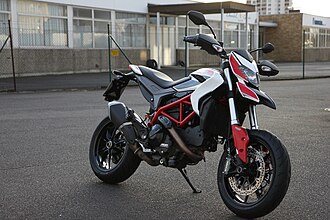
Ducati Hypermotard: The Ultimate Italian Fun Bike
The Ducati Hypermotard is one of the most distinctive motorcycles in Ducati’s lineup because it was created around a simple idea: maximize fun rather than chase conventional definitions of performance. With a tall riding position, wide handlebar, long-travel suspension and supermoto-inspired styling, the Hypermotard looks completely different from Ducati’s superbikes and sport motorcycles. Yet underneath that unusual appearance is the same engineering philosophy that defines the Italian manufacturer. The current Hypermotard family spans two very different motorcycles: the lightweight single-cylinder Hypermotard 698 Mono and the larger Hypermotard 950 family. The 698 Mono uses Ducati’s 659 cc Superquadro Mono engine to produce 77.5 hp and weighs only 151 kg without fuel, while the Hypermotard 950 uses a 937 cc Testastretta 11° V-twin producing 114 hp.
What makes the Hypermotard so appealing is the way it transforms ordinary roads into opportunities for entertainment. A conventional sportbike encourages the rider to think about speed, braking points and cornering lines, whereas the Hypermotard adds another dimension: movement. Its upright ergonomics make it easy to shift body weight, the wide handlebars provide enormous steering leverage and the long suspension allows the motorcycle to absorb imperfect pavement without losing its composure. The result is a machine that feels playful even when it is not being ridden at extreme speeds. Ducati itself describes the 698 Mono as a “fun-bike,” and that description captures the philosophy of the entire Hypermotard family.
The Origins of the Ducati Hypermotard
A Different Kind of Ducati
The Hypermotard emerged from Ducati’s desire to create something radically different from its traditional road motorcycles. Instead of building another low-slung sportbike or conventional naked machine, Ducati embraced the supermoto concept, combining a tall chassis, narrow bodywork, upright ergonomics and 17-inch road wheels. The resulting motorcycle was visually dramatic and mechanically unusual, but its greatest achievement was creating a riding experience that felt immediately playful.
The basic supermoto concept has roots in motorcycles that combine off-road-inspired chassis characteristics with road-oriented wheels and tires. Ducati adapted that formula for a premium road motorcycle, adding the company’s distinctive engines, electronics and styling. The Hypermotard consequently became something of a bridge between categories. It was too performance-oriented to be a conventional commuter, too road-focused to be a traditional dual-sport and too unconventional to be mistaken for an ordinary naked bike.
That identity has remained remarkably consistent. Even as Ducati has introduced increasingly sophisticated electronics and more powerful engines, the fundamental ingredients have stayed the same: upright ergonomics, long-travel suspension, aggressive steering geometry and a strong emphasis on rider involvement.
The Hypermotard 698 Mono
Ducati’s Modern Single-Cylinder Experiment
The most significant recent development in the family is the Hypermotard 698 Mono, Ducati’s first single-cylinder road-going supermotard. Rather than using a small version of one of its twin-cylinder engines, Ducati created the 659 cc Superquadro Mono specifically around the demands of a high-performance single-cylinder motorcycle. Ducati states that the engine is derived from the 1,285 cc Superquadro used in the 1299 Panigale and incorporates racing-inspired technology in a single-cylinder configuration.
The result is an unusually sophisticated single-cylinder engine. It uses four valves, desmodromic valve timing, liquid cooling and two balance shafts. The engine produces 77.5 hp at 9,750 rpm and 63 Nm of torque at 8,000 rpm, while the rev limiter is set at 10,250 rpm. Those numbers make the engine particularly impressive because they come from only 659 cc and a single combustion chamber.
The engine’s architecture is also highly oversquare, with a 116 mm bore and 62.4 mm stroke. This configuration allows the Superquadro Mono to operate at high engine speeds while preserving the compactness expected of a single-cylinder motorcycle. Ducati’s use of desmodromic valve control is another direct connection to its racing and superbike heritage.
Why a Single Cylinder Makes Sense
A single-cylinder engine might initially seem like an unusual choice for a company famous for high-performance V-twins and V4s. In the Hypermotard 698 Mono, however, the architecture makes perfect sense. The motorcycle is fundamentally about lightness and agility, and a single-cylinder engine can provide a compact package with relatively low mass.
The official figure is particularly striking: the 698 Mono weighs just 151 kg without fuel. That low weight changes almost everything about the riding experience. Acceleration becomes lively without requiring enormous horsepower, braking loads are reduced and direction changes can be made with very little physical effort.
This is why the 698 Mono should not be judged solely against larger motorcycles by comparing horsepower. Its appeal comes from the relationship between power and mass. A lightweight motorcycle with 77.5 hp can feel extremely energetic, particularly on narrow, technical roads where rapid changes of direction are more important than maximum straight-line speed.
The Superquadro Mono Engine
Desmodromic Technology in a Single-Cylinder Package
The Superquadro Mono is arguably the technological centerpiece of the 698. Ducati has taken its desmodromic valve-control philosophy and applied it to a modern single-cylinder engine, creating a powerplant unlike most competitors in the segment. The engine uses titanium intake valves and a desmodromic system that mechanically controls both valve opening and closing. Ducati’s development of the engine was clearly focused on achieving high rpm without abandoning the compactness of the single-cylinder format.
Two balance shafts are also used to control vibration. Single-cylinder engines naturally produce significant primary forces, so balancing is particularly important when the engine is designed to operate at high rpm. Ducati’s solution allows the Superquadro Mono to retain the character and compactness of a large single while delivering a level of refinement suitable for a premium road motorcycle.
The engine also has impressive service intervals for such a highly stressed design. Ducati lists an oil change interval of 15,000 km and a valve-clearance inspection interval of 30,000 km.
Six-Speed Transmission and Quick Shift
The 698 Mono uses a six-speed gearbox and a wet slipper clutch with hydraulic control. Ducati Quick Shift up/down is included on the RVE and Nera versions, while the standard specification is configured differently depending on market and model. The system allows rapid gear changes without conventional clutch operation and reinforces the motorcycle’s sporty character.
A quickshifter is particularly well suited to the Hypermotard concept because the rider often wants to maintain momentum while moving rapidly through a series of corners. Gear changes can therefore become part of the motorcycle’s rhythm rather than interrupting the flow of the ride.
Lightweight Chassis and Supermoto Geometry
Steel Trellis Construction
Despite its highly modern engine, the Hypermotard 698 Mono uses a tubular steel Trellis frame. Ducati has chosen a relatively simple and lightweight chassis structure that complements the single-cylinder engine. The motorcycle has a 1,443 mm wheelbase, 26.1-degree rake and 108 mm trail.
These dimensions contribute to the motorcycle’s distinctive handling. The chassis is compact enough to encourage quick direction changes while retaining sufficient stability for road riding. Combined with the wide handlebar and tall riding position, the geometry creates a motorcycle that responds readily to rider input.
The aluminum swingarm and lightweight wheels also contribute to the overall objective of keeping mass under control. Ducati has not attempted to make the 698 Mono a miniature superbike. Instead, the chassis is built around the particular demands of supermoto-style riding.
Long-Travel Suspension
The Hypermotard 698 Mono uses a fully adjustable 45 mm Marzocchi upside-down fork at the front and a Sachs rear shock connected through a progressive linkage. The suspension provides the long travel expected from a supermoto-inspired motorcycle while maintaining the control required for aggressive road riding.
The long-travel setup is one of the features that makes the Hypermotard so entertaining on imperfect roads. Where a low-slung sportbike may react sharply to potholes, bumps and broken pavement, the Hypermotard has more suspension movement available to absorb those imperfections. This does not mean the motorcycle feels soft or imprecise; instead, it gives the rider a broader range of usable road surfaces.
The result is a motorcycle that can remain composed on roads that would discourage a conventional supersport. That versatility is one of the reasons the Hypermotard has developed such a distinctive following.
The Hypermotard 950
More Power With Ducati’s V-Twin Character
While the 698 Mono emphasizes lightness, the Hypermotard 950 offers a very different interpretation of the formula. Its 937 cc Testastretta 11° L-twin produces 114 hp at 9,000 rpm and 96 Nm of torque at 7,250 rpm. The engine uses Ducati’s desmodromic valve system, liquid cooling and ride-by-wire throttle control.
The larger engine gives the 950 a broader and more muscular character. There is more torque available for rapid acceleration, and the V-twin configuration provides the distinctive pulse and exhaust note traditionally associated with Ducati.
The 950 therefore suits riders who want the Hypermotard experience but require stronger performance for high-speed roads and longer journeys. It remains agile, but it has more substantial engine presence than the single-cylinder 698 Mono.
The 950’s Supermoto Personality
The Hypermotard 950 uses a steel Trellis frame with variable-section tubes and a wide steering angle of 70 degrees. Ducati specifically developed the steering geometry to provide strong maneuverability while maintaining stability at higher speeds.
The standard 950 uses a fully adjustable 45 mm Marzocchi fork with 170 mm of travel and a Sachs rear shock offering 150 mm of travel. The combination provides substantial suspension movement while retaining the ability to tune the motorcycle for different riding styles.
The motorcycle’s wide steering range is particularly useful when riding slowly or making tight direction changes. A supermoto-style machine benefits enormously from the ability to turn the front wheel sharply, and the Hypermotard’s geometry helps it feel remarkably maneuverable despite its larger engine.
Hypermotard 950 SP: The More Extreme Version
Öhlins Suspension and Forged Wheels
For riders seeking a more track-focused version of the 950, Ducati offers the Hypermotard 950 SP. The SP receives a fully adjustable 48 mm Öhlins fork with 185 mm of travel and a fully adjustable Öhlins rear shock with 175 mm of travel. It also uses lightweight Marchesini forged aluminum wheels.
The SP’s suspension gives the rider a greater range of setup adjustment and additional travel, while the forged wheels reduce rotating and unsprung mass. Together, these features sharpen the motorcycle’s response and make the SP particularly attractive to riders who intend to ride aggressively.
The SP also uses Pirelli Diablo Supercorsa SP tires rather than the standard model’s Diablo Rosso III tires. The combination of specialized suspension, lighter wheels and stickier tires makes the SP the most performance-oriented version of the 950 family.
A More Focused Riding Position
The SP also features a flatter supermoto-style seat, allowing the rider to move more easily along the motorcycle. This is an important characteristic when riding aggressively because body position can be changed rapidly to influence cornering behavior.
The Hypermotard has always encouraged active riding, and the SP makes that philosophy even more explicit. It is not simply a more expensive version of the standard motorcycle; it is configured around riders who want to explore the limits of the chassis.
Electronics: Making Fun More Accessible
Cornering ABS and Traction Control
Modern Hypermotards combine their playful mechanical character with sophisticated electronic assistance. The 698 Mono uses Bosch Cornering ABS along with Ducati Traction Control, Ducati Wheelie Control and Engine Brake Control. Ducati also equips the motorcycle with an inertial measurement unit that helps coordinate these systems according to the motorcycle’s behavior.
This technology is particularly valuable because the Hypermotard encourages aggressive inputs. Riders may accelerate hard out of corners, unload the front wheel or brake deeply while turning. Electronic systems provide an additional layer of control without removing the rider’s ability to enjoy the motorcycle.
The 950 family similarly features Bosch Cornering ABS, Ducati Traction Control and Ducati Wheelie Control, with the systems integrated into selectable riding modes.
Riding Modes and Power Modes
The 698 Mono provides four riding modes—Sport, Road, Urban and Wet—and three power modes. This allows the rider to alter throttle response and electronic intervention according to conditions.
These modes help give the motorcycle several personalities. Sport mode can emphasize the aggressive side of the Hypermotard, while Urban and Wet modes provide a more controlled response when conditions are less favorable. Road mode sits between those extremes and is particularly appropriate for everyday riding.
This adaptability is important because a motorcycle designed purely around excitement can become tiring if it is always demanding maximum attention. The electronic package lets the Hypermotard become calmer when necessary without sacrificing its underlying personality.
Design and Ergonomics
Tall, Narrow and Aggressive
The Hypermotard’s appearance is one of its strongest defining characteristics. The motorcycle is tall and narrow, with a high seat, exposed mechanical components and minimal bodywork. The front end is compact and aggressive, while the tail rises sharply behind the rider.
The 698 Mono has a 904 mm seat height in standard form, although Ducati offers a low seat accessory that reduces this to 889 mm, and a combination of the low seat and low suspension kit can reduce it further to 849 mm.
The tall seat is not an arbitrary styling decision. It gives the rider a commanding view over traffic and provides space to move around the motorcycle. In supermoto riding, the ability to shift body position quickly is fundamental, and the Hypermotard’s ergonomics are designed around that movement.
Wide Handlebars and Rider Control
The wide, tapered aluminum handlebar provides substantial leverage. This makes the motorcycle feel responsive when changing direction and gives the rider strong control during low-speed maneuvers.
The riding position also makes the motorcycle feel less intimidating than its seat height might initially suggest. The rider sits upright rather than leaning forward over the front wheel, and the broad handlebar creates a feeling of control that is particularly valuable on narrow or technical roads.
The Hypermotard as a Real-World Motorcycle
One of the greatest strengths of the Hypermotard is that it does not require a racetrack to be entertaining. Its relatively modest top speed compared with a superbike is almost irrelevant because the motorcycle’s character comes from acceleration, braking, direction changes and body movement.
On a winding road, the rider can exploit the motorcycle’s agility without needing to travel at extreme speeds. The upright seating position makes it easy to see through corners, while the long-travel suspension handles uneven pavement. The result is a machine that can turn an ordinary stretch of road into a series of small challenges.
The 950 is particularly suited to riders who want to combine this playful character with longer-distance capability. Its larger engine has the reserves needed for highway riding and overtaking, while the comfortable ergonomics and substantial suspension make it more versatile than a dedicated track motorcycle.
The 698 Mono takes the concept in another direction. With 151 kg of mass and 77.5 hp, it is arguably closer to the pure essence of the supermoto idea: simple, light and highly responsive. Ducati has described it as a motorcycle designed to transmit excitement, and its specification strongly supports that philosophy.
Ducati Hypermotard Technical Specifications
The table below focuses on the current Hypermotard 698 Mono, which represents Ducati’s newest and most distinctive interpretation of the Hypermotard concept. Specifications can vary by market and trim level, particularly for equipment such as the quickshifter and suspension.
| Specification | Ducati Hypermotard 698 Mono |
|---|---|
| Engine | Superquadro Mono single-cylinder |
| Valve system | 4 valves, desmodromic timing |
| Cooling | Liquid-cooled |
| Displacement | 659 cc |
| Bore × stroke | 116 × 62.4 mm |
| Compression ratio | 13.1:1 |
| Maximum power | 77.5 hp @ 9,750 rpm |
| Maximum torque | 63 Nm @ 8,000 rpm |
| Rev limiter | 10,250 rpm |
| Fuel injection | Electronic injection, 62 mm throttle body |
| Throttle | Full ride-by-wire |
| Transmission | 6-speed |
| Clutch | Wet slipper/self-servo clutch |
| Frame | Tubular steel Trellis |
| Front suspension | 45 mm fully adjustable Marzocchi fork |
| Rear suspension | Sachs monoshock with progressive linkage |
| Front brake | 330 mm disc, Brembo 4-piston caliper |
| Rear brake | Disc, 2-piston caliper |
| Front tire | 120/70 ZR17 |
| Rear tire | 160/60 ZR17 |
| Wheelbase | 1,443 mm |
| Rake | 26.1° |
| Trail | 108 mm |
| Seat height | 904 mm |
| Fuel capacity | 12 litres |
| Weight without fuel | 151 kg |
| Riding modes | Sport, Road, Urban, Wet |
| Power modes | 3 |
| Electronics | Cornering ABS, DTC, DWC, EBC, DPL |
| Display | TFT/LCD instrumentation depending on version |
| Quickshifter | DQS up/down, depending on version |
Final Verdict
The Ducati Hypermotard is one of those motorcycles that makes more sense once it is ridden than when it is studied on paper. Its tall seat, long suspension and unusual styling can initially make it seem like a specialized machine, but those characteristics are precisely what give it its unique personality. The motorcycle is designed around movement, agility and fun rather than simply maximizing speed.
The latest Hypermotard 698 Mono is perhaps the purest expression of that philosophy. Its 659 cc Superquadro Mono produces 77.5 hp and 63 Nm, but the headline figure is its remarkably low 151 kg weight without fuel. The result is a motorcycle that can be thrown into corners, redirected quickly and ridden enthusiastically without requiring enormous straight-line speeds.
The Hypermotard 950, meanwhile, remains the choice for riders who want more engine and more long-distance versatility. Its 937 cc Testastretta 11° V-twin delivers 114 hp and 96 Nm, giving the motorcycle a deeper, stronger character while preserving the supermoto-inspired chassis and riding position. The 950 SP takes that formula further with Öhlins suspension, forged Marchesini wheels and more aggressive tires.
Ultimately, the Hypermotard succeeds because Ducati resisted the temptation to turn it into another conventional performance motorcycle. It does not try to be the fastest machine in the company’s range, nor does it attempt to offer the lowest seat or the smoothest highway experience. Instead, it focuses on a very specific kind of excitement: the ability to make the rider feel involved in every corner, every acceleration and every change of direction.
The 698 Mono is especially compelling because it proves that spectacular performance does not necessarily require a huge engine. Its single-cylinder layout, desmodromic valve system, lightweight chassis and sophisticated electronics create a motorcycle that feels almost purpose-built for mischief. The 950 offers a more powerful and mature interpretation, but both motorcycles share the same fundamental character.
For riders who value agility, personality and pure riding enjoyment, the Ducati Hypermotard remains one of the most distinctive motorcycles available. It is tall, loud, unconventional and deliberately playful. Most importantly, it reminds us that motorcycles do not always need to be faster to be more exciting. Sometimes the best motorcycle is simply the one that makes you want to take the long way home.
