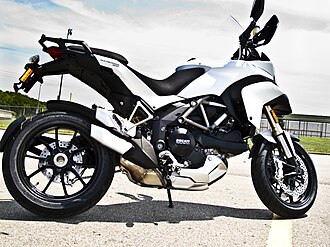
Ducati Multistrada 1200: The Adventure Motorcycle That Changed Ducati Forever
The Ducati Multistrada 1200 occupies a special place in Ducati history because it transformed the company’s idea of what a performance motorcycle could be. When it arrived in 2010, Ducati was still primarily associated with superbikes, naked motorcycles and sport-focused machines. The Multistrada 1200 challenged that identity by combining the performance of a high-powered Ducati twin with the comfort, versatility and upright riding position of an adventure-touring motorcycle. Ducati itself described the concept as “four bikes in one,” with Sport, Touring, Urban and Enduro riding modes allowing the motorcycle to adapt its engine response, traction control, suspension and ABS characteristics to different situations.
The Multistrada 1200 was not simply another large adventure motorcycle with a Ducati badge. It represented a major change in direction for the company. Internally known by the codename “Cayenne,” the project was intended to create a motorcycle capable of combining sporting performance with touring comfort, everyday practicality and limited off-road ability. Ducati’s own history describes the model as a symbolic turning point that helped the company expand beyond its traditional sports-bike identity.
What makes the Multistrada 1200 particularly interesting today is the way its fundamental philosophy anticipated the modern adventure-performance category. Long before radar-equipped touring motorcycles and sophisticated electronic suspension became commonplace, the Multistrada was already attempting to make one motorcycle behave like several different machines. It could be a fast road bike on Sunday morning, a comfortable touring motorcycle in the afternoon and a practical commuter on Monday. That versatility became the foundation for the Multistrada family that eventually evolved into Ducati’s modern V4 range.
The Birth of the Multistrada 1200
Ducati’s Second-Generation Adventure Revolution
The original Multistrada 1000 appeared in 2003, establishing Ducati’s first serious attempt at building a versatile crossover motorcycle. It was unconventional even by Ducati standards, combining a 17-inch front wheel, trellis frame, single-sided swingarm and air-cooled Desmodue engine with an upright riding position and touring capability. Ducati’s historical material explains that the original concept was intended to combine sporting use with touring and some off-road capability without abandoning the company’s performance identity.
The 2010 Multistrada 1200 took that idea to another level. Rather than simply enlarging the existing motorcycle, Ducati developed an entirely more ambitious machine. The styling became larger and more substantial, aerodynamic protection improved, passenger space increased and luggage options became more important. At the same time, Ducati installed an engine derived from its 1198 superbike platform and developed an extensive electronic management system around it.
The result was a motorcycle that looked dramatically different from Ducati’s superbikes but still carried unmistakable Ducati DNA. Its high front section, narrow tail and beak-like front bodywork established a visual language that would remain recognizable throughout later generations of Multistrada motorcycles.
A Two-Wheeled SUV Concept
Ducati’s designers were influenced by the emerging automotive SUV concept, and the Multistrada 1200 was effectively conceived as a two-wheeled interpretation of that idea. It offered a commanding riding position, generous space and the ability to travel across different surfaces, but it retained the performance-oriented personality expected from a Ducati.
That combination was important because traditional adventure motorcycles had generally prioritized off-road capability, while sport-tourers emphasized road performance. The Multistrada attempted to blur that distinction. Its 17-inch front wheel made it especially road-oriented, while its Enduro riding mode and generous suspension settings gave it enough versatility to leave the pavement when necessary.
Ducati was effectively asking riders to stop thinking in terms of separate motorcycles for separate purposes. Instead, the Multistrada 1200 proposed a single motorcycle that could change its personality electronically.
The 1198-Based Testastretta Engine
Superbikes Meet Adventure Touring
The engine was one of the most remarkable aspects of the original Multistrada 1200. Ducati started with technology derived from the 1198 superbike but substantially modified the engine’s character for the demands of a versatile road motorcycle. The resulting Testastretta Evoluzione 11° engine displaced 1,198.4 cc and produced around 150 hp at 9,250 rpm in the original 2010 specification. Ducati’s historical material notes that its maximum torque reached 12.1 kgm at 7,500 rpm.
The crucial change was not simply reducing or increasing horsepower. Ducati modified the valve timing to make the engine more flexible and tractable at lower and middle engine speeds. The 11° designation refers to the reduced valve-overlap period, allowing the engine to deliver stronger low-rpm behavior than a pure superbike engine while also improving emissions and fuel efficiency.
This created one of the Multistrada’s defining characteristics: the ability to produce genuinely serious acceleration without requiring the rider to constantly chase the upper reaches of the rev counter. The motorcycle could cruise smoothly, accelerate strongly from relatively low engine speeds and still deliver the unmistakable excitement of a high-performance Ducati twin when the throttle was opened.
Power That Was Extraordinary for an Adventure Bike
When the Multistrada 1200 arrived, its output was extraordinary for the adventure category. Ducati’s heritage archive describes the model as capable of up to 150 hp and highlights how its combination of technology and performance raised the dual-sport segment to a new level.
That engine performance changed the expectations surrounding adventure motorcycles. Riders no longer had to accept that choosing a tall, comfortable touring motorcycle meant giving up sporting acceleration. The Multistrada demonstrated that an adventure-oriented chassis could accommodate an engine with serious sporting credentials.
This was one of the reasons the motorcycle developed such a strong identity. It was not merely comfortable. It was fast, and it was fast in a distinctly Ducati way.
Four Motorcycles in One
Sport Mode
Sport mode represented the most aggressive personality of the original Multistrada 1200. Ducati configured the motorcycle for sharper throttle response, stronger engine character, firmer suspension settings and a more performance-oriented level of traction-control intervention. The result was a machine that could behave much more like a large naked sportbike than a conventional touring motorcycle.
This was perhaps the most surprising aspect of the Multistrada concept. A rider could climb aboard a motorcycle equipped with luggage and passenger accommodation and, with a change of riding mode, transform its behavior into something considerably more aggressive. The engine’s sporting heritage suddenly became much more obvious.
Touring Mode
Touring mode was designed for long-distance travel. Engine response became smoother, suspension settings were softened and electronic assistance was configured to provide a more relaxed experience. Ducati’s objective was to allow the motorcycle to cover substantial distances without demanding the rider’s constant attention.
The touring personality was central to the Multistrada’s success. A motorcycle this powerful would have little practical value if it were uncomfortable after an hour, so Ducati concentrated on creating a riding position and chassis capable of carrying both rider and passenger for long journeys.
The upright seating position also improved visibility in traffic and made it easier for the rider to look through corners. Combined with wind protection and luggage options, the Multistrada became a genuine long-distance machine rather than simply a tall sportbike.
Urban Mode
Urban mode reduced engine output and increased electronic intervention, making the Multistrada more manageable in city environments. Ducati’s original calibration reduced output to around 100 hp and increased traction-control intervention, while the suspension settings were also adjusted.
For a motorcycle capable of producing approximately 150 hp, having a calmer urban setting was particularly useful. It allowed the rider to exploit the motorcycle’s visibility and maneuverability without constantly dealing with the full intensity of the engine.
This was an early example of a feature that has since become common across high-performance motorcycles: electronic systems could fundamentally alter the personality of the same engine without requiring mechanical changes.
Enduro Mode
Enduro mode completed the four-bike concept. Ducati configured the motorcycle for rougher surfaces by altering engine output, traction control and suspension characteristics while increasing ground clearance. According to Ducati’s historical account, the original Enduro setup used approximately 100 hp and raised the rear suspension to provide an additional 20 mm of ground clearance.
The Multistrada was never intended to replace a dedicated off-road motorcycle, particularly because of its road-focused 17-inch front wheel, but Enduro mode expanded the motorcycle’s range considerably. Gravel roads, dirt tracks and rough rural routes became realistic possibilities rather than absolute boundaries.
This flexibility was precisely what Ducati wanted. The motorcycle did not need to excel at every individual task. It simply needed to be capable enough in each environment that the rider would not feel forced to leave it in the garage when the journey changed direction.
The Electronics Revolution
Riding Modes and Traction Control
The original Multistrada 1200 was significant because its electronics were not merely safety accessories. They were central to the motorcycle’s concept. Ducati integrated engine mapping, throttle response, traction control and suspension behavior into the riding modes, allowing the motorcycle’s character to change electronically.
This approach represented a major step forward for the company. Instead of developing separate motorcycles for sport, touring, city use and rough roads, Ducati used electronics to allow one motorcycle to cover all four roles.
The idea seems familiar today, but at the time it was a bold proposition. The Multistrada helped establish the idea that advanced electronic controls could be used not only to make motorcycles safer but also to give them multiple personalities.
Evolution Toward IMU-Based Systems
The technology continued to evolve with later versions of the Multistrada 1200. The 2015 generation introduced a more sophisticated Testastretta DVT engine and an inertial measurement unit, or IMU. Ducati explains that the IMU could monitor roll, pitch and yaw, improving the operation of cornering ABS, traction control and semi-active suspension while also supporting functions such as cornering lights and cruise control.
This development was enormously important because it allowed electronic systems to understand not merely how quickly a wheel was turning but how the entire motorcycle was moving through space. That information could then be used to adjust intervention according to lean angle and other dynamic conditions.
The Multistrada 1200 consequently became a technological showcase for Ducati, demonstrating that a large adventure motorcycle could be every bit as sophisticated as a premium sportbike.
The 2015 Multistrada 1200 DVT
Variable Valve Timing Arrives
The 2015 generation marked another major step forward with Ducati’s Testastretta DVT engine. The displacement remained 1,198.4 cc, but the engine gained Ducati’s Dual Variable Timing system, which independently varied intake and exhaust valve timing. Ducati lists output at 160 hp and torque at 136 Nm for this generation.
DVT addressed one of the fundamental challenges of performance engines: maximizing high-rpm power without sacrificing low-speed flexibility. By varying valve timing across the rev range, Ducati could give the engine a broader personality.
That made the Multistrada even more effective as an all-purpose motorcycle. The rider could enjoy strong low-speed tractability while still having access to substantial high-rpm performance. It was a technological refinement of the original Multistrada philosophy rather than a departure from it.
More Than Just More Horsepower
The importance of the 2015 update went beyond the increase in output. The arrival of the IMU, improved electronics and DVT engine demonstrated how Ducati was increasingly treating the Multistrada as a technological flagship rather than simply an adventure derivative.
The motorcycle became more sophisticated without abandoning its central purpose. It remained a machine for traveling, cornering, commuting and exploring, but it could now perform those tasks with greater precision and electronic control.
This combination helped cement the Multistrada as a genuine alternative to traditional sport-touring motorcycles and large adventure machines.
The Multistrada 1200 S and Premium Equipment
Skyhook Electronic Suspension
The higher-specification Multistrada 1200 S models added sophisticated electronic suspension technology, including Ducati Skyhook Suspension. The system could adjust suspension behavior dynamically, helping the motorcycle remain controlled while improving comfort across changing road surfaces and loads.
This technology was especially valuable on a motorcycle intended to carry luggage and passengers. The ideal suspension setup for a solo rider on a smooth mountain road is not necessarily ideal when the motorcycle is carrying a passenger and full luggage. Electronic suspension allowed the Multistrada to compensate for those changing demands more effectively.
The S versions therefore demonstrated Ducati’s willingness to apply premium sportbike technology to touring-oriented motorcycles.
Pikes Peak: The Sporting Multistrada
Ducati also developed the Multistrada 1200 Pikes Peak, a version inspired by the company’s success at the famous Pikes Peak International Hill Climb. Ducati notes that rider Greg Tracy won the event in 2010 on a production-based Multistrada, helping inspire the development of a dedicated Pikes Peak version.
The Pikes Peak became the sporting extreme of the Multistrada family. It emphasized road performance and offered a more aggressive equipment package while retaining the practicality of the core platform.
Its existence demonstrated just how broad the Multistrada concept had become. The same basic motorcycle could be configured as a long-distance touring machine, a practical everyday bike, an adventure-oriented motorcycle or an aggressive road performer.
Design and Ergonomics
A New Ducati Shape
The Multistrada 1200’s design represented a significant departure from Ducati’s traditional sports motorcycles. Instead of a low fairing and tucked-in riding position, it used a tall front section, upright ergonomics and a narrow rear body. Ducati’s historical material describes the design as being influenced by the automotive SUV concept and emphasizes the contrast between the voluminous front and slender tail.
The design was not universally conventional, but that was part of its appeal. The motorcycle looked substantial without becoming visually heavy. The beak projected beyond the 17-inch front wheel, while the high fairing provided meaningful wind protection for long-distance riding.
The narrow tail also created a visual connection with Ducati’s sport motorcycles. Even though the motorcycle was physically larger, the designers retained enough of Ducati’s sporting proportions to prevent it from looking like a conventional touring machine.
Rider and Passenger Comfort
Ducati specifically increased space for both rider and passenger during the development of the 1200. The company worked on improved aerodynamic protection, greater room aboard and increased luggage capacity.
This focus on passenger comfort is important because the Multistrada was conceived as a genuine travel motorcycle. It was not merely designed around a solo rider who occasionally carries luggage. The passenger and luggage were considered fundamental parts of the motorcycle’s purpose.
That philosophy helped make the Multistrada attractive to riders who wanted a motorcycle capable of long-distance travel without sacrificing Ducati’s sporting character.
Multistrada 1200 Technical Specifications
Because the Multistrada 1200 evolved substantially during its production life, specifications vary between model years and versions. The following table summarizes the 2015-generation Multistrada 1200 with the 1,198.4 cc Testastretta DVT engine; Ducati’s official historical material lists this generation at 160 hp and 136 Nm. Earlier versions produced approximately 150 hp, while later 1200 variants had different equipment and specifications.
| Specification | Ducati Multistrada 1200 DVT |
|---|---|
| Engine | Testastretta DVT L-twin |
| Valve system | Desmodromic, 4 valves per cylinder |
| Cooling | Liquid-cooled |
| Displacement | 1,198.4 cc |
| Bore × stroke | 106 × 67.9 mm |
| Maximum power | 160 hp @ 9,500 rpm |
| Maximum torque | 136 Nm @ 7,500 rpm |
| Variable valve timing | Ducati DVT, intake and exhaust |
| Fuel system | Electronic fuel injection |
| Throttle | Ride-by-wire |
| Transmission | 6-speed |
| Frame | Tubular steel Trellis |
| Rear swingarm | Aluminum, single-sided |
| Riding modes | Sport, Touring, Urban, Enduro |
| Traction control | Ducati Traction Control |
| ABS | Cornering-capable system on later generations |
| Suspension | Conventional or Ducati Skyhook electronic suspension, depending on version |
| Front wheel | 17-inch |
| Rear wheel | 17-inch |
| Fuel tank | Approximately 20 litres |
| Instrumentation | TFT/display depending on version |
| Cruise control | Available on later versions |
| Key technology | DVT, IMU, riding modes, electronic suspension depending on model |
Why the Ducati Multistrada 1200 Still Matters
The Motorcycle That Expanded Ducati’s Identity
The importance of the Multistrada 1200 extends beyond its sales or technical specification. It changed the perception of Ducati as a manufacturer. Before the Multistrada, Ducati’s identity was overwhelmingly connected with motorcycles designed around sporting performance. The 1200 proved that the company could build a motorcycle for long-distance travel, passengers, luggage, urban use and rough roads without abandoning the performance characteristics that made Ducati distinctive.
That transformation became increasingly important as the motorcycle market evolved. Riders began demanding machines that could perform multiple roles rather than requiring separate motorcycles for commuting, touring and recreational riding. The Multistrada was exceptionally well positioned for that trend.
Its “four bikes in one” philosophy was therefore more than a marketing slogan. It described a genuine engineering strategy.
The Foundation for the Modern Multistrada
The Multistrada 1200 also established the technological and philosophical foundation for later generations. The 1260 continued the basic concept with a larger 1,262 cc engine, while the 2020 Multistrada V4 represented another major transformation. Ducati’s own history describes the V4 as a new paradigm, using a 1,158 cc V4 Granturismo engine, a 19-inch front wheel, monocoque chassis and advanced electronics including front and rear radar.
Although the modern V4 is considerably more advanced, its underlying mission remains remarkably similar to that of the original 1200: deliver performance, comfort and versatility in one motorcycle.
That continuity is perhaps the greatest compliment to the Multistrada 1200. Its basic idea was so successful that Ducati continued refining rather than abandoning it.
Final Verdict
The Ducati Multistrada 1200 was one of the motorcycles that helped redefine what a modern adventure-performance motorcycle could be. When Ducati introduced it in 2010, the idea of combining a roughly 150-horsepower superbike-derived engine with an upright adventure chassis, sophisticated electronics and four selectable riding personalities was genuinely radical. Ducati was not simply entering an existing category; it was trying to create a new interpretation of the performance touring motorcycle.
Its greatest strength was the way its components worked together. The Testastretta engine provided extraordinary performance, while the upright ergonomics and touring equipment made long journeys realistic. Riding modes allowed the motorcycle to become calmer or more aggressive according to circumstances, while traction control, ABS and later IMU-based systems brought levels of electronic sophistication that were unusual when the model first appeared.
The 2015 DVT generation pushed the concept further with 160 hp, 136 Nm of torque, variable valve timing and a sophisticated inertial platform. Versions such as the Multistrada 1200 S added electronic suspension, while the Pikes Peak demonstrated that the same platform could be turned toward serious sporting use.
Perhaps the most impressive thing about the Multistrada 1200 is that its core idea has survived. Today’s Multistrada motorcycles are more powerful, more electronically sophisticated and more capable than the original 1200, but they continue to follow the same fundamental philosophy: one motorcycle should be able to take the rider almost anywhere without forcing them to sacrifice performance or comfort.
The Multistrada 1200 therefore deserves to be remembered not simply as an older Ducati adventure motorcycle, but as a turning point in the company’s history. It demonstrated that Ducati could move beyond the racetrack without abandoning its sporting soul. It gave riders a motorcycle capable of touring across continents, attacking mountain roads, commuting through cities and venturing onto rougher surfaces—all while retaining the unmistakable character of an Italian performance machine.
That is the legacy of the Ducati Multistrada 1200: a motorcycle that turned versatility into a performance feature rather than a compromise.
