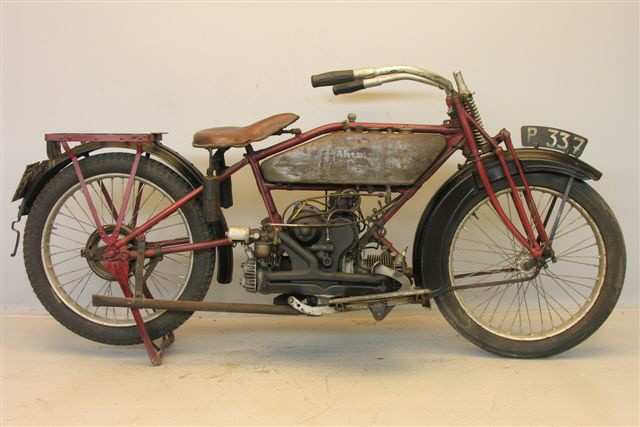
The Harley-Davidson Model W, produced in the mid-1910s, represents an important transitional design in the company’s early development of dependable, lightweight single-cylinder motorcycles. It was envisioned as a practical and accessible machine that could serve riders who needed reliability, manageable performance, and straightforward maintenance. Positioned during a period when motorcycling was evolving rapidly away from motorized bicycles, the Model W served as a bridge between Harley-Davidson’s earlier pedal-assist machines and the more refined singles that would follow later in the decade. While not as widely recognized as some of Harley-Davidson’s later models, the Model W demonstrates how the company experimented with new materials, improved lubrication systems, and more cohesive engineering to create a machine that was both durable and easy to operate. Its simple mechanical layout and lightweight frame made it popular among new riders, messenger services, and urban commuters seeking a dependable motorized vehicle.
Engine Architecture and Mechanical Design
The Model W used a single-cylinder, four-stroke engine of approximately 500 cc displacement, designed to deliver predictable torque and moderate power suitable for everyday utility riding. The cylinder head and barrel were made from cast iron with pronounced cooling fins to help dissipate heat during extended operation. The engine operated with an F-head layout, in which the intake valve was automatic—opening via atmospheric pressure—while the exhaust valve was mechanically actuated by a cam-driven tappet. This arrangement simplified valve control while maintaining adequate performance and reliability for the era.
Fuel was delivered through a compact carburetor featuring manual adjustments for mixture control. These adjustments were typically operated via levers on the handlebars, allowing the rider to fine-tune performance based on load and terrain. The ignition system generally relied on a magneto, providing spark independent of battery power and reducing the risk of electrical failures in remote or rugged environments. The lubrication method followed a total-loss oiling system, which required the rider to regulate oil flow manually. Although this method demanded attention, it ensured consistent lubrication across a wide range of operating conditions and was standard practice during the period. The engine’s output was modest by modern standards—generally in the 3.5 to 4.5 horsepower range—but sufficient to propel the machine to reasonable commuting speeds while maintaining smooth and predictable operation.
Frame, Chassis Construction, and Structural Integrity
The chassis of the Model W featured a tubular steel diamond frame that reflected its bicycle heritage while incorporating reinforcements for the demands of motorized travel. The dual lower rails cradled the engine securely, helping distribute loads throughout the structure and adding rigidity without excessive weight. The frame geometry provided a comfortable upright riding position, with the seat mounted on a sprung post to improve comfort on rough and unpaved roads.
One of the notable engineering improvements introduced with machines of this era was the increased use of brazed lugs—metal joints that strengthened connections between frame tubes and improved overall durability. The Model W benefited from this structural approach, achieving reliable long-term strength while remaining easy to service. The compact wheelbase and narrow frame also contributed to agility, making the motorcycle well-suited for city riding and tight maneuvering. Many of these features also reflected Harley-Davidson’s attention to practical maintenance, as most components were designed for easy removal and adjustment using basic tools.
Suspension, Steering Geometry, and Handling Characteristics
Suspension on the Model W followed early motorcycle design conventions but incorporated improvements that made riding more manageable. The front employed an early springer fork utilizing a coil-sprung leading-link mechanism to absorb bumps and reduce vibration transmitted to the rider. This configuration delivered limited travel compared to later suspensions but represented a significant step forward from rigid forks used on earlier motor-bicycle designs.
The rear of the motorcycle remained rigid, relying on the sprung saddle and the tall profile of pneumatic tires to cushion impacts. Despite its simplicity, the combination worked well for the type of riding the Model W was intended for: moderate speeds over modestly maintained surfaces. The steering geometry was tuned for stability, enabling the bike to track predictably across uneven surfaces while preserving light steering effort. This balance made the Model W accessible for newer riders, who valued its calm and forgiving handling.
Drivetrain, Transmission, and Control Systems
The Model W employed a belt-driven final drive, a common but effective system in early Harley-Davidson motorcycles. Power was transmitted from the engine pulley to a large rear wheel pulley via a flat leather or fabric-reinforced belt. The belt drive offered smooth, quiet operation and required relatively little maintenance compared to chain-driven systems, though it did necessitate careful tension adjustment to prevent slippage.
The motorcycle operated without a conventional transmission; it used a direct-drive configuration in which engine speed translated directly to rear wheel speed. Riders managed load and acceleration through throttle control, ignition timing, and the tensioning mechanism that allowed the belt to be loosened for idling or tightened for movement. Although primitive by modern standards, this method provided a reliable and simple solution that reduced mechanical complexity. Braking was similarly straightforward: a rear hub coaster brake that activated when the rider pedaled backward on the auxiliary pedal mechanism. This type of brake, borrowed from bicycle design, was adequate for the moderate speeds the Model W was capable of.
Wheels, Tires, and Braking Performance
The wheels of the Model W featured 28-inch spoked rims, built with steel spokes laced into robust hubs capable of handling both engine torque and the rough conditions common to early 20th-century roads. Pneumatic tires with generous sidewalls provided much of the motorcycle’s shock absorption, and their balloon-style design helped maintain traction on dirt and gravel surfaces.
As mentioned, braking relied solely on the rear coaster brake. While this system lacked the stopping power of later drum or disc brakes, it was dependable in dry conditions and relatively easy to maintain. Because the Model W’s top speed remained within modest limits—generally 40 to 45 mph—the braking setup was considered adequate for the time.
Performance, Riding Dynamics, and Practical Usage
Performance of the Harley-Davidson Model W focused on steady, manageable acceleration and reliable function rather than high speed. Top speed varied with rider weight and conditions but typically fell within the 40–45 mph range, making it ideal for early urban, suburban, and rural travel. The motorcycle’s lightweight construction and simple controls afforded new riders confidence, while experienced riders appreciated the dependable torque and efficient fuel consumption.
The Model W’s utility made it a popular choice for everyday transportation, postal carriers, and couriers, who valued its ease of service and predictable operation. Its fuel economy was notable, often exceeding 70 miles per gallon due to the efficient displacement and low mass. Despite its simplicity, the motorcycle offered a satisfying riding experience, combining smooth engine characteristics with a nimble chassis that remained responsive across varied terrain conditions.
Technical Specifications (Summary)
- Engine: Single-cylinder, four-stroke
- Displacement: Approximately 500 cc
- Valve System: F-head configuration (automatic intake, mechanical exhaust)
- Power Output: Around 3.5–4.5 hp
- Fuel Delivery: Carburetor with manual mixture controls
- Ignition: Magneto ignition
- Lubrication: Total-loss system with manual control
- Frame: Tubular steel diamond frame
- Front Suspension: Springer-type fork
- Rear Suspension: Rigid frame with sprung saddle
- Transmission: Direct drive (no gearbox)
- Final Drive: Leather/fabric-reinforced belt
- Brakes: Rear coaster brake
- Wheels: 28-inch spoked wheels with pneumatic tires
- Top Speed: ~40–45 mph
Legacy and Historical Significance
The Harley-Davidson Model W stands as a meaningful example of early American motorcycle design, reflecting Harley-Davidson’s focus on creating machines that combined mechanical simplicity with everyday utility. Although overshadowed historically by the company’s later heavyweight models and powerful V-twins, the Model W played an important role in establishing Harley-Davidson’s reputation for durability and practicality. Its user-friendly operation and economical performance made it accessible to a wide audience at a time when motorcycling was becoming increasingly popular. Today, surviving examples of the Model W are prized by vintage enthusiasts who appreciate its historical value and its place in Harley-Davidson’s early engineering story.
