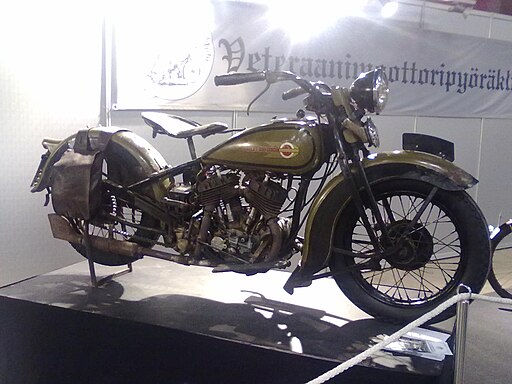
The Harley-Davidson RL 45, produced from 1932 to 1936, stands as one of the most significant motorcycles from the company’s Great Depression–era lineup. As part of the flathead “R” series, the RL 45 helped Harley-Davidson survive one of the toughest economic climates in American industrial history. It represented a step forward in mechanical refinement, styling, and usability compared to earlier models, combining a robust side-valve V-twin engine with a newly refined chassis and improved suspension components. The motorcycle was engineered to deliver reliable horsepower at a price point that appealed to working-class riders, police departments, and delivery services. Notably, the RL 45 arrived during Harley-Davidson’s Art Deco design phase, giving it distinctive styling elements characterized by sweeping lines, rounded surfaces, and elegant tank graphics that contributed to its lasting visual appeal.
Engine Design, Combustion Characteristics, and Cooling
At the heart of the RL 45 was a 45 cubic-inch (742 cc) side-valve V-twin engine, part of Harley-Davidson’s increasingly sophisticated flathead family. This side-valve arrangement placed both intake and exhaust valves within the cylinder block rather than overhead, improving mechanical simplicity and reducing manufacturing cost. Although side-valve engines produced less peak power than overhead-valve configurations, they excelled in reliability, torque production, and ease of maintenance—critical qualities in an era when riders often performed their own servicing.
The RL 45 produced approximately 18 to 20 horsepower, a notable figure for its displacement and time period. The engine made its best power at moderate rpm, delivering a smooth torque curve ideal for city and country riding. Fuel was fed through a carburetor that featured adjustable mixture controls, allowing riders to compensate for weather, elevation, or load changes. Cooling was provided by large, deeply finned cast-iron cylinders and heads, which dissipated heat efficiently under typical riding conditions. Lubrication used a constant-loss oiling system, in which oil was circulated through the engine and partially burned during combustion. A hand-operated pump allowed the rider to increase oil flow when needed, ensuring adequate lubrication during long climbs or hot weather. The RL engine became known for its durability, often running thousands of miles with only minor adjustments.
Transmission, Clutch, and Final Drive
The RL 45 was equipped with a three-speed hand-shift transmission, a hallmark of Harley-Davidson motorcycles during the era. The gearbox offered a wide ratio spread, from a low first gear suited for hill starts and heavy loads to a tall third gear optimized for steady cruising. Riders operated the transmission through a tank-mounted gate-style shift lever, which provided clear tactile feedback during gear changes. Complementing the transmission was a foot-operated rocker clutch, giving the rider the ability to modulate engagement smoothly, a crucial advantage in low-speed maneuvering or stop-and-go traffic.
Power was delivered to the rear wheel via a roller chain final drive, selected for its strength and ability to handle the torque of the 45-inch flathead. The chain drive also enabled easy sprocket changes, allowing riders to tailor gearing for sidecar duty, city riding, or open-road travel. The drivetrain as a whole was designed for longevity, with robust gears, thick case castings, and accessible lubrication points that simplified routine maintenance.
Frame Construction, Chassis Dynamics, and Riding Ergonomics
The RL 45 featured Harley-Davidson’s double-loop tubular steel frame, designed for rigidity and stability. This frame layout cradled the V-twin engine securely, distributing weight evenly across the chassis while providing a low center of gravity. The result was a motorcycle that felt planted on uneven roads, a crucial advantage considering the rough road surfaces common throughout the early 1930s.
Rider ergonomics were carefully considered in the RL’s design. A sprung solo saddle absorbed significant vibration and impacts from the road, reducing fatigue during long rides. The wide handlebars provided excellent leverage, making the bike maneuverable even at low speeds or when fitted with a sidecar. Footboards rather than footpegs offered a stable platform, enabling riders to adjust their stance during extended travel.
Stylistically, the RL 45 adopted many Art Deco influences, including streamlined fuel tanks, sculpted fenders, and elegant graphics. These visual refinements contributed to the model’s enduring popularity among collectors and restorers, many of whom consider the RL series among the most beautiful flatheads Harley-Davidson ever produced.
Suspension, Steering Geometry, and Handling
Suspension on the RL 45 was typical for the period yet engineered with surprising sophistication. The front featured Harley-Davidson’s forged I-beam springer fork, which used a central coil spring supported by linkage arms to provide limited but effective suspension travel. This springer design offered durability and control, helping the front wheel maintain traction over rough pavement or dirt roads. Because the RL lacked rear suspension, the sprung saddle played a key role in rider comfort, effectively absorbing much of the vertical shock that modern rear shocks would handle.
Steering geometry was optimized for stability at cruising speeds, with a gentle rake and trail that made the motorcycle predictable and confidence-inspiring. Combined with the bike’s long wheelbase and substantial weight, the RL 45 felt secure in corners and resistant to wobble, characteristics that made it popular with police forces and commercial riders who needed dependable high-mileage performance.
Wheels, Tires, and Braking Systems
The RL 45 rode on 18-inch spoked wheels fitted with balloon-tread tires that provided both cushioning and traction across a range of surfaces. These tires improved ride comfort significantly, compensating for the rigid rear frame and helping the motorcycle maintain grip on dirt, gravel, or worn pavement.
Braking was handled by mechanical drum brakes located at the front and rear. Although modest by modern standards, these drums were effective for the speeds the RL could achieve. Properly adjusted, the drum brakes provided smooth, progressive stopping power and remained functional even when exposed to mud, dust, or rain. The simple mechanical linkage meant that serviceability was straightforward, an important consideration for riders during the Depression era.
Performance Characteristics and Riding Experience
Performance on the RL 45 emphasized torque, smoothness, and mechanical dependability. The motorcycle’s top speed typically ranged between 65 and 70 mph, depending on gearing and load. Its acceleration was modest but steady, with the side-valve engine delivering power in a broad, predictable band. This made the RL well-suited for both city riding and long-distance travel, especially when fitted with accessories such as luggage racks, toolboxes, or a sidecar.
Fuel economy was respectable for its displacement, often averaging between 40 and 55 miles per gallon, an important metric for riders during a period when fuel costs represented a major expense. The riding experience was characterized by a calm, rhythmic engine note, a stable chassis, and a user-friendly clutch and gearbox that rewarded smooth, deliberate operation.
Technical Specifications (Summary)
- Engine: 45 cu in (742 cc) flathead V-twin
- Valve Train: Side-valve configuration
- Power Output: Approx. 18–20 hp
- Fuel Delivery: Carburetor with manual mixture adjustments
- Ignition: Magneto or coil/battery (varied by year and trim)
- Lubrication: Constant-loss system with manual pump assist
- Transmission: 3-speed hand-shift
- Clutch: Foot-operated rocker clutch
- Final Drive: Chain
- Frame: Double-loop tubular steel
- Front Suspension: I-beam springer fork
- Rear Suspension: Rigid frame, sprung saddle
- Brakes: Front and rear mechanical drum brakes
- Wheels: 18-inch spoked rims
- Top Speed: ~65–70 mph
- Fuel Economy: ~40–55 mpg
Legacy and Historical Significance
The Harley-Davidson RL 45 remains a vital part of the company’s legacy, representing the resilience and creativity that saw Harley-Davidson through the Great Depression. Its dependable flathead engine, elegant Art Deco styling, and robust mechanical design made it a favorite among riders who demanded reliability above all else. The RL series laid the foundation for the later W-series 45-inch motorcycles, including the iconic WLA used extensively during World War II. Today, the RL 45 is cherished by collectors for its mechanical simplicity, graceful styling, and historical importance. It stands as a testament to Harley-Davidson’s engineering determination during one of the most challenging chapters in American motorcycling history.
