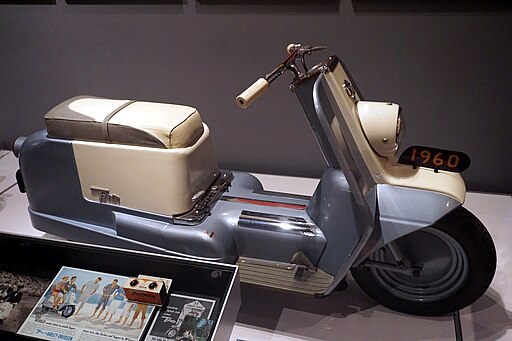
The Harley-Davidson Topper, produced from 1960 to 1965, occupies a distinctive place in the company’s history as its only mass-produced scooter. At a time when European scooters such as Vespa and Lambretta were attracting enormous popularity, Harley-Davidson sought to enter the lightweight urban mobility market with a uniquely American interpretation. Rather than simply mimicking its European competitors, the Topper introduced several engineering concepts that set it apart, including a fiberglass body shell, a continuously variable transmission, and an air-cooled two-stroke engine engineered for commuter-friendly simplicity. The Topper demonstrated Harley-Davidson’s willingness to experiment with nontraditional formats, while still integrating elements of durability and rugged practicality that reflected the brand’s heritage. Although commercial success was limited, the scooter remains a fascinating example of mid-century American industrial design and the company’s broadening ambitions during that era.
Engine Construction and Powertrain Characteristics
At the heart of the Harley-Davidson Topper was a 165 cc single-cylinder, two-stroke engine mounted horizontally beneath the scooter’s bodywork. The engine used aluminum cylinder construction with a cast-iron liner to balance weight savings with reliability. The two-stroke layout, uncommon for Harley-Davidson, simplified internal mechanics and reduced moving parts. A piston-ported induction system controlled airflow, and fuel entered through a compact carburetor designed for low-speed stability and predictable throttle response. Combustion mixture was prepared using a pre-mix system in which the rider manually blended oil with gasoline, a standard practice for many two-stroke scooters of the era.
Cooling was managed using a forced-air system, notable because the Topper’s enclosed body prevented consistent natural airflow. An internal fan circulated air across the cylinder and head through a shrouded ducting arrangement, ensuring consistent thermal performance even during prolonged slow-speed riding. The engine produced around 9 horsepower, sufficient to move the lightweight scooter through urban environments with agility. A recoil starter, hidden beneath the seat, eliminated the need for a kickstarter and provided a more user-friendly launching method. Overall, the powerplant was engineered for durability, simplicity, and easy servicing—priorities aligned with the evolving commuter market.
Torque Converter Transmission and Driveline
One of the Topper’s most technologically interesting components was its “Scootaway Drive,” a continuously variable transmission (CVT) that used a belt-driven torque converter. Unlike most scooters of the period that relied on multi-stage geared transmissions requiring manual shifting, the Topper’s CVT adjusted ratios automatically based on engine speed and load. A variable-diameter pulley system expanded and contracted under centrifugal force, providing seamless acceleration and eliminating gear changes entirely. This design made the Topper extremely accessible to new riders, as its operation essentially mirrored that of a small automatic vehicle.
Power was transmitted to the rear wheel through an enclosed belt drive. Early models experienced some issues with belt contamination due to moisture entering the housing, but later production incorporated improved seals and drainage to increase reliability. The driveline system reflected the company’s aim to create a scooter that required minimal rider input while still delivering strong low-end torque for city riding or modest inclines.
Chassis, Bodywork, and Frame Engineering
The Harley-Davidson Topper used a robust tubular steel frame hidden under a molded fiberglass body, a material choice that distinguished it from the pressed-steel forms used by European manufacturers. Fiberglass allowed Harley-Davidson to craft sweeping, sculpted surfaces that remained lightweight while offering resistance to corrosion. The lower half of the body formed a unibody-style enclosure that protected the engine and driveline from road debris, while the upper fairing integrated a leg shield and floorboard to enhance rider comfort.
The design emphasized easy access for service. Removable side panels and a hinged seat revealed most major mechanical components. Although not a performance-oriented machine, the frame provided ample sturdiness for everyday riding and could manage light cargo loads when fitted with optional luggage racks. The scooter’s proportions allowed for a low center of gravity, contributing to stability and rider confidence even at low speeds.
Suspension, Steering, and Riding Dynamics
The suspension system on the Topper was simple but effective. The front used a trailing-link fork with a compact spring-and-damper unit, designed to reduce dive under braking and absorb the smaller bumps and irregularities common to urban roads. At the rear, a single shock absorber mounted beneath the frame provided moderate travel and contributed to the scooter’s predictable handling characteristics. The wheelbase and geometry favored stability over aggressive maneuvering, ensuring that new riders could operate the Topper without undue sensitivity or harshness.
Steering was managed through a conventional handlebar assembly integrated into the front cowl. Because of the scooter’s narrow wheels and modest weight, directional response was light and easy, making it ideal for city navigation and tight parking environments. The riding posture was upright and relaxed, with a broad saddle capable of supporting both the rider and an optional passenger on certain versions.
Braking, Wheels, and Tires
The Topper employed drum brakes on both front and rear wheels, typical of the period. These mechanical drums offered adequate stopping performance for the scooter’s weight and power, though they required occasional adjustment to maintain optimal responsiveness. The wheels were 12-inch steel rims fitted with relatively wide tires for their size, chosen to balance stability and maneuverability. The larger-than-average scooter tires provided improved traction compared to narrow European designs, and their taller sidewalls contributed additional cushioning to the ride.
Performance, Efficiency, and Practical Operation
With its 9-horsepower engine and CVT driveline, the Harley Topper reached a typical top speed of 45–50 mph, depending on rider weight and terrain. Acceleration was smooth due to the torque converter’s continuous ratio adjustment. Fuel economy remained one of the scooter’s strengths, often averaging between 70 and 90 miles per gallon, a key advantage for budget-conscious riders. The Topper’s enclosed mechanical layout protected critical components from weather and road grime, reducing wear and extending service intervals.
Operationally, the scooter was designed for simplicity. The rider started the engine using a pull-starter, adjusted the choke for warm-up, then relied on the automatic transmission to handle movement. The lack of manual shifting made it an attractive option for inexperienced riders, students, and urban commuters looking for motorcycle-style mobility without the learning curve of traditional two-wheelers.
Technical Specifications (Summary)
- Engine: 165 cc single-cylinder, two-stroke
- Cooling: Forced-air cooling with internal fan
- Power Output: Approx. 9 hp
- Induction: Piston-ported with carburetor
- Fuel/Oil System: Pre-mix two-stroke mixture
- Starter: Recoil (pull) starter
- Transmission: CVT “Scootaway Drive” torque converter
- Final Drive: Belt drive, fully enclosed
- Frame: Tubular steel frame with fiberglass body panels
- Front Suspension: Trailing-link fork
- Rear Suspension: Single rear shock absorber
- Brakes: Front and rear drum brakes
- Wheels/Tires: 12-inch rims with balloon-style tires
- Top Speed: ~45–50 mph
- Fuel Economy: ~70–90 mpg
Legacy and Historical Importance
Although the Harley-Davidson Topper was produced for only five years, its legacy endures as a bold but unconventional chapter in the company’s history. It demonstrated that Harley-Davidson was willing to explore new market segments and adopt innovative technologies—such as a CVT and fiberglass bodywork—long before these features became commonplace. While the scooter never achieved the cultural impact or global popularity of its European competitors, it has since become a collectible symbol of 1960s Americana and an example of Harley’s design experimentation. Today, surviving Toppers are appreciated by enthusiasts for their quirky engineering, distinctive styling, and role in diversifying the company’s mid-century portfolio.
.jpg)