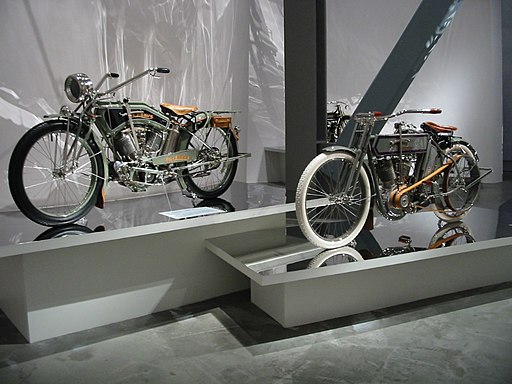
The Harley-Davidson Model 7D, introduced in 1911, occupies a crucial point in the company’s early engineering evolution. It is remembered as Harley-Davidson’s first production motorcycle to use a V-twin engine, a configuration that would eventually define the brand’s identity. Although only a small number were produced, the 7D laid the groundwork for the iconic V-twin lineage that followed. Built during a period when motorcycle design was rapidly transitioning from motor-bicycles to purpose-engineered motorized machines, the 7D combined lightweight construction with a pioneering powertrain. Its engineering choices—frame geometry, lubrication method, ignition design, and transmission system—reflect both experimentation and growing technical maturity for the young company.
Engine Architecture and Mechanical Design
The defining feature of the Model 7D is its 49.5-cu-in (810 cc) V-twin, arranged at approximately 45 degrees—an angle that would become a hallmark for later Harley-Davidson two-cylinder engines. The powerplant used atmospheric intake valves with mechanically operated exhaust valves, a typical configuration for the era. The cylinders used cast-iron barrels and heads with integral cooling fins arranged to maximize airflow when mounted in the frame. Despite being an early-generation engine, the 7D demonstrated careful attention to weight distribution and balance. The crankcase was cast in two pieces, designed to house a flywheel assembly that delivered smoother operation compared to single-cylinder predecessors. Power output is typically estimated around 6.5 horsepower, modest by modern standards but a notable jump from Harley’s earlier singles.
Lubrication relied on a total-loss system, in which oil was manually metered by the rider through an adjustable drip feed. From there, the oil entered the crankcase, lubricated key engine components, and exited through designated escape points. The system required attentive operation but ensured consistent lubrication in an era before fully pressurized systems were standard. The carburetor was a primitive but effective design, generally a Schebler unit, which allowed the rider to fine-tune mixture using handlebar-mounted levers. The magneto ignition system offered reliable spark delivery independent of the battery, crucial for long-distance riding on rough early-20th-century roads.
Chassis, Frame Construction, and Suspension
The Model 7D retained a design lineage rooted in heavy-duty bicycle frames, though strengthened and adapted for the increased stresses of a V-twin engine. The frame used tubular steel construction with brazed lug joints, formed into a diamond configuration with an integrated engine cradle. Reinforcement around the lower frame rail helped manage torsional loads introduced by the twin-cylinder engine. The rigid rear frame was typical of motorcycles of the time, relying on pneumatic tires and a sprung saddle to take the brunt of shock absorption.
At the front, the motorcycle used Harley-Davidson’s early springer-type front fork, which employed a pair of leading links supported by a central coil spring. This setup yielded a modest amount of travel but provided more stability and comfort than a rigid fork. The front fork’s geometry was carefully tuned to the machine’s weight balance, particularly because the V-twin engine introduced more forward mass compared to the lightweight single-cylinder engines. The fork also helped reduce wheel chatter on unpaved surfaces, which accounted for the majority of roads during the era.
Transmission, Drivetrain, and Control Systems
The Model 7D used a belt-driven final drive, transferring power through a leather or composite belt to a large rear pulley. There was no conventional transmission; instead, the motorcycle used a direct-drive system where engine speed directly translated to wheel speed. Riders controlled engine load and speed through a combination of throttle, ignition timing, and a manual primary drive tension adjuster, which allowed the belt to be loosened to disengage or tightened to engage the rear wheel. The absence of a clutch and gearbox required skill and anticipation, especially when stopping or climbing hills.
Control ergonomics followed the conventions of the era. Instead of a twist-grip throttle, the rider manipulated throttle and spark advance using levers on the handlebar. The left side typically controlled timing, while the right managed fuel flow. A foot-operated coaster brake on the rear wheel, based on a modified bicycle hub design, supplied the primary stopping force. This mechanical brake required significant rider input to achieve effective deceleration but was adequate for the modest speeds the 7D could reach.
Wheels, Tires, and Braking Systems
The motorcycle rode on 28-inch bicycle-style spoked wheels, built with inner-tube pneumatic tires that helped compensate for the lack of suspension at the rear. Wheel hubs were reinforced to handle the added torque of the twin-cylinder engine. Braking was handled solely at the rear wheel, relying on the internal expanding shoe mechanism typical of coaster brakes at the time. While primitive, this braking system reflected what was considered standard for motorcycles of the early 1910s.
Performance Characteristics and Riding Dynamics
Top speed for the Model 7D generally fell between 45 and 50 mph, depending on rider weight, road surface, and tuning. Acceleration was smoother and stronger than Harley’s earlier single-cylinder models, thanks to the improved torque characteristics of the V-twin engine. The power curve emphasized low-end and mid-range output, making the motorcycle suitable for hilly terrain and longer-distance travel. The rigid frame and minimal suspension meant that handling required a firm, steady approach, especially on rough or rutted roads. Still, the springer fork contributed to better stability than many contemporary designs.
Fuel capacity typically hovered around 3 gallons, providing notable range for the era. Combined with the modest fuel consumption of the engine, the motorcycle was capable of maintaining long touring distances without frequent refueling. However, the rider needed to remain engaged with the machine—adjusting oil flow, managing ignition timing, and monitoring belt tension—making the 7D as much a mechanical experience as a transportation tool.
Technical Specifications (Summary)
- Engine: 49.5 cu in (810 cc) V-twin
- Valve System: Atmospheric intake, mechanical exhaust
- Power Output: Approx. 6.5 hp
- Fuel System: Schebler carburetor with manual mixture controls
- Ignition: Magneto ignition
- Lubrication: Total-loss manual oiling system
- Frame: Tubular steel diamond frame, rigid rear
- Front Suspension: Early springer fork
- Transmission: Direct drive, belt final drive, no gearbox
- Brakes: Rear coaster brake
- Wheels: 28-inch spoked rims with pneumatic tires
- Top Speed: Approximately 45–50 mph
- Fuel Capacity: About 3 gallons
Legacy and Historical Significance
Although the Model 7D saw limited production, its true impact comes from its role in launching Harley-Davidson’s V-twin heritage. The engineering choices made for the 7D directly informed later models, including the stronger and more reliable F-head twins that defined Harley’s lineup throughout the 1910s. Collectors today regard the 7D as one of the most important early Harley-Davidsons—not because of its power or speed, but because it represents the beginning of a design philosophy that became inseparable from the brand’s identity. It is a motorcycle that bridges experimentation and tradition, demonstrating a pivotal moment in the company’s technical expansion and long-term vision.
