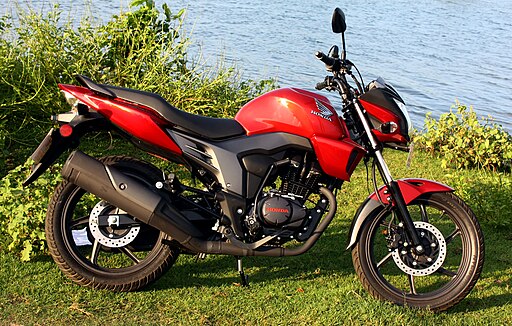
Honda CB Trigger
The Honda CB Trigger stakes its claim in the entry-level naked-bike segment by blending sporty styling, user-friendly ergonomics, and a punchy 150 cc engine. Launched in 2013 to succeed the CB Dazzler, this Indian-market favorite quickly won riders over with its smooth power delivery, frugal fuel economy, and a host of rider-friendly technologies. In this article, we’ll dive deep into its technical parameters—engine, chassis, suspension, brakes, dimensions, electronics and more—to show you exactly why the CB Trigger remains a compelling choice for new and experienced riders alike.
Design & Styling
Neo-Retro Naked Aesthetic
Honda dressed the CB Trigger in a compact “naked” form factor. The narrow, muscular tank and stubby tail contrast with a raised, LED-equipped headlamp. Sharp body creases and minimal side panels impart a modern edge, while the stubby underbelly cowl hints at its sporty intentions.
Ergonomics & Rider Triangle
– Seat height: 800 mm – Handlebar width: 740 mm – Rider triangle: Upright seating position with slightly rear-set footpegs for a balanced blend of comfort and control. This layout keeps fatigue at bay during urban commuting yet encourages a more engaged stance when carving twisty backroads.
Engine & Performance
149.1 cc Single-Cylinder Powerplant
– Configuration: Air-cooled, 4-stroke, single-cylinder, OHC – Displacement: 149.1 cc – Bore × Stroke: 57.3 mm × 57.8 mm – Compression ratio: 9.5 : 1 – Fuel system: PGM-FI electronic fuel injection – Max power: 14.1 PS @ 8 500 rpm – Max torque: 12.5 Nm @ 6 000 rpm
The compact SOHC layout keeps mechanical complexity low, while PGM-FI ensures crisp throttle response, reliable cold starts, and compliance with modern emission norms.
Idle Start-Stop System (ISS)
A standout feature in this class, Honda’s ISS automatically switches the engine off after a few seconds of idle—then restarts instantly when the clutch lever is pulled. In heavy traffic, this trims fuel consumption by up to 10%.
Transmission & Final Drive
5-Speed Gearbox
– Gear ratios: Closely spaced first through fourth for strong acceleration; a taller fifth for relaxed highway cruising. – Clutch: Cable-actuated, multi-plate wet type.
Gears slot in crisply, and the light clutch pull makes stop-and-go traffic or spirited canyon runs equally effortless.
Chain Drive
A conventional 520-series O-ring chain transmits power to the rear wheel. Easy to adjust and maintain, it strikes a good balance of durability and efficiency.
Chassis & Suspension
Diamond Frame
– Material: High-tensile steel – Wheelbase: 1 336 mm – Rake / Trail: 26° / 94 mm
Honda’s diamond frame contributes to a responsive steering feel without sacrificing mid-corner stability.
Front Suspension
– Type: 31 mm telescopic forks – Travel: 130 mm
Rear Suspension
– Type: Dual shock absorbers – Preload adjustment: 5-step preload on each side – Travel: 125 mm
This simple yet effective setup soaks up urban potholes and manages moderate B-road inclines with predictable composure.
Brakes & Wheels
Braking System
– Front: 276 mm hydraulic disc with two-piston caliper – Rear: 130 mm drum brake
A Combined Braking System (CBS) links front and rear brakes for more stable stop-control when you apply only one lever.
Wheels & Tires
– Front: 17″ alloy with 80/100-17 tire – Rear: 17″ alloy with 100/90-17 tire
The light alloy wheels paired with sticky tubeless tires deliver quick turn-in and confident cornering grip.
Dimensions & Capacities
| Parameter | Specification |
|---|---|
| Overall length | 2 035 mm |
| Overall width | 740 mm |
| Overall height | 1 065 mm |
| Seat height | 800 mm |
| Ground clearance | 165 mm |
| Wheelbase | 1 336 mm |
| Fuel tank capacity | 12 L (incl. 2 L reserve) |
| Kerb weight | 147 kg |
The compact footprint and respectable ground clearance make the CB Trigger agile in tight urban streets yet poised enough for open-road exploration.
Fuel Economy & Range
– Claimed consumption: 45–50 km/L under mixed riding – Estimated real-world range: 500–600 km per tank
High efficiency stems from the mild compression ratio and PGM-FI system, making this bike a thrifty all-rounder for daily commuters and weekend riders.
Instrumentation & Electronics
Semi-Digital Console
– Analog tachometer with redline indicator – Digital speedometer, trip meters (dual), fuel gauge, clock
Additional Features
– Engine start/stop indicator for ISS – Low-fuel warning lamp – Electric starter with back-up kick-lever (in select markets)
The straightforward dash gives all critical information at a glance, without overwhelming novice riders.
Maintenance & Ownership
Recommended Service Intervals
– Oil & filter change: every 4 000 km – Valve clearance check: every 12 000 km – Air filter cleaning: every 6 000 km (more frequently in dusty conditions) – Chain lubrication & adjustment: every 1 000 km
Ownership Highlights
– Simple engine layout: fewer parts reduce potential failure points. – Parts availability: wide network of Honda spares keeps running costs low. – Resale value: the Trigger’s reliability and brand reputation ensure strong second-hand demand.
Conclusion
The Honda CB Trigger deftly balances sporty styling, manageable performance, and everyday practicality. Its advanced features—PGM-FI, Idle Start-Stop, CBS—remain rare in the 150 cc segment, while its steel diamond frame and proven suspension geometry foster confidence in a variety of riding conditions. Whether you’re a new rider seeking a trustworthy companion or a budget-minded enthusiast craving a nimble hooligan, the CB Trigger proves that fun, frugality, and technology can harmoniously coexist in a compact naked bike.
