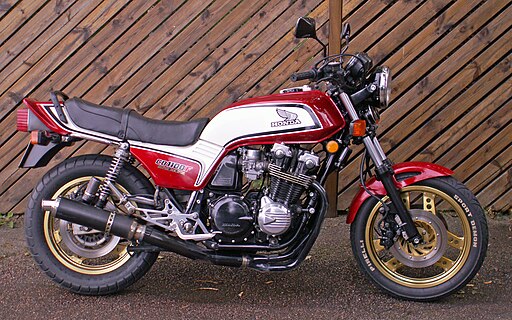
The Honda CB1100F is a classic muscle motorcycle that represents the peak of Honda’s air-cooled inline-four engineering from the early 1980s. Produced for only a short period (1983–1984 in most markets), the CB1100F was the ultimate evolution of Honda’s CB-F series, which began with the revolutionary CB750. It combined aggressive styling, advanced technology for its era, and blistering performance, earning it a legendary status among enthusiasts and collectors alike.
As the successor to the CB900F, the CB1100F was designed to deliver more power, improved handling, and sharper aesthetics. In its time, it was one of the fastest production motorcycles on the road and demonstrated Honda’s mastery of the air-cooled inline-four configuration before the industry transitioned to liquid cooling.
Engine and Performance
At the heart of the Honda CB1100F lies a robust air-cooled inline four-cylinder engine that exemplified Honda’s engineering excellence of the era. The motor was based on the CB900F’s powerplant but significantly upgraded for displacement, breathing efficiency, and overall performance.
Technical Specifications:
-
Engine type: Air-cooled, 4-stroke, DOHC, inline 4-cylinder
-
Displacement: 1,062 cc
-
Bore x Stroke: 70.0 mm x 69.0 mm
-
Compression ratio: 9.7:1
-
Maximum power: 108 hp (80 kW) at 8,500 rpm
-
Maximum torque: 94 Nm at 7,500 rpm
-
Fuel system: Four 34 mm Keihin CV carburetors
-
Ignition: Electronic CDI
-
Transmission: 5-speed constant mesh
-
Final drive: O-ring chain
The CB1100F’s engine was a masterpiece of its time. With twin overhead camshafts and four valves per cylinder, it produced smooth, linear power across the rev range. The use of larger 34 mm carburetors and improved porting contributed to stronger top-end performance compared to its predecessor.
The result was a motorcycle capable of quarter-mile times in the low 11-second range and a top speed approaching 225 km/h (140 mph), making it one of the most formidable road bikes of its generation.
Chassis and Suspension
The CB1100F’s chassis was engineered to complement its powerful engine with improved rigidity, handling, and stability. The frame was derived from the CB900F’s design but reinforced to handle the increased performance.
Chassis Specifications:
-
Frame type: Tubular steel double cradle
-
Front suspension: 37 mm air-assisted telescopic fork, 150 mm travel
-
Rear suspension: Twin Showa gas-charged shocks with adjustable preload and rebound damping, 120 mm travel
-
Front brake: Dual 276 mm discs with twin-piston calipers
-
Rear brake: Single 276 mm disc
-
Front tire: 3.50 V19
-
Rear tire: 4.50 V18
The suspension system provided a good balance between sporty handling and ride comfort, while the twin-shock setup offered tunability for different riding conditions. The braking performance was impressive for the time, thanks to Honda’s high-quality disc system on both wheels.
The CB1100F’s frame geometry and low center of gravity gave it excellent high-speed stability, a characteristic that made it a favorite among riders who enjoyed long stretches of open road and spirited cornering.
Design and Styling
The CB1100F’s design epitomizes early 1980s sportbike aesthetics—muscular, clean, and purposeful. It blended European-inspired styling with Japanese precision, resulting in a motorcycle that looked as fast as it performed.
Design Highlights:
-
Aerodynamic half-fairing (on some markets’ versions)
-
Sculpted fuel tank with knee cutouts for rider comfort
-
Flat handlebar setup for aggressive yet comfortable riding posture
-
Signature “Super Sport” graphics with bold striping
-
Polished engine cases and aluminum components
-
Compact, rectangular headlight and integrated tail section
The bike’s proportions and stance reflected a shift toward the modern “naked sportbike” design philosophy, emphasizing mechanical beauty over full fairings. The wide tank and short tail gave it a muscular, athletic appearance, while the red and blue “Super Sport” livery became instantly recognizable among enthusiasts.
Ergonomics and Comfort
Honda designed the CB1100F to be a versatile machine—comfortable enough for daily riding and touring, yet aggressive enough for performance-oriented riders. The ergonomics struck a balance between upright comfort and sportbike control.
Ergonomic Specifications:
-
Seat height: 795 mm
-
Wheelbase: 1,520 mm
-
Ground clearance: 150 mm
-
Fuel tank capacity: 22 liters
-
Dry weight: 246 kg
The wide, flat seat provided ample room for both rider and passenger, while the handlebar position allowed for natural arm placement and reduced fatigue on long rides. Combined with the broad torque curve of the engine, the CB1100F was an exceptionally capable long-distance performer for its class.
Handling and Ride Characteristics
The CB1100F was praised for its excellent handling characteristics, which combined stability, agility, and confidence-inspiring control. Despite being a large-displacement motorcycle, it responded quickly to steering input and felt composed in both fast corners and low-speed maneuvers.
The reinforced steel frame, along with quality suspension components, provided a solid foundation that minimized flex. Riders of the time often remarked on the bike’s predictability and precision compared to its competitors.
At high speeds, the CB1100F remained planted and smooth—its long wheelbase and aerodynamics contributing to remarkable straight-line stability. Even when pushed to its limits, it maintained composure, making it equally suitable for performance riding and touring.
Performance and Acceleration
When introduced, the CB1100F was among the fastest and most powerful production motorcycles in the world. Its performance figures were remarkable for an air-cooled engine, showcasing Honda’s technological leadership.
Performance Data:
-
0–100 km/h (0–62 mph): 3.2 seconds
-
Quarter-mile time: 11.1 seconds @ 122 mph
-
Top speed: Approximately 225 km/h (140 mph)
-
Fuel economy: Around 6.5 L/100 km (15–16 km/L)
These numbers made the CB1100F a genuine “superbike” of its time, capable of outperforming nearly all of its rivals, including the Kawasaki GPz1100 and Suzuki GS1100E.
Reliability and Maintenance
Like most Hondas from the era, the CB1100F was engineered with reliability and longevity in mind. Its air-cooled engine was overbuilt for durability, capable of enduring high mileage with minimal mechanical issues when properly maintained.
Recommended Maintenance Intervals:
-
Oil and filter change: Every 6,000 km
-
Valve clearance inspection: Every 12,000 km
-
Carburetor synchronization: Every 12,000 km
-
Chain lubrication: Every 1,000 km or after wet rides
-
Spark plug replacement: Every 12,000 km
Owners and restorers continue to praise the CB1100F for its build quality and ease of maintenance. Parts availability remains strong thanks to Honda’s support for classic models and an active aftermarket community.
Legacy and Collectibility
The Honda CB1100F represents the pinnacle of Honda’s air-cooled performance machines before the transition to liquid-cooled engines with the VF and later CBR series. Its combination of brute power, refined engineering, and timeless design has made it a sought-after classic.
Collectors prize the CB1100F for its rarity—particularly the 1983 model, which was produced for only one year in most regions. Restored examples are highly valued, and many enthusiasts regard it as one of the most beautifully engineered motorcycles of the early 1980s.
The CB1100F’s DNA can be traced to Honda’s later CB1100 (introduced in 2010), which paid homage to the original with retro styling and modern technology, proving the lasting influence of the Super Sport series.
Conclusion
The Honda CB1100F stands as a symbol of an era when performance, engineering, and style converged to create motorcycles that were both powerful and enduring. It embodied Honda’s philosophy of precision, balance, and quality, offering riders an unmatched blend of speed, comfort, and reliability.
With its potent air-cooled inline-four engine, strong chassis, and iconic styling, the CB1100F remains one of the finest examples of early 1980s superbikes. Decades later, it continues to be celebrated not only for its performance but also for its craftsmanship—a timeless machine that captures the essence of Honda’s golden age of motorcycling.
