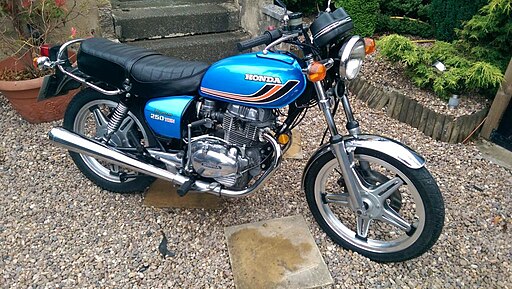
Honda CB400T
The Honda CB400T, known in North America as the Hawk and in other markets as the Dream or Twinsport, sits at the crossroads of approachable performance and everyday usability. Released in 1975, this 395 cc parallel-twin fused modern engineering with a compact package, delivering torque-rich power, agile handling, and reliable build quality. Its blend of spirited ride experience and commuter-friendly ergonomics helped cement its reputation as one of the era’s most versatile mid-size motorcycles.
Historical Context
Evolution from CB350 and CB360
Honda’s CB350 and CB360 twins captured imaginations in the late 1960s and early 1970s by offering smooth twin-cylinder engines in lightweight chassis. By mid-decade, riders craved more low-end grunt and user-friendly features. The CB400T addressed this by stretching displacement to 395 cc, adding a six-speed gearbox, and refining suspension and brakes.
Market Reception and Production
Debuting for the 1975 model year, the CB400T Hawk arrived amid growing interest in mid-size street machines. Honda produced the model through 1977, then updated it as the CB400N Hawk for 1978–1979. Total production exceeded 30,000 units worldwide, demonstrating strong demand for its blend of style, performance, and reliability.
Engine and Performance
Powerplant Architecture
The CB400T’s engine is a 395 cc air-cooled, four-stroke parallel twin configured with a single overhead camshaft operating four valves per cylinder. Its 70 mm bore and 50.6 mm stroke strike a balance between rev-happy characteristics and usable low-rpm torque.
Induction and Fuel Delivery
Fuel is metered by twin 28 mm Keihin constant-velocity carburetors. Vacuum-slide throttles ensure smooth response, while individually replaceable foam pre-filters help shield the engine from airborne contaminants.
Power and Torque Figures
- Maximum Power: 37 hp at 9,000 rpm
- Peak Torque: 3.2 kg·m at 7,500 rpm
- Top Speed: Approximately 165 km/h
- 0–100 km/h Acceleration: Around 6.8 seconds
These figures positioned the CB400T ahead of most 350 cc twins of its time, offering broad flexibility between city commuting and open-road bursts.
Transmission and Final Drive
Gearbox and Clutch
A six-speed constant-mesh transmission keeps the engine in its sweet spot, whether you’re cruising at highway speeds or carving twisty backroads. The wet multi-plate clutch delivers linear engagement, minimizing chatter as revs climb.
Chain Drive Setup
Power travels to the rear wheel through a #530 O-ring chain. Factory sprocket sizing—17 teeth front and 42 teeth rear—strikes a balance between brisk acceleration and comfortable highway gearing. A stamped-steel chain guard protects the drive from debris.
Chassis and Suspension
Frame Construction
The CB400T uses a tubular steel double-cradle frame engineered for torsional rigidity and light weight. Reinforcements at the headstock and swingarm pivot points ensure stable handling under load without unnecessary mass.
Front Suspension
A 35 mm conventional telescopic fork offers 140 mm of travel and damping tuned for a supple yet controlled ride. Preload is fixed but spring rates suit both single-rider and two-up scenarios.
Rear Suspension
Dual chrome-plated shock absorbers feature adjustable preload collars and provide 120 mm of wheel travel. Hydraulic damping prevents bottoming out under hard acceleration or heavy loads.
Brakes, Wheels, and Tires
Braking System
- Front: 276 mm hydraulic disc with single-piston caliper
- Rear: 130 mm leading-trailing drum
The front disc gives confident stopping power while the rear drum keeps weight in check and simplifies maintenance.
Wheel and Tire Setup
- Front Wheel: Spoked 19 × 1.60 in rim with 3.00-19 tire
- Rear Wheel: Spoked 18 × 2.15 in rim with 3.50-18 tire
Spoked rims absorb road vibrations and suit a range of tubed or tubeless tire conversions.
Electrical System and Instrumentation
Charging and Ignition
A 12 V electrical system powered by a 90 W alternator keeps lights bright and the maintenance-free battery charged. Point-type ignition with electronic advance ensures reliable spark timing across the rev range.
Cockpit Layout
- Speedometer: Up to 180 km/h
- Tachometer: Up to 12,000 rpm
- Indicator Lights: Neutral, high-beam, and turn signals
Ergonomic switches and clear analog gauges make at-a-glance monitoring effortless at any pace.
Ergonomics and Rider Interface
Seating and Controls
A 775 mm seat height and gently tapered saddle provide confidence for riders of various statures. Moderately swept handlebars and mid-mounted footpegs establish an upright, relaxed posture ideal for urban commuting and weekend touring alike.
Rider Comfort Features
Rubber handlebar grips and vibration-damping footpegs reduce fatigue. A compact windscreen on later Hawk models helps deflect airflow on longer journeys.
Dimensions, Weight, and Capacities
Key Measurements
| Specification | Measurement |
|---|---|
| Overall Length | 2,075 mm |
| Overall Width | 800 mm |
| Overall Height | 1,100 mm |
| Wheelbase | 1,350 mm |
| Ground Clearance | 165 mm |
| Seat Height | 775 mm |
Weight and Fuel Range
| Specification | Measurement |
|---|---|
| Dry Weight | 168 kg |
| Wet Weight | 175 kg |
| Fuel Capacity | 12 L (incl. 1.5 L reserve) |
| Theoretical Range | Up to 180 km |
A sub-180-kg wet weight makes low-speed maneuvers easy, while a 12-liter tank balances range and tank-slapping agility.
Legacy and Customization
Enthusiasts treasure the CB400T Hawk for its approachable twin-cylinder character and classic 1970s styling. Popular modifications include:
- Electronic CDI ignition kits for maintenance-free starts
- Upswept or low-mount retro exhausts to fine-tune power delivery and aesthetics
- Modern LED lighting that fits existing housings
- Tubeless-conversion rims for reliability and easier flat repair
Its combination of simplicity and tunability makes the CB400T a favorite canvas for custom builds ranging from café racers to street scramblers.
Conclusion
The Honda CB400T remains a testament to mid-1970s motorcycle engineering, offering balanced performance, rider-friendly ergonomics, and robust reliability. Whether snapped through city streets or explored on winding country roads, its torquey twin, nimble chassis, and timeless styling continue to captivate new generations of riders and collectors alike.
