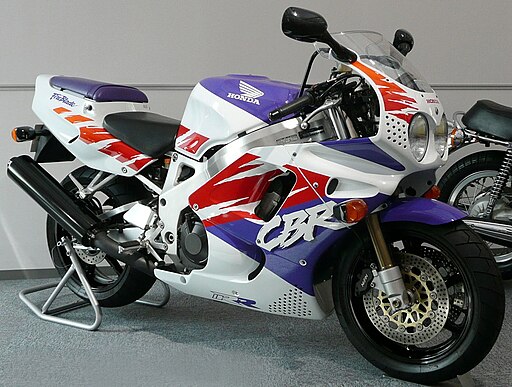
The Honda CBR900RR, also known as the Fireblade, is a legendary sportbike that revolutionized the superbike segment when it was introduced in 1992. Honda’s goal was to create a lightweight, high-performance motorcycle that could compete on the track while remaining manageable on the street. By focusing on a balance of power, agility, and handling, the CBR900RR set new standards for liter-class motorcycles and influenced sportbike design for decades.
Engine Architecture and Performance
The CBR900RR is powered by an inline four-cylinder, liquid-cooled, DOHC engine. Honda engineered it for high-revving performance with a compact and lightweight design. Early models had a displacement of 893 cc, while later versions grew to 919 cc and 954 cc depending on the generation.
Key engine specifications:
-
Displacement: 893–954 cc depending on model year
-
Configuration: Inline four-cylinder, DOHC
-
Bore x Stroke: 75 mm x 50.9 mm (first generation 893 cc)
-
Compression Ratio: 11.0:1
-
Valve Train: 16 valves
-
Fuel System: Carburetors initially, later models transitioned to electronic fuel injection
-
Ignition: Digital CDI
-
Power Output: 122–160 horsepower depending on model and year
-
Torque: 64–69 lb-ft at 8,500–9,500 rpm
The engine’s lightweight construction, combined with a short-stroke design, allows rapid revving and sharp throttle response. Titanium valves and forged pistons in later models further reduce reciprocating mass.
Transmission and Drivetrain
The CBR900RR features a six-speed constant-mesh transmission, optimized for both street and track performance. The clutch is a multi-plate wet type, providing smooth engagement and reliable durability under high-stress conditions. Gear ratios are designed to balance acceleration and top-speed capability, with later versions allowing fine-tuning for racing applications.
Chassis and Frame
Honda pioneered the use of an aluminum twin-spar frame for the CBR900RR, focusing on rigidity and light weight. The frame was narrow and compact, improving handling and allowing riders to shift weight efficiently during aggressive cornering.
Chassis specifications:
-
Frame Type: Aluminum twin-spar
-
Wheelbase: Approximately 1,405–1,410 mm
-
Rake/Trail: 24.5 degrees / 99 mm
-
Dry Weight: 185–195 kg depending on year and configuration
-
Seat Height: 800–810 mm
The compact design reduces overall mass while maintaining torsional stiffness for high-speed stability.
Suspension System
The suspension system was tuned to deliver precise feedback while remaining compliant for street use.
Front Suspension:
-
Type: Inverted telescopic fork
-
Diameter: 41 mm
-
Adjustability: Preload and damping adjustments on later models
Rear Suspension:
-
Type: Pro-Link single shock with aluminum swingarm
-
Adjustability: Preload and rebound damping
-
Travel: 120–130 mm
This setup allows riders to maintain control at high lean angles while providing comfort over uneven surfaces.
Braking Components
The CBR900RR employs high-performance braking systems to match its power output.
Front Brakes:
-
Dual hydraulic discs
-
Disc Diameter: 296 mm
-
Calipers: 4-piston radial-mount
Rear Brake:
-
Single hydraulic disc
-
Disc Diameter: 220 mm
-
Caliper: Single-piston
Brake systems evolved over the years, with later models featuring improved radial calipers and braided steel lines for enhanced performance.
Wheels and Tires
Honda equipped the Fireblade with lightweight alloy wheels to reduce unsprung mass and improve handling agility.
Wheel and tire specifications:
-
Front Wheel: 17-inch cast aluminum
-
Rear Wheel: 17-inch cast aluminum
-
Front Tire: 120/70-ZR17
-
Rear Tire: 180/55-ZR17 (later models up to 190/50-ZR17)
The tires and wheel design allow optimal traction and stability in aggressive cornering and high-speed riding.
Fuel System and Efficiency
The fuel system transitioned from carburetors to electronic fuel injection in later models to meet performance and emission standards.
-
Fuel Capacity: 18 liters
-
Fuel Delivery: 36 mm carburetors initially, later 38–42 mm throttle bodies with electronic fuel injection
-
Fuel Economy: Approximately 30–40 mpg depending on riding conditions
The system provides precise fuel metering for both low-end tractability and high-end power delivery.
Bodywork and Aerodynamics
The CBR900RR features a fully faired design optimized for aerodynamic efficiency. Honda prioritized narrow bodywork to reduce frontal area and allow the rider to move freely. The fairing design also directs airflow around the engine to assist in cooling and stability at high speeds.
-
Materials: Lightweight composite plastics
-
Features: Integrated windscreen, dual headlights, and under-seat tail section
-
Rider Ergonomics: Aggressive yet manageable sportbike posture, with slightly rear-set footpegs
Electrical System and Instrumentation
The electrical system supports modern sportbike features and reliability.
-
Battery: 12V maintenance-free
-
Lighting: Dual halogen headlamps, LED indicators in later models
-
Instrument Cluster: Analog tachometer, speedometer, temperature gauge, fuel gauge, and trip meters
-
Ignition: Digital CDI for precise spark control
Later models incorporated electronic aids such as adjustable engine mapping and traction control for enhanced performance.
Performance and Handling
The CBR900RR is praised for its exceptional power-to-weight ratio, nimble handling, and precise feedback. Its lightweight frame allows riders to accelerate, brake, and change direction with minimal effort. Cornering stability and engine response make it competitive on both track and street environments.
Model Evolution and Upgrades
The Fireblade underwent multiple upgrades throughout its production:
-
893 cc initial models (1992–1995) emphasized weight reduction and agile handling
-
919 cc models (1996–1999) featured larger displacement and refined suspension
-
954 cc models (2000–2003) incorporated fuel injection, larger brakes, and electronics for improved performance
Each generation maintained Honda’s philosophy of blending high performance with rider-friendly ergonomics.
Legacy and Influence
The CBR900RR redefined the liter-class sportbike by proving that performance could be paired with manageable weight and agile handling. Its innovations influenced not only Honda’s subsequent Fireblade models but also the design philosophy of the entire sportbike segment. It remains a benchmark for lightweight, high-performance motorcycles and is celebrated for its engineering excellence and rider-focused design.
Conclusion
The Honda CBR900RR Fireblade represents a perfect blend of power, agility, and innovation. Its lightweight aluminum frame, high-revving V4 engine, advanced suspension, and aerodynamic bodywork set new standards in sportbike engineering. With continuous development and thoughtful design, the Fireblade became a legendary model in Honda’s lineup and a symbol of what a performance-oriented yet manageable sportbike can achieve.
