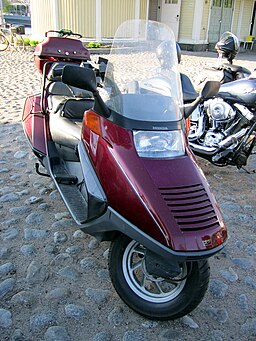
Honda CN250
The Honda CN250, often recognized by its street name Helix or Fusion depending on the market, redefined scooter cruising when it debuted in 1986. With its unique elongated frame, comfortable ergonomics, and surprisingly capable 249 cc engine, the CN250 carved out a niche between commuter scooters and touring motorcycles. Its timeless, laid-back styling and dependable engineering have earned it a dedicated following that persists decades after production ended. This article delves deep into the CN250’s design, powertrain, chassis, electronics, and operational characteristics, providing a comprehensive technical portrait of this iconic maxi-scooter.
Design and Ergonomics
Bodywork and Styling
Honda clothed the CN250 in broad, sweeping panels that emphasize its low-slung profile. The fairing extends smoothly from the handlebar yoke down to the floorboard, creating a continuous wind-cheating surface. Integrated side covers conceal the engine and transmission, while chrome accents on mirrors and trim pieces lend classic flair. A small windscreen redirects airflow over the rider’s upper body without compromising the scooter’s sleek silhouette.
Seating and Rider Comfort
The hallmark of the CN250 is its extra-long, dual-density bench seat. At 1,030 mm in length, it accommodates riders of varying heights and offers ample room for a passenger without feeling cramped. The stepped seat design provides back support under hard acceleration, while plush foam contours ensure comfort on extended rides. Floorboards span the scooter’s width, allowing subtle weight shifts and multiple foot positions to combat fatigue on longer journeys.
Powertrain and Performance
Engine Specifications
| Specification | Detail |
|---|---|
| Engine Type | 249 cc liquid-cooled SOHC 2-valve single |
| Bore × Stroke | 69 mm × 66 mm |
| Compression Ratio | 10 : 1 |
| Fuel Delivery | PGM-FI electronic fuel injection |
| Cooling System | Closed-loop coolant circuit |
| Ignition | Full transistorized |
Power Output and Delivery
The CN250’s SOHC single produces a conservative 20 PS at 7,000 rpm and 22 N·m of torque at 5,500 rpm. Its broad torque curve makes acceleration from a stop smooth and linear, perfectly matched to urban traffic conditions. Despite modest peak figures, the Helix feels brisk for its class, achieving 0–60 km/h in just under 6 seconds. High-geared final ratios allow comfortable cruising at 80–100 km/h with minimal vibration and stable fueling.
Transmission and Final Drive
Power flows through a continuously variable transmission (CVT) with a centrifugal clutch and a belt drive. The CVT’s ramp-type variator ramps up engine speed quickly in traffic, then seamlessly shifts to taller ratios at speed. This setup delivers no-shift convenience and near-silence at cruising pace. Regular belt inspections and replacements every 15,000 km ensure optimal performance and longevity.
Chassis and Suspension
Frame Construction
A steel twin-tube backbone frame undergirds the CN250, engineered for rigidity and rider comfort. The frame’s double cradle design encircles the engine, isolating vibration and contributing to torsional stiffness. Strategic bracing under the footboards maintains chassis integrity under load, whether carrying luggage or two occupants.
Front Suspension
Conventional telescopic forks with 35 mm stanchions offer 100 mm of travel. Internally, fork springs are valved for a balance between comfort and roll rigidity. The forks track straight through potholes and absorb road chatter, preventing fatigue. Rubber gaiters protect stanchions from grit and moisture, extending seal life.
Rear Suspension
A twin-shock rear suspension system provides 85 mm of rear wheel travel. Each shock features preload adjustment via external collars, accommodating rider weight or luggage. Progressive damping characteristics yield a soft initial stroke for minor bumps and firmer resistance under heavier compression, ensuring stability in corners and under braking.
Brakes, Wheels, and Tires
Braking System
Stopping power comes from a single 220 mm hydraulic disc up front, paired with a sealed mechanical drum brake at the rear. The front caliper employs dual pistons for even pad wear and consistent bite. Residents of wet climates appreciate the predictable feel and easy maintenance. Drum shoes are accessed via a simple backing plate, making adjustments straightforward.
Wheels and Tires
The CN250 rolls on 14-inch cast aluminum wheels, chosen for their light weight and corrosion resistance. Factory tire sizes are 120/90-14 front and 130/90-14 rear, tube-type constructions that deliver a cushioned ride. The generous sidewalls allow the scooter to absorb road irregularities, while the wide contact patches enhance stability at speed. Periodic balancing and correct air pressures (front 1.8 bar, rear 2.0 bar) preserve handling precision.
Electrical System and Instrumentation
Electrical Architecture
A 12 V, 8 Ah maintenance-free battery feeds the CN250’s electrical demands. A 130 W stator output and a full-wave rectifier deliver stable voltage to the ignition and lighting circuits. Standard equipment includes a halogen headlamp (35 W/35 W), wraparound rear light, and LED indicators in later model years. Wire harnesses use heat-shrunk connectors and protective sleeving to minimize corrosion and chafing.
Dashboard and Controls
The instrument cluster combines analog speedometer and fuel gauge with a digital odometer and trip meter. Warning lamps for oil pressure, low fuel, high beam, and turn signals sit adjacent to the gauge faces. A split-lever park/turn system locks the steering when parked, while handlebar-mounted switches are logically grouped for horn, indicators, lights, and starter.
Dimensions, Weight, and Capacities
| Measurement | Value |
|---|---|
| Overall Length | 2,310 mm |
| Overall Width | 830 mm |
| Overall Height | 1,405 mm |
| Wheelbase | 1,565 mm |
| Seat Height | 665 mm |
| Ground Clearance | 115 mm |
| Curb Weight | 170 kg |
| Fuel Tank Capacity | 11 L |
| Oil Capacity | 2.0 L |
These dimensions combine to produce a stable touring platform that still maneuvers easily through tight city streets. The low seat height aids riders of shorter stature and reduces concerns about setting both feet down at stops.
Fuel Economy and Range
Thanks to its efficient fuel injection and lean-burn mapping, the CN250 returns approximately 28 km/L in mixed riding. Conservative throttle use on highways can push this figure north of 32 km/L. With an 11 L tank and a 2 L reserve, riders can expect a real-world range of around 250 km between fill-ups, making it ideal for day-long jaunts or urban commuting without frequent gas station stops.
Maintenance and Reliability
Honda engineered the CN250 for longevity and ease of service. Routine maintenance items include:
- Engine oil and filter: every 4,000 km
- Valve clearance check: every 8,000 km
- CVT belt inspection: every 7,500 km
- Brake fluid change: every 2 years
- Coolant replacement: every 24 months
The accessible engine bay, with removable panels on both sides, simplifies oil changes and spark plug access. Genuine parts—filters, belts, brake shoes—remain available through Honda’s global dealer network, ensuring decades-long serviceability.
Riding Experience and Practicality
The CN250’s combination of torque-rich engine, smooth CVT, and relaxed ergonomics makes it a natural for cruising and commuting alike. Riders appreciate the scoot’s ability to maintain highway speeds with minimal noise and vibration. The capacious under-seat storage holds a full-face helmet or a small bag, while optional trunk and side-case accessories expand carrying capacity for groceries or touring gear. The low center of gravity inspires confidence, especially when navigating parking lots or slow-speed turns.
Legacy and Aftermarket Support
Though Honda ceased production in many markets by the early 2000s, the CN250’s fan base continues to thrive. Enthusiast clubs worldwide offer technical forums, parts swaps, and ride-out events. Aftermarket vendors supply performance variators, high-flow air filters, and custom exhausts to sharpen throttle response. Restoration experts reproduce original fairings and seat covers, while modern LED lighting upgrades enhance visibility and aesthetic appeal.
Conclusion
The Honda CN250 remains a landmark in scooter history—a maxi-scooter that combined motorcycle-style engineering with scooter-level convenience. Its robust engine, comfortable ergonomics, and durable chassis delivered a riding experience unmatched by smaller machines or heavier touring bikes of its era. For riders seeking a blend of practicality and laid-back performance, the CN250 continues to stand as a testament to Honda’s foresight and engineering excellence.
