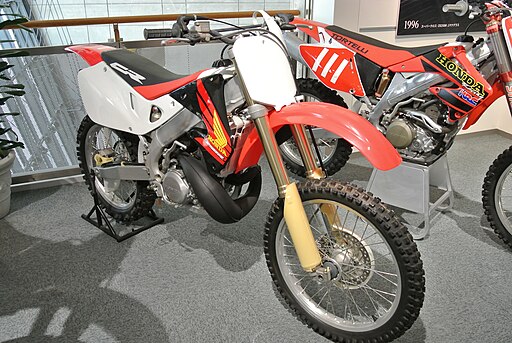
Honda CR250R
The Honda CR250R stands as a legend in two-stroke motocross history. Designed for serious off-road competition, it delivers razor-sharp handling, explosive power, and a feather-light chassis. From its debut in 1973 until its final model year in 2007, the CR250R evolved through multiple generations, each pushing performance boundaries and setting standards for race‐ready machinery. Whether wrung out at the gate drop or ridden in amateur club races, the CR250R remains an icon of agility and raw excitement.
Historical Evolution
Early Generations (1973–1982)
Honda’s entry into the 250cc motocross arena began with a bold two-stroke prototype in 1973. Early CR250 models featured steel frames, simple suspension, and punchy powerplants. As the 1970s progressed, incremental improvements to port timing, exhaust design, and chassis stiffness gave riders better acceleration, braking, and cornering feedback.
Mid-Era Advancements (1983–1994)
The mid-1980s ushered in a radical redesign. Honda introduced aluminum frames to reduce weight, inverted forks for increased front-end stiffness, and refined Exhaust Valve Actuation systems (RC valves) to broaden the powerband. By 1994, the CR250R had become a top contender in world championship events, thanks to its nimble handling and potent midrange surge.
Late-Model Sophistication (1995–2007)
From the late 1990s onward, Honda honed the CR250R with high-tech refinements: twin-shaft engine layouts to lower the center of gravity, Pro-Link rear suspension with adjustable damping, and advanced composite materials to shed grams. The introduction of cartridge-style forks and upgraded ignition systems kept the CR250R competitive until the two-stroke era’s end in 2007.
Engine and Powerplant
Two-Stroke Cylinder Design
At the core of every CR250R lies a single-cylinder, liquid-cooled, two-stroke engine. Honda’s engineers meticulously sculpted intake and exhaust port shapes to maximize high-RPM horsepower while retaining controllability. The powerplant’s ceramic-plated cylinder bore and aluminum piston keep reciprocating mass low for lightning-fast rev response.
Power Valve Technology
Honda’s Realtime Chambered exhaust Valve (RC valve) system dynamically adjusts exhaust port timing. At lower RPMs, the valve partially closes to raise exhaust pressure and enhance torque. As RPMs climb, the valve opens fully, allowing unhindered gas flow and peak horsepower above 9,000 rpm. This mechanism broadens the usable powerband, easing throttle modulation through varied track conditions.
Transmission and Clutch
A five-speed constant-mesh gearbox transfers power to the rear wheel. Close-ratio gearing optimizes acceleration out of corners and top‐end speed on straights. A multi-plate wet clutch, featuring high‐friction plates and a robust diaphragm spring, resists fade under repeated slip during launches and tight technical sections.
Chassis and Suspension
Aluminum Twin-Spar Frame
Modern CR250Rs employ an aluminum twin-spar frame engineered for precise flex characteristics. The front section provides torsional rigidity for accurate steering, while the rear spars allow controlled flex to absorb landings. The frame’s narrow profile enhances rider movement from side to side, crucial during aggressive cornering.
Pro-Link Rear Suspension
Honda’s Pro-Link system pairs a rising-rate single shock with an aluminum swingarm. Adjustable preload, compression, and rebound damping let riders dial in rear grip and bump compliance. Progressive leverage ratios help the rear end resist bottoming under big jumps.
Front Forks
High-performance models use inverted telescopic forks with spring preload adjusters and separate damping circuits. The cartridge-style design delivers consistent damping feel, reducing fade during long motos and heat buildup under repeated impacts.
Braking System and Wheels
Front and Rear Brakes
The CR250R’s stopping power comes from wave-form disc rotors mounted to lightweight hubs. The front caliper employs dual pistons for strong initial bite and linear feel, while the rear single-piston caliper balances trail braking control. Brake pad materials and rotor sizes evolved through the generations, culminating in high-temp-resistant discs that maintain consistent performance.
Wheel and Tire Configuration
Mounted on sturdy aluminum rims, the CR250R uses 21-inch front and 19-inch rear wheels. Spoke tension and rim profiles are engineered to withstand harsh impacts without compromising weight. Aggressive knobby tires, selected by individual riders, provide grip in loose, wet, or hard-packed terrain.
Performance Characteristics
Power Delivery and Handling
The CR250R’s two-stroke engine unleashes a sudden surge in the mid-to-high RPM range. Skilled riders exploit the explosive acceleration out of corner exits, while careful clutch work keeps traction under control. The lightweight chassis, combined with a low center of gravity, enables rapid direction changes and precise line selection.
Top Speed and Acceleration
With correct gear ratios and an unobstructed track, the CR250R can reach speeds up to 135 km/h (84 mph). Acceleration from standstill to gate-speed is blistering, and the narrow powerband challenges riders to maintain momentum through smooth cornering and timely gear shifts.
Electrical and Lubrication
CDI Ignition
A compact Capacitor Discharge Ignition unit provides consistent spark timing across the RPM range. CDI technology enables rapid voltage buildup for strong sparks at high engine speeds and reduces maintenance compared to mechanical advance systems.
Oil Injection and Mixing
Later CR250R models feature Honda’s dual‐oil injection system, automatically metering both crankcase and premix oil to the cylinder. This ensures optimal lubrication under high stress while minimizing excessive smoke and reducing oil consumption.
Maintenance and Service
Routine Maintenance Schedule
- Air Filter Cleaning: after every ride in dusty conditions
- Engine Oil Check and Gearbox Oil Change: every 5 hours of riding
- Spark Plug Inspection: every 10 hours
- RC Valve Servicing: every 20 hours to ensure smooth operation
- Wheel Bearing and Swingarm Inspection: every 10 hours
Rebuild Considerations
Two-stroke engines demand periodic top-end rebuilds. Factors such as piston ring wear, cylinder scoring, and crankshaft bearing play critical roles in restoring peak performance. Seasoned racers often replace pistons and rings every two to three race weekends to maintain consistent power.
Technical Specifications
| Specification | Detail |
|---|---|
| Engine Displacement | 249.4 cc |
| Engine Type | Liquid-cooled, two-stroke, single-cylinder |
| Bore × Stroke | 66.4 mm × 72 mm |
| Compression Ratio | 8.5 : 1 |
| Valvetrain | Realtime Chambered exhaust Valve (RC valve) |
| Carburetion | Mikuni TMX 38 mm (or Keihin PJ 38) |
| Ignition | CDI |
| Transmission | 5-speed constant mesh |
| Clutch | Wet multi-plate, hydraulic actuation |
| Frame | Aluminum twin-spar |
| Front Suspension | Inverted fork, spring preload, compression and rebound adjusters |
| Rear Suspension | Pro-Link single shock, preload, compression and rebound adjusters |
| Front Brake | 260 mm wave disc, dual-piston caliper |
| Rear Brake | 240 mm wave disc, single-piston caliper |
| Front Wheel | 21 in aluminum rim |
| Rear Wheel | 19 in aluminum rim |
| Seat Height | 945 mm |
| Wheelbase | 1,485 mm |
| Dry Weight | 97 kg |
| Fuel Capacity | 8.5 L |
| Top Speed | ~135 km/h |
Legacy and Impact
The Honda CR250R shaped an entire generation of motocross standards. Its pioneering use of aluminum frames and power-valve technology influenced competitors across the paddock. Even after two‐stroke rules faded from world championship series, riders continued to race CR250Rs in classic and club events, celebrating the unfiltered connection between throttle, chassis, and ground. The CR250R’s DNA lives on in modern four-stroke machines, but its distinct character remains unmatched—a pure expression of two-stroke motocross adrenaline.
