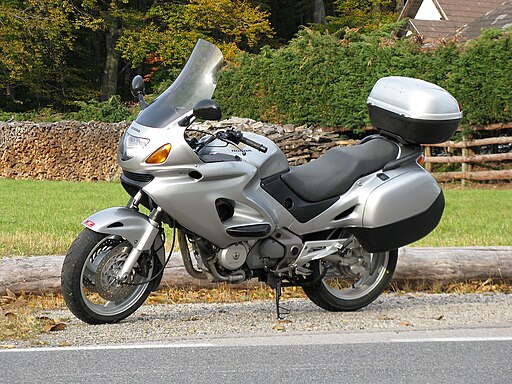
Honda Deauville
The Honda Deauville carved out a unique niche as a middleweight sport-touring motorcycle, combining compact packaging, integrated luggage and relaxed ergonomics for riders seeking all-round versatility. Launched in 1998 as the NT650V Deauville, it evolved into the NT700V Deauville in 2006, refining engine performance, chassis dynamics and onboard amenities to meet changing touring demands.
Historical Evolution
First Generation NT650V (1998–2005)
Honda debuted the NT650V Deauville in 1998 as the first production motorcycle with built-in side panniers. Based on the tried-and-tested NTV650 powerplant, its liquid-cooled 52° V-twin SOHC engine displaced 647 cc, delivered smooth torque and met emission standards with a catalytic converter update in 2002. The chassis combined a tubular steel frame, Pro-Link monoshock and telescopic fork into a user-friendly package that excelled on daily commutes and weekend jaunts.
Second Generation NT700V (2006–2013)
In 2006 Honda increased displacement to 680 cc, fitted a DOHC head with four valves per cylinder and upgraded fuel delivery to PGM-FI electronic injection. The NT700V retained shaft final drive, dual 296 mm front discs and the integrated panniers but added a lower seat height, ABS option and refined styling to modernize its appeal for long-distance riding.
Engine and Powertrain
Liquid-cooled V-twin Design
Both generations employ a 52° V-twin layout for inherent smoothness. The NT650V’s SOHC head with three valves per cylinder emphasizes tractable midrange power, while the NT700V’s DOHC four-valve configuration broadens the rev ceiling and sharpens throttle response.
Induction and Ignition
The original model uses two 36 mm flat-slide carburetors, whereas the 700 series relies on PGM-FI electronic injection for precise fueling and cleaner emissions. A digital transistorized ignition with electronic advance ensures reliable starting and consistent spark timing in all conditions.
Transmission and Final Drive
A five-speed gearbox channels torque through a durable shaft drive. This arrangement virtually eliminates rear wheel maintenance and underscored the Deauville’s touring credentials by providing smooth, quiet power delivery and extended service intervals.
Chassis, Suspension and Brakes
The Deauville’s tubular steel double-cradle frame balances rigidity with compliance. Up front, a 41 mm telescopic fork offers 115 mm of travel; at the rear, a Pro-Link monoshock with adjustable preload delivers 120 mm of wheel travel and plush comfort under load. Braking is handled by twin 296 mm front discs—two-piston calipers on the NT650V and three-piston units on the NT700V—paired with a single 276 mm rear disc and one- or two-piston caliper respectively, delivering predictable stopping power across varying road conditions.
Dimensions, Weight and Performance
The NT650V measures 1 473 mm between axles with an 814 mm seat height and dry weight of 223 kg. Peak output is 40.9 kW at 7 897 rpm and 56.9 Nm at 6 053 rpm, yielding a top speed around 170 km/h and standing quarter-mile in 14.4 seconds. The NT700V stretches the wheelbase to 1 476 mm, lowers seat height to 805 mm, and tips the scales at 236 kg (dry). Its increased 51 kW horsepower at 8 000 rpm and 66.2 Nm at 6 500 rpm boost top speed to approximately 185 km/h and knock the quarter-mile down to 14.0 seconds.
Fuel Capacity and Economy
Both variants carry 19.5 litres of fuel. The NT650V averages around 5.8 L/100 km in mixed riding, while the NT700V holds a slight edge thanks to fuel injection, hovering near 5 L/100 km even under spirited use.
Rider Ergonomics and Features
An upright riding position, swept handlebar and forward footpeg placement create a relaxed posture ideal for all-day comfort. Integrated hard panniers carry 23 L each in the original model and 26 L each on later versions, while an optional top box expands load capacity. Standard twin seats accommodate riders and pillions with ample padding and passenger grab handles for security.
Maintenance and Reliability
Honda’s reputation for bullet-proof V-twin engines shines in the Deauville. Valve clearance checks every 24 000 km and oil changes every 6 000 km keep both engines running smoothly. Shaft drive lubrication intervals of 24 000 km and occasional brake pad and tire replacements are the bulk of routine upkeep, making the Deauville a low-hassle choice for touring fleets and private owners alike.
Technical Specifications Comparison
| Parameter | NT650V Deauville (2002–03) | NT700V Deauville (2006–07) |
|---|---|---|
| Engine type | Liquid-cooled 52° V-twin; SOHC; 3v/cyl | Liquid-cooled 52° V-twin; DOHC; 4v/cyl |
| Displacement | 647 cc | 680 cc |
| Bore × Stroke | 79 × 66 mm | 81 × 66 mm |
| Compression Ratio | 9.2 : 1 | 10.0 : 1 |
| Induction | 2 × 36 mm flat-slide carburetors | PGM-FI electronic injection |
| Ignition | Digital transistorized | Digital transistorized |
| Max Power | 40.9 kW @ 7 897 rpm | 38.3 kW @ 8 000 rpm |
| Max Torque | 56.9 Nm @ 6 053 rpm | 66.2 Nm @ 6 500 rpm |
| Transmission | 5-speed manual | 5-speed manual |
| Final Drive | Shaft | Shaft |
| Front Suspension | 41 mm telescopic fork; 115 mm travel | 41 mm telescopic fork; 115 mm travel |
| Rear Suspension | Pro-Link monoshock; adjustable preload; 120 mm travel | Single damper; adjustable preload; 120 mm travel |
| Front Brakes | 2 × 296 mm discs; 2-piston calipers | 2 × 296 mm discs; 3-piston calipers |
| Rear Brakes | Single 276 mm disc; 1-piston caliper | Single 276 mm disc; 2-piston caliper |
| Wheelbase | 1 473 mm | 1 476 mm |
| Seat Height | 814 mm | 805 mm |
| Dry Weight | 223 kg | 236 kg |
| Wet Weight | 249 kg | 239 kg |
| Fuel Capacity | 19.5 L | 19.5 L |
| Top Speed | 170 km/h | 185 km/h |
