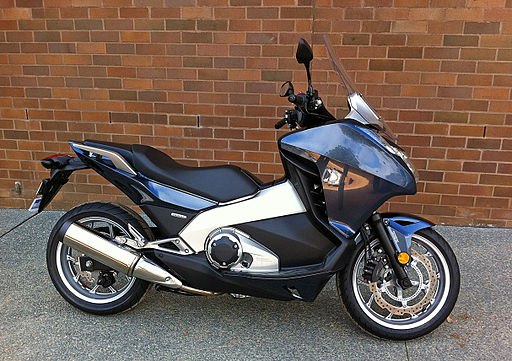
Honda NC700D Integra
The Honda NC700D Integra is a hybrid crossover that blends motorcycle dynamics with maxi-scooter convenience, built around a compact, torquey parallel-twin, a six-speed Dual Clutch Transmission (DCT), and motorcycle-style chassis geometry. The Integra was engineered to deliver commuter ease, strong fuel economy, and approachable long-distance capability while offering a distinctive packaging solution that places the fuel tank beneath the seat to lower the center of gravity and create usable under-seat storage.
Powertrain
Engine architecture and characteristics
The Integra uses a 670 cc liquid-cooled parallel-twin with SOHC and four valves per cylinder, designed for low-revving, tractable torque rather than high-rpm power. The short-bore, long-stroke layout (73 mm × 80 mm) and a compression ratio of 10.7:1 yield strong midrange torque and smooth throttle response well suited to urban riding and steady highway cruising. The engine features a 270° crankshaft that produces an uneven firing order and V-twin-like character while maintaining compact packaging and reduced vibration.
Power and torque
The standard output is rated at 38.1 kW (51.1 hp) at 6,250 rpm with peak torque of 62 N·m at 4,750 rpm. The tuning emphasizes usable pull from idle through the midrange, enabling relaxed acceleration from town speeds and confident overtakes on the open road without requiring constant gear changes.
Induction, fueling and ignition
Fuel is delivered by an advanced PGM-FI electronic fuel injection system tuned to prioritize fuel economy and throttle smoothness. Ignition is computer-controlled digital transistorized with electronic advance, and engine internals include measures to reduce friction—offset cylinders and optimized balance shaft drive—that improve efficiency and durability.
Dual Clutch Transmission (DCT)
The Integra’s six-speed Dual Clutch Transmission (DCT) offers three operating modes: fully automatic Drive (D), sportier automatic Sport (S), and Manual (M) selectable via handlebar controls. DCT uses two parallel clutch packs to preselect gears and provide lightning-fast, seamless shifts in automatic modes while allowing clutchless, sequential manual control when the rider prefers direct engagement. The DCT’s adaptive logic responds to throttle inputs, load and road gradient for intuitive operation across commuting and touring scenarios.
Final drive
Power is transferred to the rear wheel via a conventional chain final drive, combining compactness, mechanical efficiency and easy routine maintenance for owners who prefer to service drive components themselves.
Chassis, suspension and geometry
Frame and overall packaging
The Integra uses a rigid tube steel diamond frame engineered to deliver predictable handling, torsional stiffness for highway stability and a forgiving ride for everyday use. The under-seat fuel tank lowers the center of gravity and frees a practical under-seat compartment that improves daily usability without compromising chassis balance.
Steering geometry and wheelbase
Steering geometry balances stability and agility with an approximate rake of 27° and a trail near 110 mm. Wheelbase is 1,525 mm, creating a stable platform at speed while retaining manageable turning characteristics for urban manoeuvres.
Suspension setup
Front suspension uses a 41 mm telescopic fork with around 120 mm of travel, tuned for controlled dive under braking and compliance over urban imperfections. The rear uses a Pro-Link single monoshock with progressive leverage and roughly 120 mm of travel, adjustable for preload to accommodate rider weight and luggage. The suspension package prioritizes comfort and composure under two-up loads while maintaining traction and steering precision.
Wheels, tires and brakes
Wheels and tyre sizes
The Integra rides on 17-inch die-cast alloy wheels with road-focused tyre sizes: 120/70-ZR17 up front and 160/60-ZR17 at the rear. This tyre and wheel combination optimizes pavement grip, stability, and confident cornering for a commuter/tourer leaning more toward asphalt than off-road use.
Braking and safety systems
Stopping power comes from a single 320 mm front wavy disc gripped by a multi-piston caliper and a 240 mm rear wavy disc with a single-piston caliper. Combined ABS is fitted as standard to manage distribution of braking force between front and rear and to minimize wheel lock on slippery surfaces. Brake pad compounds and hydraulic sizing are selected to deliver good initial bite, consistent fade resistance, and predictable modulation for both city and highway braking demands.
Dimensions, capacities and performance
Key dimensions and weights
- Wheelbase: 1,525 mm.
- Overall length: ~2,195 mm.
- Overall width: ~790 mm.
- Overall height: ~1,440 mm.
- Seat height: ~790 mm (market dependent).
- Ground clearance: Balanced for urban obstacles and mild touring roads.
- Wet/curb weight: Approximately 238 kg depending on market and fitment.
Fuel capacity and range
The Integra carries approximately 14.1 litres of fuel beneath the seat. Combined with the model’s efficient midrange tuning and conservative consumption figures, real-world fuel consumption commonly falls in the low 3–4 L/100 km range, yielding a practical touring range suitable for daily commuting and medium-distance trips.
Performance characteristics
The combination of a torque-rich twin and DCT yields brisk in-gear acceleration and smooth, linear power delivery. Real-world 0–100 km/h performance is competitive for the segment, while top speed figures place the Integra well within safe highway cruising margins. The low center of gravity and balanced chassis give the bike confidence-inspiring stability in bends and calm behaviour in crosswinds.
Ergonomics, instrumentation and practical features
Rider ergonomics
The riding position is upright and relaxed with a forward-neutral footpeg placement and a wide, comfortable seat that supports urban stop-start traffic and long stints on the motorway. The under-seat storage compartment offers practical space for a helmet or daily items; the fuel-under-seat layout contributes to a low, planted feel when cornering or changing direction.
Cockpit and instruments
Instrumentry blends analogue and digital elements or a full digital layout depending on model year and trim, displaying speed, gear position (on DCT models), fuel level, trip meters, and basic vehicle diagnostics. Controls for DCT mode selection and manual shift buttons are ergonomically placed on the left and right switchgear for quick access without compromising rider focus.
Electrical and accessory readiness
The charging system is sized to support factory accessories and common rider add-ons such as heated grips, auxiliary lighting and phone chargers. Wiring and mounting points are accessible for aftermarket luggage, top cases and touring screens, enabling owners to tailor the Integra for longer journeys.
Maintenance, reliability and ownership considerations
Routine service items
The Integra’s liquid-cooled parallel-twin is designed for predictable service intervals: regular oil and filter changes, valve clearance inspections at specified intervals, and standard checks for spark plugs and air filter condition. The DCT is engineered for long service life with scheduled fluid changes; its sealed clutches and mechatronic unit require less frequent adjustment than a conventional manual clutch but benefit from strict adherence to service intervals.
Practical ownership advantages
- Strong fuel economy lowers running costs for commuters and touring riders.
- DCT provides an exceptionally low-effort ride in urban traffic and allows manual engagement for more spirited riding.
- Under-seat storage and low centre of gravity improve day-to-day usability and handling feel.
- Wide aftermarket support for luggage, comfort and protection accessories simplifies configuration for long-distance touring.
Common owner upgrades
- Windscreens and touring screens for improved highway comfort.
- Suspension revalving or spring upgrades for heavier riders or fully laden two-up touring.
- Luggage systems and top boxes to expand carrying capacity beyond under-seat volume.
- Sport or comfort seat replacements for long-distance ergonomics.
Detailed technical summary
- Engine type: Liquid-cooled parallel twin, SOHC, 4 valves per cylinder.
- Displacement: 670 cc.
- Bore × stroke: 73 mm × 80 mm.
- Compression ratio: 10.7:1.
- Fuel system: PGM-FI electronic fuel injection.
- Ignition: Computer-controlled digital transistorised with electronic advance.
- Power: 38.1 kW (51.1 hp) @ 6,250 rpm.
- Torque: 62 N·m @ 4,750 rpm.
- Transmission: 6-speed Dual Clutch Transmission (DCT) with Drive, Sport and Manual modes.
- Final drive: Chain.
- Frame: Rigid tube steel diamond frame.
- Front suspension: 41 mm telescopic fork, ~120 mm travel.
- Rear suspension: Pro-Link single monoshock, preload adjustable, ~120 mm travel.
- Front brake: Single 320 mm wavy disc with multi-piston caliper.
- Rear brake: Single 240 mm wavy disc with single-piston caliper.
- ABS: Combined two-channel ABS as standard.
- Wheels/tyres: 17 in alloy wheels; 120/70-ZR17 front, 160/60-ZR17 rear.
- Fuel capacity: 14.1 litres.
- Seat height: ~790 mm.
- Wheelbase: 1,525 mm.
- Wet weight: ~238 kg (market dependent).
Conclusion
The Honda NC700D Integra is a pragmatic, well-engineered solution for riders who want the ease of an automatic and the dynamic character of a motorcycle in one package. Its torque-focused engine, user-friendly DCT, low center of gravity and practical under-seat storage make it an excellent choice for daily commuting, occasional touring and riders seeking low operating costs without sacrificing rider engagement. The Integra’s balanced chassis, conservative suspension tuning and robust braking system create a comfortable, confidence-inspiring platform that adapts readily to accessory upgrades for longer trips or heavier loads.
