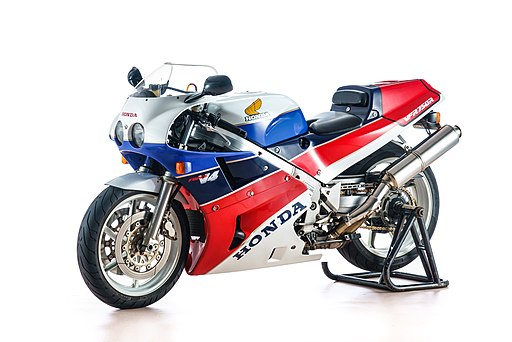
Honda VFR750R
The Honda VFR750R, commonly known by its chassis code RC30, is a limited-production homologation special engineered by Honda Racing Corporation (HRC) between 1987 and 1990. Designed to dominate World Superbike racing while remaining street-legal, the RC30 fused race-derived V4 power with ultralight aluminum monocoque chassis components and cutting-edge suspension. Only 3,000 units were built worldwide, making it one of the most coveted sport bikes of its era.
Engine and Drivetrain
Engine Architecture and Displacement
At its heart sits a 748 cc liquid-cooled 90° V4 featuring gear-driven double overhead camshafts and four valves per cylinder. This compact, high-revving layout delivers a unique firing pulse and broad powerband ideal for high-speed corner exit and track performance.
Bore, Stroke and Compression
The RC30’s cylinders are bored to 70.0 mm with a short 48.6 mm stroke. A relatively high 11.0 : 1 compression ratio balances peak output with reliability under race conditions.
Induction and Ignition System
Fuel flows through four 38 mm downdraft Keihin CV carburetors equipped with manual chokes for precise throttle response. Digital CDI ignition ensures consistent spark timing at all engine speeds, supporting rapid rev-up to its 12,500 rpm redline.
Transmission and Final Drive
Power is delivered through a close-ratio six-speed gearbox optimized for quick shifts under load. A lightweight slipper clutch on the outer plates mitigates rear-wheel hop during aggressive downshifts. Final drive is by chain, selected for minimal drivetrain losses and ease of ratio changes for track setups.
Performance and Power Delivery
Peak power is rated at 118 hp (88 kW) at 11,000 rpm in unrestricted trim, with torque peaking around 71 Nm at 9,000 rpm. Restricted Japanese models produce approximately 75.9 hp (56.6 kW) at 9,500 rpm. The dry weight hovers near 180 kg, yielding an exceptional power-to-weight ratio and top speeds approaching 246 km/h (153 mph).
Chassis and Frame
Frame Design and Geometry
The RC30 pioneered an aluminum twin-spar “monotruss” frame featuring cast headstock and swingarm pivot sections joined by extruded backbone rails. This design delivers superb torsional rigidity and precise feedback at high lean angles. Steering geometry—24° rake with 91 mm trail—strikes a balance between cornering agility and high-speed stability.
Suspension Setup
Front suspension uses 43 mm inverted Showa USD forks with adjustable preload, compression, and rebound damping, 110 mm travel. Rear employs a Pro-Arm single-sided swingarm with Pro Squat linkage, mono-shock adjustable for preload, compression and rebound, offering 130 mm of travel. This fully adjustable package provides razor-sharp turn-in and consistent feedback on track surfaces.
Wheels, Tires, and Braking
Wheel and Tyre Sizes
Cast aluminum wheels measure 17 inches front and rear. Standard tyre fitment is 120/70-17 up front and 170/60-18 at the rear, providing a wide contact patch for cornering loads and braking forces.
Brake System
Stopping power comes from dual 310 mm front discs gripped by two-piston calipers and a single 220 mm rear disc with a two-piston caliper. Brake pad compounds and hydraulic sizing were development-grade for fade resistance under race conditions, and ABS was intentionally omitted to save weight.
Dimensions, Weight, and Capacities
Physical Dimensions and Ergonomics
- Wheelbase: 1,410 mm
- Overall length: 2,045 mm; width: 700 mm; height: 1,100 mm
- Seat height: 785 mm off the ground for confident rider reach
- Ground clearance: 130 mm to prevent peg strikes on steep lean angles
Mass and Fuel Capacity
Dry weight: approximately 180 kg; wet curb weight around 206–221 kg depending on market fittings and fuel load. Fuel tank holds 18–20 litres, balancing track endurance with minimal mass high on the frame.
Electronics and Instrumentation
Instrumentation blends analog tachometer with a digital speedometer/odometer and displays for clock, gear position, coolant temperature, and oil pressure. The minimal wiring harness and absence of electronic rider aids reinforce the RC30’s purebred race orientation.
Maintenance and Ownership
Service Requirements
Routine maintenance includes valve clearance inspections at 12,000 km intervals, carburetor synchronization, and gear-drive timing checks. The RC30’s gear-driven cams eliminate timing chain adjustments, while hydraulic lifters (where equipped) reduce lash checks.
Parts Availability and Modifications
Although production was limited, aftermarket support remains strong among vintage sport-bike specialists. Common upgrades include modern brake pads, adjustable rearsets, billet foot controls, and ECU tuning to unlock full power on unrestricted models.
Specification Summary
| Parameter | Specification |
|---|---|
| Engine | 748 cc 90° V4 liquid-cooled, DOHC, 4 v/cyl |
| Bore × Stroke | 70.0 mm × 48.6 mm |
| Compression Ratio | 11.0 : 1 |
| Carburetion | 4 × 38 mm Keihin CV |
| Ignition | CDI digital |
| Transmission | 6-speed close-ratio; slipper clutch |
| Final Drive | Chain |
| Frame | Aluminum monotruss twin spar |
| Front Suspension | 43 mm USD Showa forks; adj. preload, comp., rebound; 110 mm travel |
| Rear Suspension | Pro-Arm single-sided swingarm; adj. preload, comp., rebound; 130 mm |
| Front Brakes | 2 × 310 mm discs, 2-piston calipers |
| Rear Brake | 220 mm disc, 2-piston caliper |
| Wheels/Tires | 17 in cast; 120/70-17 front; 170/60-18 rear |
| Wheelbase | 1,410 mm |
| Rake/Trail | 24° / 91 mm |
| Seat Height | 785 mm |
| Dry/Wet Weight | ~180 kg / 206–221 kg |
| Fuel Capacity | 18–20 litres |
| Top Speed | ~246 km/h (153 mph) |
Conclusion
The Honda VFR750R RC30 remains a milestone in sport-bike engineering, showcasing HRC’s dedication to bringing race-winning technology to the road. Its lightweight aluminum monocoque-style chassis, race-derived V4 engine, and fully adjustable suspension set a new benchmark for handling and performance. Today, the RC30’s rarity and proven track heritage make it one of the most sought-after classics among enthusiasts.
