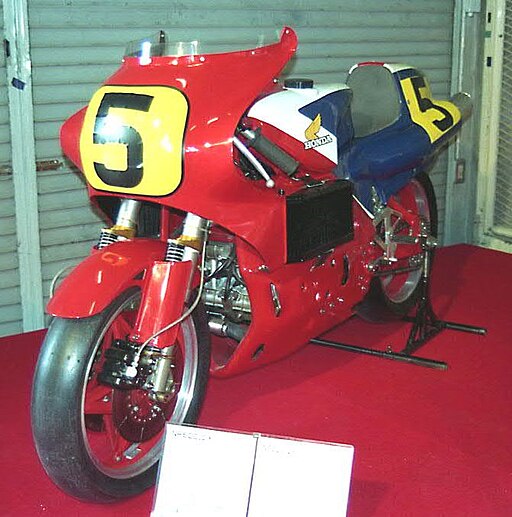
The Honda NR500 stands as one of the most technically ambitious racing motorcycles ever developed, created with the singular objective of challenging and redefining the limits of Grand Prix motorcycle engineering. Conceived during an era dominated by two-stroke racing machines, the NR500 was Honda’s bold attempt to prove that a four-stroke design could achieve equal or superior performance at the highest level of competition. This philosophy led to a radical departure from conventional engine design and mechanical architecture, resulting in a machine that prioritized innovation over evolutionary refinement. Every component of the NR500 was designed around the pursuit of higher rotational speeds, improved volumetric efficiency, and reduced mechanical losses, making it a technological showcase rather than a traditional racing motorcycle.
Engine Architecture and Oval Piston Design
At the heart of the Honda NR500 lies its most defining feature, a liquid-cooled 500 cc V4 engine employing an unprecedented oval piston configuration. Instead of utilizing standard circular pistons, Honda engineered elongated oval pistons to emulate the surface area of two pistons within a single cylinder, effectively creating the equivalent of an eight-cylinder engine within a four-cylinder layout. Each cylinder featured eight valves and two connecting rods per piston, allowing for superior airflow and higher engine speeds compared to traditional designs. This complex configuration enabled extremely high RPM potential, which was critical for competing with the power output of contemporary two-stroke rivals. The result was an engine capable of producing high peak power while maintaining the mechanical robustness inherent to four-stroke operation.
Valvetrain and Combustion Efficiency
The NR500 engine employed a dual overhead camshaft system meticulously designed to operate the multiple valves per cylinder with precise timing and control. The extensive valvetrain complexity improved breathing efficiency, allowing optimized fuel and air mixture flow into the combustion chamber and effective evacuation of exhaust gases. This resulted in improved combustion stability at extremely high engine speeds, which was essential for sustained racing performance. The precise coordination of valve timing and fuel injection allowed the NR500 to achieve a highly controlled power curve, though it demanded exceptional maintenance and tuning expertise due to its advanced and tightly packed mechanical layout.
Crankshaft, Lubrication, and Internal Dynamics
The internal dynamics of the NR500 were engineered to manage the enormous stresses associated with high rotational speeds and unique piston movement. The crankshaft was designed to balance the forces generated by the oval pistons and dual connecting rods, minimizing vibration and mechanical fatigue. A sophisticated dry-sump lubrication system ensured consistent oil delivery under extreme acceleration, lean angles, and braking forces, maintaining reliability during high-performance operation. The entire engine assembly was built with lightweight, high-strength materials to withstand the intense thermal and mechanical loads experienced during Grand Prix racing.
Transmission and Power Transfer System
The NR500 featured a multi-plate wet clutch paired with a close-ratio transmission optimized for racing application. Gear ratios were designed to keep the engine within its narrow but potent power band, allowing precise acceleration control on varying circuit layouts. The transmission system emphasized smooth yet rapid gear engagement to minimize power interruption during shifts. Power transfer to the rear wheel was achieved via a lightweight chain drive system, chosen for its efficiency and ability to handle the significant torque output generated by the high-revving engine.
Chassis Construction and Structural Design
The frame of the Honda NR500 represented another technological leap, utilizing a monocoque construction instead of a traditional tubular frame. This design integrated the fuel tank and structural elements into a single unified shell, reducing overall weight while increasing rigidity and aerodynamic efficiency. The monocoque structure contributed to improved mass centralization and minimized flex under heavy load conditions. This configuration also allowed the engine to act as a stressed member, further enhancing the structural integrity and responsiveness of the chassis during aggressive racing maneuvers.
Suspension and Handling Characteristics
The NR500 was equipped with a sophisticated suspension system tailored for high-speed circuit performance. The front end utilized telescopic forks with race-tuned damping to maintain stability under heavy braking and corner entry conditions. At the rear, a high-performance shock absorber system provided controlled rebound and compression characteristics, enabling consistent traction and precise feedback through high-speed corners. The overall geometry was designed to deliver a balance between agility and high-speed stability, allowing the motorcycle to maintain composure during rapid direction changes and sustained cornering loads.
Braking System and Performance Control
High-performance disc brakes were installed at both the front and rear, engineered to provide powerful and predictable stopping force in racing environments. The brake components were selected to endure extreme heat buildup without significant fade, ensuring consistent performance throughout prolonged race sessions. The braking system was calibrated to deliver progressive modulation, allowing riders to maintain precise control when approaching corners at high speed and during sudden deceleration scenarios.
Aerodynamics and Bodywork Engineering
The bodywork of the NR500 was designed with a strong focus on reducing aerodynamic drag and improving high-speed stability. The streamlined fairing and narrow profile minimized air resistance while directing airflow efficiently around the rider and mechanical components. Careful shaping of the fairing helped enhance cooling performance and reduce turbulence, which was critical for maintaining consistent engine temperature and aerodynamic balance during intense racing conditions.
Operational Challenges and Competitive Legacy
While the Honda NR500 was a masterpiece of engineering innovation, its advanced complexity presented significant operational challenges. The intricate engine design required precise maintenance, meticulous tuning, and constant engineering refinement to remain competitive against more established two-stroke platforms. Despite its mixed success in racing results, the NR500 left an enduring legacy by pushing the boundaries of what was technically possible in motorcycle design. It demonstrated Honda’s commitment to innovation and engineering excellence, influencing future developments in high-performance four-stroke racing technology and reinforcing its position as a pioneer in motorsport engineering.
Overall Significance and Technical Impact
The Honda NR500 stands as a landmark achievement in the history of motorcycle engineering, representing a bold exploration into unconventional design solutions. Its oval piston engine, monocoque chassis, and advanced mechanical systems showcased a forward-thinking approach that challenged conventional assumptions about racing performance. Although it was ultimately outpaced by simpler and more practical designs, the NR500 remains a symbol of technical daring and creative ingenuity, illustrating the pursuit of performance beyond traditional engineering boundaries.
