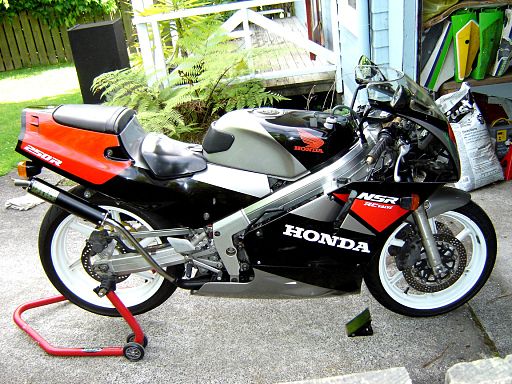
Honda NSR250R
The Honda NSR250R emerged in 1987 as a street-legal embodiment of Grand Prix two-stroke technology. Over three generations (MC16, MC18, MC21, MC28), Honda refined its compact, high-revving V-twin engine and razor-sharp chassis to deliver a true race replica for the road. Lightweight, potent, and fiercely agile, the NSR250R became the benchmark 250 cc sportbike of its era. This in-depth article explores every facet of the NSR250R—from engine internals and exhaust innovation to chassis geometry, electronics, and real-world performance.
Engine and Performance
Engine Architecture
The heart of the NSR250R is a liquid-cooled, two-stroke 90° V-twin displacing 249 cc. Each cylinder measures 54 mm in bore and 54.5 mm in stroke, yielding a near-square layout that balances torque and top-end power. Honda’s rotary induction system, coupled with reed valves per cylinder, maximizes midrange tractability and throttle response.
Key engine features:
- 90° V-twin crankshaft for primary balance
- Dual Mikuni carburetors (28 mm to 34 mm across generations)
- Automatic RC (Revolutionary Controlled) power valve to broaden the torque curve
- Liquid cooling with stainless steel water jacket and high-flow radiators
Power Delivery and Exhaust System
Peak output hovers around 45 PS (44 hp) at 11,000 rpm, thanks to precise port timing and the RC valve’s expansion-chamber optimization. Exhaust gases travel through two tuned pipes into a single large-volume muffler, producing a crisp bark and strong mid-range thrust. The system’s backpressure management ensures tractable low-speed manners while preserving a riotous spike as the revs approach redline.
Chassis and Handling
Frame Design and Geometry
Honda equipped the NSR250R with an aluminum box-section frame, a pioneering move in the late 1980s. By incorporating the engine as a semi-stressed member, Honda reduced overall weight to around 140 kg (dry) and achieved exceptional torsional rigidity. Key geometry metrics include:
- Wheelbase: 1,350 mm
- Rake: 24.5°
- Trail: 97 mm
This geometry promotes stability at speed without compromising flickability in tighter corners.
Suspension Components
The NSR250R’s suspension evolved through its lifespan:
– Front:
- MC16/MC18: 35 mm telescopic forks, 120 mm travel
- MC21: Upside-down 41 mm Showa forks, 120 mm travel
- MC28: Fully adjustable 41 mm Showa forks, 130 mm travel
– Rear:
- Pro-Link single shock
- Adjustable rebound damping and spring preload
- Travel from 113 mm (early) to 120 mm (MC28)
Riders could dial in sag and damping to suit street or track use.
Wheels and Tires
Spoked wheels gave way to lightweight cast-aluminum rims in later models. Typical tire spec:
- Front: 110/70-17
- Rear: 130/70-17
These sizes strike a balance between nimble turn-in and rear-end stability under power.
Braking System
Braking hardware grew more sophisticated with each generation:
- Early: Single 296 mm front disc with dual-piston caliper, single 220 mm rear disc
- Later: Dual 286 mm front discs with four-piston calipers, single 220 mm rear disc
The dual-disc setup on MC28 models provided superb bite and fade resistance, mirroring race-bike standards.
Electronics and Ignition
The NSR250R relied on a CDI (capacitor-discharge ignition) unit delivering precise spark timing across the rev range. The electrical system remained simple, with a compact stator producing about 120 W at 5,000 rpm—enough for lighting and charging without excess weight. Instrumentation included:
- 16,000 rpm tachometer
- 280 km/h speedometer
- Warning lights for oil pressure, neutral, and high beam
Dimensions and Capacities
| Specification | MC16/MC18 | MC21 | MC28 |
|---|---|---|---|
| Engine Displacement | 249 cc | 249 cc | 249 cc |
| Bore × Stroke | 54 × 54.5 mm | 54 × 54.5 mm | 54 × 54.5 mm |
| Compression Ratio | 7.2 :1 | 7.2 :1 | 7.2 :1 |
| Peak Power | 43 PS @ 10,500 rpm | 44 PS @ 10,500 rpm | 45 PS @ 11,000 rpm |
| Peak Torque | 29 Nm @ 9,500 rpm | 29.5 Nm @ 9,500 rpm | 30 Nm @ 9,500 rpm |
| Transmission | 6-speed | 6-speed | 6-speed |
| Frame Type | Aluminum box | Aluminum box | Aluminum box |
| Front Suspension Travel | 120 mm | 120 mm | 130 mm |
| Rear Suspension Travel | 113 mm | 113 mm | 120 mm |
| Front Brake | 296 mm single disc | 296 mm single disc | 286 mm dual discs |
| Rear Brake | 220 mm disc | 220 mm disc | 220 mm disc |
| Wheelbase | 1,350 mm | 1,350 mm | 1,350 mm |
| Seat Height | 785 mm | 790 mm | 795 mm |
| Dry Weight | 138 kg | 140 kg | 143 kg |
| Fuel Capacity | 14 L | 14 L | 14 L |
Ergonomics and Rider Comfort
A race-inspired riding position places weight over the front wheel for aggressive cornering. Clip-on handlebars and rear-set footpegs may fatigue long-distance riders, but the slim fuel tank and narrow seat profile allow effortless ground reach and quick transitions between lean angles.
Maintenance and Servicing
Routine care keeps an NSR250R eager and reliable:
- Replace spark plugs every 3,000 km to fend off two-stroke fouling
- Clean and inspect carburetors and reed valves every 6,000 km
- Change gear oil and inspect transmission every 6,000 km
- Flush coolant and inspect hoses annually
- Service front forks and rear shock seals every two years
While two-stroke engines demand more frequent attention than four-strokes, Honda’s modular design simplifies access to key components.
Riding Experience
On the road or the track, the NSR250R delivers an intoxicating rush. The power valve broadens the torque curve enough for urban riding, yet the engine truly thrives above 8,000 rpm, where a savage surge carries you toward the 12,500 rpm redline. Chassis rigidity and sharp geometry reward precise rider inputs, while the light curb weight makes direction changes effortless. The biting brakes and communicative suspension lend confidence when pushing hard. Few bikes in any class match the NSR250R’s blend of intensity, balance, and two-stroke character.
Conclusion
The Honda NSR250R stands as a pinnacle of two-stroke engineering and small-capacity sportbike design. Across its four model evolutions, it married cutting-edge chassis technology with a thrilling V-twin powerplant, creating an enduring legend among enthusiast riders and collectors. Even decades after its final production run, the NSR250R’s intoxicating exhaust note, razor-sharp handling, and mechanical purity continue to captivate those who seek raw, unfiltered motorcycling excitement.
