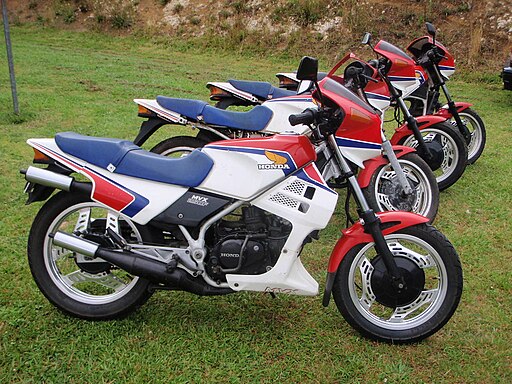
Honda MVX250F
The Honda MVX250F debuted in the early 1980s as a radical experiment in two-stroke performance. Its standout feature was a V-3 cylinder layout—an engine architecture rarely seen outside of prototype racing machines—designed to deliver explosive power in a compact package. Honda aimed to outclass rival 250 cc two-strokes by blending a broad, tractable powerband with razor-sharp handling. Though produced for only a couple of years, the MVX250F left a lasting impression on sportbike enthusiasts for its mechanical ingenuity and vivid riding character.
This article delves into every technical aspect of the MVX250F: from its intricate V-3 powerplant and exhaust innovation, through chassis geometry and suspension tuning, to its ergonomic details and on-road persona. Whether you’re a vintage-bike restorer or simply curious about an unusual slice of motorcycle history, this in-depth exploration covers the MVX250F’s design rationale, specification sheet, and real-world behavior.
Engine and Performance
Engine Architecture
At the heart of the MVX250F sits a two-stroke, liquid-cooled 247.2 cc V-3 engine. The three cylinders are arranged in a 90° vee, with one cylinder facing forward and a pair angling rearward, creating a compact “VVV” formation under the fuel tank.
- Bore × Stroke: 54.0 mm × 54.4 mm
- Total Displacement: 247.2 cc
- Compression Ratio: 6.5 :1
This V-3 configuration allowed Honda to balance primary forces better than an inline triple or parallel twin, reducing vibration at high rpm and enabling a lighter crank assembly. The result is a powerplant that revs to 11,000 rpm with minimal harshness, encouraging riders to exploit its upper-crank horsepower.
Induction and Exhaust
Fuel and air enter each cylinder through three Mikuni VM24 carburetors—one per cylinder—fine-tuned to synchronize mixture delivery across the vee-layout. Each carburetor feeds a small intake tract directly into its cylinder’s reed valve manifold. This arrangement yields instant throttle response, vital for a race-bred two-stroke.
The exhaust system features three expansion chambers converging into a two-into-one muffler underneath the tail section. The dual-stage chambers are precisely designed to harness the two-stroke “tuned pipe” effect, broadening the effective powerband and boosting midrange torque without sacrificing top-end rush.
Transmission and Final Drive
Power transfers to the rear wheel via a six-speed gearbox, renowned for its precise, dog-leg shift pattern that places first gear down and the five higher ratios within a close-spaced H-pattern. The gearbox sits integrally within the crankcase, reducing rotating mass and overall engine width. A sealed O-ring chain connects the transmission’s output sprocket to the rear wheel, balancing durability with minimal weight.
- Gear Ratios (selected): 1st: 2.533 :1 2nd: 1.789 :1 3rd: 1.384 :1 6th: 0.941 :1
A final drive ratio of 3.000 :1 delivers brisk acceleration off the line without overly tall gearing for highway cruising.
Chassis and Handling
Frame and Geometry
Honda employed a steel double-cradle frame, with main spars running beneath the engine before sweeping upward to support the steering head. By using the engine as a stressed member in key areas, engineers kept weight down and rigidity up. Key geometry figures include:
- Wheelbase: 1,350 mm
- Rake: 25.0°
- Trail: 100 mm
This setup strikes a balance between high-speed stability and flickable low-speed agility. The short wheelbase and tight steering geometry make the MVX250F exceptionally responsive—ideal for carving switchbacks or threading through urban traffic.
Suspension Setup
Front suspension is handled by 35 mm telescopic forks with 120 mm travel, calibrated for firm control under braking and compliance over uneven surfaces. The rear features dual shock absorbers with adjustable preload and 110 mm travel, mounted to a box-section swingarm. Riders can dial in rear sag to suit solo or two-up riding, or to accommodate light luggage.
- Front Forks: Travel: 120 mm Spring Preload: Fixed
- Rear Shocks: Travel: 110 mm Spring Preload: Adjustable
This tangible adjustability allowed privateer racers to tune ride height and spring rate on race weekends, while street riders benefited from a planted chassis feel in everyday use.
Wheels and Tires
The MVX250F rolls on spoked wheels fitted with tubed tires—110/90-18 front and 120/80-18 rear. These dimensions optimize the contact patch for spirited cornering without drifting grip on lean, two-stroke power delivery. The slender front tire enhances turn-in precision, while the wider rear shell supports the engine’s torque pulses.
Braking and Safety
Brake Components
Stopping duties fall to dual 276 mm discs up front, each clamped by a two-piston caliper, and a single 220 mm disc at the rear with a single-piston caliper. The dual-disc front setup provides strong initial bite and fade resistance during hard track sessions, while the rear disc offers balanced modulation for trail braking.
- Front Brake: Dual 276 mm discs, two-piston calipers
- Rear Brake: Single 220 mm disc, single-piston caliper
Safety Features
Although advanced electronics were rare in the early 1980s, Honda integrated several mechanical safety features:
- Recirculating lubrication pump prevents oil starvation at extreme bank angles.
- Reed-valve backflow-cutoff ensures consistent mixture at high rpm.
- High-strength steel frame rails offer controlled flex under load, reducing chassis knock-back.
These elements combine to mitigate two-stroke’s traditional snatchiness, giving riders confidence to exploit the MVX250F’s full potential.
Electrical System and Instrumentation
Charging and Ignition
A compact stator assembly generates 12 V at 140 W, powering the CDI ignition unit, lighting, and accessories. The electronic ignition map is optimized for a flat torque curve, advancing spark at mid-range rpm and retarding it slightly at redline to prevent detonation in high-octane unleaded fuel.
Instrumentation and Controls
The cockpit presents a large analog tachometer centrally, flanked by a 200 km/h speedometer. A small gear position indicator sits below the tach, while warning lamps for neutral, oil pressure, high beam, and turn signals line the bottom of the binnacle. Clip-on handlebars and compact switchgear keep weight forward and controls within easy thumb access.
Dimensions and Capacities
| Specification | Measurement |
|---|---|
| Engine Displacement | 247.2 cc |
| Bore × Stroke | 54.0 mm × 54.4 mm |
| Compression Ratio | 6.5 :1 |
| Power Output | 42 hp @ 10,500 rpm |
| Torque | 30.8 Nm @ 9,000 rpm |
| Transmission | 6-speed, chain final drive |
| Frame Type | Steel double cradle, engine stressed member |
| Front Suspension | 35 mm telescopic fork, 120 mm travel |
| Rear Suspension | Dual shocks, preload adjustable, 110 mm travel |
| Front Brake | Dual 276 mm discs |
| Rear Brake | Single 220 mm disc |
| Wheelbase | 1,350 mm |
| Seat Height | 795 mm |
| Dry Weight | 152 kg |
| Fuel Capacity | 18.5 L |
| Top Speed | Approximately 160 km/h |
Ergonomics and Rider Comfort
Rider Triangle
Clip-on handlebars mounted below the triple clamp create a mild forward lean, positioning weight over the front wheel for confident turn-in. Adjustable footpegs locate the rider’s knees close to the tank, yielding precise feedback through curves. This sports-oriented stance may feel firm during urban crawling, yet rewards aggressive riding with tactile chassis senses.
Seat and Wind Protection
The single-piece seat is narrow at the front, widening toward the pillion area. This design aids leg reach at stops, while offering enough foam thickness for short track sessions. An optional fairing and small windshield—available in select markets—divert wind blast at highway speeds, reducing rider fatigue on longer rides.
Maintenance and Servicing
Routine servicing, though more involved than a four-stroke, remains accessible thanks to Honda’s modular engine design:
- Spark Plugs: Replace every 6,000 km to prevent fouling.
- Reed Valves: Inspect bilge and petal condition every 12,000 km.
- Expansion Chambers: Check welding seams and rubber outriggers for vibration fatigue.
- Clutch and Gearbox: Oil change every 6,000 km with two-stroke–specific gear oil.
- Cooling System: Coolant flush and hose inspection annually.
Availability of OEM parts may be limited today, but specialist vendors supply reproduction reeds, gaskets, and rebuild kits to keep MVX250Fs running strong.
Riding Experience
On the road, the MVX250F’s character is unmistakable. The two-stroke V-3 delivers an explosive surge around 7,000 rpm, pulling hard through its six-speed box. Below 5,000 rpm, it runs smoothly enough for city riding, though riders learn quickly to slip the clutch on low-speed turns. High-speed stability benefits from the chassis stiffness and weight distribution, inspiring confidence on sweepers and open highways.
The motorcycle’s short wheelbase and sharp geometry allow direction changes at will, yet the controlled flex of the double-cradle frame soaks up track-induced shocks. Braking from 160 km/h to corner entry remains composed, thanks to the twin-disc setup and balanced geometry. While modern sportbikes eclipse its outright numbers, few machines deliver such visceral emotion in exchange for a modest displacement.
Conclusion
The Honda MVX250F stands as one of the most innovative 250 cc motorcycles ever built. Its two-stroke V-3 engine, coupled with race-inspired exhaust tuning and agile chassis, created a ride experience both precise and thrilling. Though production ended after two model years, the MVX250F’s mechanical creativity continues to fascinate collectors, racers, and enthusiasts. For anyone seeking a piece of motorcycle history that marries engineering daring with pure riding excitement, the MVX250F remains an enduring icon.
