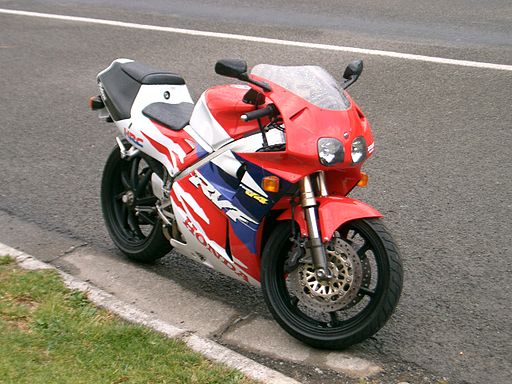
Honda RVF400
The Honda RVF400 emerged in the early 1990s as a street-legal homage to Honda’s racing technology. Its compact 399 cc V4 engine, lightweight chassis, and precise handling earned it instant acclaim among riders seeking track performance in a road-going package. Limited production numbers and exclusive distribution in select markets added to its mystique, making the RVF400 a coveted model for collectors and sport riding enthusiasts alike.
Historical Context
Racing Pedigree and Inspiration
Honda leveraged its successful RC45 and RC30 racing machines when developing the RVF400. The compact V4 layout, gear-driven camshafts, and chassis geometry all trace back to Honda’s endurance and World Superbike efforts. By adapting these technologies for road use, Honda created a machine that bridged the gap between showroom and circuit.
Market Positioning and Production
Introduced in 1994 and sold primarily in Japan and Europe, the RVF400 targeted experienced riders seeking high-revving performance without the weight penalty of larger displacement. Production ran until 1996, with total numbers kept relatively low. This scarcity, combined with its engineering pedigree, underpins the model’s enduring collectibility.
Engine and Performance
V4 Architecture
The RVF400 features a 90-degree V4 engine with four overhead cams and four valves per cylinder. Gear-driven cams ensure precise timing at high revs, while liquid cooling maintains optimal operating temperatures even under sustained track use.
Output and Torque
Peak power stands at 59 hp at 12 000 rpm, with maximum torque of 40 Nm at 10 000 rpm. The engine delivers a linear torque curve from 8 000 to 12 000 rpm, rewarding riders who keep the revs high through corners. A six-speed transmission with close ratios helps maintain the engine in its powerband during both acceleration and deceleration phases.
Intake and Exhaust
Dual 33 mm Keihin flat-slide carburetors feed the engine with an optimal air-fuel mixture. A polished stainless-steel exhaust system with underseat routing enhances midrange response and produces a sharp, race-inspired soundtrack.
Chassis and Frame
Aluminum Twin-Spar Frame
An extruded aluminum twin-spar frame provides exceptional rigidity and lightness. The design minimizes flex under heavy braking and hard cornering, delivering precise feedback to the rider’s inputs.
Swingarm and Subframe
A lightweight aluminum swingarm with braced construction enhances rear wheel control and stability. The subframe, bolted directly to the main spars, supports a sculpted seat and tail section designed for aerodynamic efficiency.
Suspension
Front Forks
Adjustable 41 mm Showa inverted forks offer 120 mm of travel. Riders can fine-tune compression and rebound damping to suit track days or street commuting, balancing comfort with aggressive handling.
Rear Monoshock
A Showa Pro-Link monoshock with preload, compression, and rebound adjustment provides 118 mm of travel. The linkage design delivers rising-rate damping, ensuring compliance on small bumps and resistance under heavy acceleration.
Braking System
Dual 296 mm front discs with twin-piston calipers deliver powerful, fade-resistant braking. Braided steel lines maintain consistent lever feel during repeated stops. At the rear, a single 220 mm disc with a single-piston caliper ensures balanced deceleration and improved stability under braking.
Wheels and Tires
Lightweight 17 inch cast aluminum wheels wear 110/70-17 front and 150/60-17 rear tires. The narrow front section allows quick turn-in, while the wider rear tire provides ample grip for hard launches and fast corner exits.
Dimensions and Weight
| Specification | Metric | Imperial |
|---|---|---|
| Wheelbase | 1 360 mm | 53.5 in |
| Seat Height | 795 mm | 31.3 in |
| Ground Clearance | 135 mm | 5.3 in |
| Fuel Capacity | 18 L | 4.8 US gal |
| Dry Weight | 168 kg | 370 lb |
| Wet Weight | 183 kg | 403 lb |
Electronics and Instrumentation
The RVF400 employs a digital ignition system for precise spark timing. A compact cockpit features an analog tachometer, digital speedometer, fuel gauge, lap timer, and gear position indicator. Minimalist switchgear keeps controls intuitive and focused on the ride.
Riding Experience
On winding roads and tight circuits, the RVF400 feels like an extension of the rider’s body. The chassis communicates every bump and turn, while the high-revving V4 engine demands precise throttle control. Its light weight and narrow profile allow rapid direction changes, making it especially rewarding in technical sections.
Maintenance and Common Issues
Regular oil changes every 6 000 km and valve clearance checks at 12 000 km preserve engine longevity. The gear-driven cam system requires little adjustment, though careful inspection of timing gear for wear is recommended on high-mileage examples. Carburetor synchronization and coolant replacement at specified intervals keep performance sharp and temperatures in check.
Legacy and Collectibility
With limited production and direct links to Honda’s racing heritage, the RVF400 commands respect among collectors and track day riders. Well-maintained examples appreciate steadily in value. Its influence persists in modern middleweight sportbikes that continue to adopt compact engines and race-derived chassis designs.
Conclusion
The Honda RVF400 remains a benchmark for compact V4 sportbikes. Its blend of razor-sharp handling, race-inspired engine, and premium components make it a timeless classic. For riders seeking an engaging, track-focused machine in a road-legal format, the RVF400 still represents one of the finest compromises of performance and agility ever offered in the 400 cc class.
