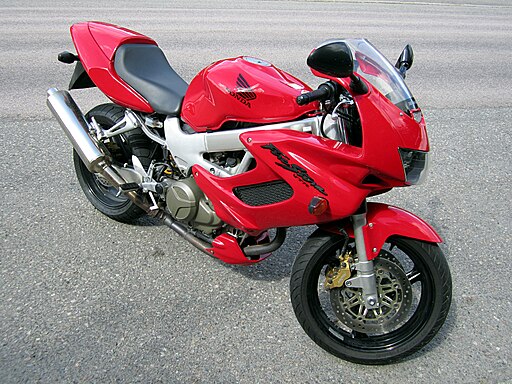
The Honda VTR1000F, also known as the Super Hawk in North America and the Firestorm in other markets, was a sport motorcycle produced by Honda between 1997 and 2005. It represented Honda’s venture into the world of large-capacity V-twin sportbikes—a category dominated at the time by European manufacturers like Ducati. The VTR1000F was designed to blend V-twin torque and character with Honda’s signature reliability, refinement, and everyday usability.
Unlike the razor-sharp, race-focused CBR models, the VTR1000F was engineered as a real-world sportbike—comfortable enough for everyday riding yet powerful and agile enough to thrill on twisty roads. It stood out for its broad torque curve, smooth delivery, and distinctive exhaust note, making it one of the most characterful Hondas of its era.
Engine and Performance
At the heart of the VTR1000F is a 996cc liquid-cooled, 90-degree V-twin engine. This configuration was chosen for its perfect primary balance and characteristic low-end torque. The design was heavily influenced by lessons learned from Honda’s racing programs but tuned for real-world usability rather than outright competition.
-
Engine Type: Liquid-cooled 4-stroke 90° V-twin
-
Displacement: 996 cc
-
Bore x Stroke: 98.0 mm x 66.0 mm
-
Compression Ratio: 9.4:1
-
Maximum Power Output: Approximately 110 hp (82 kW) @ 9,000 rpm
-
Maximum Torque: 97 Nm (71.5 lb-ft) @ 7,000 rpm
-
Fuel System: Dual 48 mm Keihin semi-downdraft carburetors
-
Ignition System: Digital transistorized with electronic advance
-
Transmission: 6-speed constant mesh
-
Final Drive: O-ring chain
The engine’s massive 48 mm carburetors—the largest ever fitted to a production Honda at the time—give the bike sharp throttle response and robust midrange performance. A gear-driven counterbalancer ensures smoothness, while the 90-degree layout naturally cancels primary vibrations, eliminating the need for heavy damping or complex balancers.
The VTR1000F’s power delivery is immediate and muscular, with a strong surge from low revs and a thrilling top-end rush. It was capable of sprinting from 0–100 km/h in under 3.5 seconds, and it topped out around 250 km/h, placing it firmly in superbike territory for its time.
Chassis and Frame
The VTR1000F utilizes a semi-pivotless aluminum twin-spar frame, a design that connects the swingarm directly to the engine cases. This layout saves weight and improves rigidity, providing sharp handling and responsive feedback.
-
Frame Type: Aluminum twin-spar, semi-pivotless design
-
Front Suspension: 41 mm cartridge-style telescopic fork, preload adjustable
-
Rear Suspension: Single shock absorber with 7-step preload and rebound adjustability, Pro-Link system
-
Front Wheel Travel: 120 mm
-
Rear Wheel Travel: 128 mm
The frame design is innovative, with the swingarm pivot mounted directly to the engine. This reduces overall mass and enhances torsional rigidity, contributing to a precise and stable ride. The suspension setup offers a blend of comfort and control, ideal for both spirited cornering and long-distance riding.
Braking System
The braking system on the VTR1000F is designed for strength and stability, matching its powerful engine performance.
-
Front Brakes: Dual 296 mm floating discs with 4-piston calipers
-
Rear Brake: Single 220 mm disc with 2-piston caliper
The braking performance is strong and consistent, offering excellent feedback. The dual front rotors and rigid calipers provide confident stopping power, while the rear brake adds stability during corner entry and low-speed maneuvering.
Dimensions and Weight
The Honda VTR1000F was built to be compact yet comfortable, combining a low center of gravity with a natural riding position.
-
Overall Length: 2,080 mm
-
Overall Width: 720 mm
-
Overall Height: 1,155 mm
-
Wheelbase: 1,430 mm
-
Seat Height: 810 mm
-
Dry Weight: 193 kg
-
Wet Weight: Approximately 215 kg
-
Fuel Tank Capacity: 16 liters (including 3.5-liter reserve)
The bike’s compact proportions and moderate seat height make it approachable for a wide range of riders. Its mass is centralized thanks to the V-twin layout and low-mounted engine, improving agility and balance.
Wheels and Tires
The VTR1000F rides on lightweight cast-aluminum wheels, designed for strength and reduced unsprung mass.
-
Front Tire: 120/70 ZR17
-
Rear Tire: 180/55 ZR17
These tire sizes provide excellent grip and stability, enhancing the bike’s handling precision while allowing for quick turn-in and predictable cornering.
Fuel System and Range
One of the few criticisms of the VTR1000F was its limited fuel range, primarily due to the relatively small tank and large carburetors that made it thirsty under aggressive riding.
-
Fuel Consumption: Approximately 14–16 km/l under normal riding conditions
-
Range: Roughly 200–230 km per tank
However, the efficient power delivery and smooth torque made it easy to ride at moderate speeds, where fuel consumption improved noticeably.
Design and Styling
The VTR1000F carries a distinctive aesthetic that balances sportiness and practicality. The design reflects the late-1990s sportbike trends but incorporates unique elements that give it an identity of its own.
-
Twin-spar aluminum frame visible through minimal fairings
-
Dual side-mounted radiators for efficient cooling and weight distribution
-
Compact twin headlights giving a sharp, predatory look
-
Under-engine exhaust collectors leading to twin silencers
The side-mounted radiators were a key visual and functional feature, improving mass centralization while keeping the bike’s profile narrow. The ergonomics were more relaxed than those of pure supersport models, allowing for longer rides without excessive fatigue.
Riding Dynamics
The Honda VTR1000F delivers a riding experience defined by torque, stability, and flexibility. The V-twin engine’s power pulses provide strong drive out of corners, while the chassis remains composed even under hard acceleration. The wide handlebars and balanced geometry make it intuitive to maneuver, whether on mountain roads or urban streets.
The suspension is tuned for compliance, soaking up bumps effectively without sacrificing cornering precision. The bike’s midrange torque means fewer gear changes are required, making it ideal for both relaxed touring and spirited riding.
At higher speeds, the aerodynamic fairing provides decent wind protection, and the chassis maintains rock-solid stability. The engine’s unique sound—deep, throaty, and mechanical—adds to the visceral experience that defines this motorcycle.
Maintenance and Reliability
True to Honda’s reputation, the VTR1000F is exceptionally reliable. Its V-twin engine is robust and capable of high mileage when properly maintained. Routine servicing includes carburetor synchronization, valve clearance checks, and regular oil changes.
Known reliability highlights include:
-
Sturdy clutch and gearbox design
-
Durable camchain system with automatic tensioners
-
Excellent electrical reliability compared to contemporary European twins
Owners often report trouble-free operation for well over 100,000 kilometers. The only frequent complaints relate to the fuel range and occasional camchain tensioner wear, which can be easily addressed with aftermarket replacements.
Legacy and Influence
The Honda VTR1000F paved the way for Honda’s future twin-cylinder sportbikes, including the VTR1000 SP1 and SP2 (RC51)—machines that went on to dominate the World Superbike Championship. While the VTR1000F was less aggressive than its racing siblings, it introduced many riders to the appeal of a large V-twin sportbike.
Its combination of usable performance, comfort, and reliability made it one of the most practical liter-class twins of its time. Even today, the VTR1000F retains a cult following among enthusiasts who appreciate its distinctive character and mechanical simplicity.
Conclusion
The Honda VTR1000F remains one of Honda’s most distinctive motorcycles—a sportbike that successfully blended the character of a V-twin with the refinement and dependability that defined Honda engineering. It offered a unique riding experience: muscular yet manageable, fast yet forgiving.
With its broad torque delivery, stable chassis, and unmistakable sound, the VTR1000F stands as a testament to Honda’s ability to innovate beyond convention. It wasn’t just a competitor to the European twins—it was a machine that delivered the thrill of a superbike with the civility of a road-going companion, earning its lasting reputation as one of the most engaging and well-balanced sport motorcycles of its generation.
