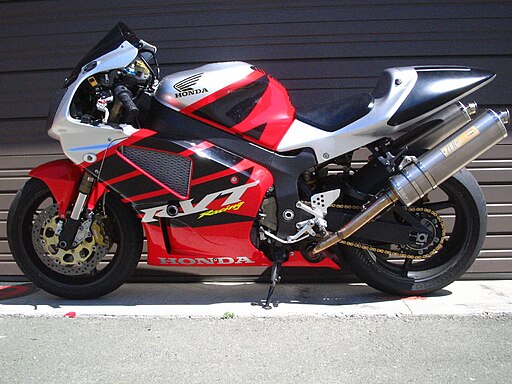
The Honda RC51, also known by its internal code RVT1000R (in North America) and VTR1000 SP1/SP2 (in other regions), stands as one of the most legendary superbikes in Honda’s racing history. Introduced in 2000, the RC51 was Honda’s answer to the dominance of Ducati’s V-twin superbikes in the World Superbike Championship (WSBK). It was designed with a singular mission: to reclaim racing glory through the power of a twin-cylinder engine, complying with WSBK’s regulations of the era that favored V-twin configurations.
The RC51 was not just a reworked production bike—it was a purpose-built race machine homologated for the road. Developed directly from Honda Racing Corporation’s (HRC) expertise, it carried the DNA of pure competition. Its blend of aggressive styling, a powerful 999cc V-twin engine, and race-oriented chassis engineering made it an instant icon.
Engine and Performance
At the heart of the Honda RC51 lies a 999cc liquid-cooled 90° V-twin engine, developed specifically to challenge Ducati’s Desmodromic twins. Unlike Honda’s inline-four superbikes of the time, this engine focused on massive torque delivery, linear power output, and strong midrange performance.
-
Engine Type: Liquid-cooled 4-stroke 90° V-twin
-
Displacement: 999 cc
-
Bore x Stroke: 100 mm x 63.6 mm
-
Compression Ratio: 10.8:1
-
Valve Train: DOHC, 8 valves (4 per cylinder)
-
Fuel System: PGM-FI (Programmed Fuel Injection) with dual injectors per cylinder
-
Ignition: Digital transistorized
-
Maximum Power Output: 136 hp (101 kW) @ 9,500 rpm
-
Maximum Torque: 105 Nm (77.4 lb-ft) @ 8,000 rpm
-
Transmission: 6-speed constant mesh
-
Final Drive: O-ring chain
The RC51’s engine was built around large 54 mm throttle bodies and a high-performance fuel injection system, giving it crisp throttle response and broad power delivery. The 90-degree V-twin layout provided perfect primary balance, reducing vibrations while allowing for a compact engine design that aided mass centralization.
The massive torque output made it particularly effective in real-world and racing conditions, where drive out of corners was critical. In race trim, this engine could easily exceed 180 horsepower, making it a formidable competitor on the track.
Chassis and Frame
Honda engineered the RC51’s chassis with a twin-spar aluminum frame, a significant departure from the tubular steel trellis frames typically seen on Italian superbikes. This design emphasized rigidity, stability, and precise feedback at high speeds.
-
Frame Type: Twin-spar aluminum alloy
-
Front Suspension: 43 mm Showa inverted fork, fully adjustable for preload, compression, and rebound damping
-
Rear Suspension: Pro-Link with Showa fully adjustable monoshock
-
Front Wheel Travel: 120 mm
-
Rear Wheel Travel: 130 mm
The frame design allowed for optimal mass centralization, pairing perfectly with the V-twin’s compact layout. This gave the RC51 its distinctive handling character—stable at high speeds, yet nimble in transitions.
The second-generation model, the SP2 (2002–2006), received subtle yet impactful updates: lighter frame construction, revised steering geometry, and improved suspension settings. These refinements contributed to sharper handling and more predictable cornering stability.
Braking System
As a machine born for the track, the RC51’s braking system was designed to deliver immense stopping power and control.
-
Front Brakes: Dual 320 mm floating discs with 4-piston Nissin radial-mount calipers
-
Rear Brake: Single 220 mm disc with single-piston caliper
-
Brake Lines: Braided stainless steel for consistent performance
The brakes provided exceptional feedback, allowing riders to modulate pressure precisely even under aggressive braking conditions. The rigid aluminum frame further enhanced braking stability, preventing flex or instability during deceleration.
Wheels and Tires
The RC51 rode on lightweight cast-aluminum wheels, designed to reduce unsprung mass and improve suspension response.
-
Front Wheel: 17 x 3.50 inch
-
Rear Wheel: 17 x 6.00 inch
-
Front Tire: 120/70 ZR17
-
Rear Tire: 190/50 ZR17
This tire combination gave the motorcycle excellent grip and feedback, especially in high-performance riding conditions.
Dimensions and Weight
The RC51’s dimensions were carefully engineered for optimal balance between agility and high-speed stability.
-
Overall Length: 2,065 mm
-
Overall Width: 685 mm
-
Overall Height: 1,125 mm
-
Wheelbase: 1,410 mm
-
Seat Height: 820 mm
-
Curb Weight: 224 kg (SP1) / 219 kg (SP2)
-
Fuel Tank Capacity: 18 liters
Although heavier than some inline-four superbikes, the RC51’s central mass distribution and V-twin configuration gave it exceptional stability and predictable cornering behavior.
Aerodynamics and Design
The RC51’s bodywork was crafted with racing functionality as a top priority. Its fairing and fuel tank shape were designed for aerodynamic efficiency and rider ergonomics.
-
Dual ram-air intakes located at the front of the fairing force-fed air directly into the throttle bodies for improved top-end power.
-
Compact tail section and under-seat exhaust system enhanced aerodynamics and central mass distribution.
-
Aggressive race-inspired fairing with minimal drag and optimal cooling airflow.
The under-tail twin exhaust design, developed in collaboration with HRC, gave the RC51 not only a balanced weight distribution but also its iconic, deep V-twin exhaust note that became instantly recognizable.
Electronics and Instrumentation
The RC51 was built during an era when rider skill, not electronics, defined performance. However, Honda equipped it with precise, race-oriented electronic systems for optimal performance.
-
PGM-FI fuel injection provided seamless throttle response.
-
Analog tachometer with digital speedometer offered clear visibility of revs at a glance.
-
Minimalist dash included temperature gauge, fuel light, and trip meters, reflecting its racing roots.
There were no traction control systems, ride modes, or ABS — the RC51’s connection between rider and machine was purely mechanical, offering raw feedback and total engagement.
Performance Characteristics
The RC51’s riding experience is defined by its muscular torque delivery and stability. The V-twin engine offers a wave of midrange power that pulls with authority, while the chassis provides confidence at both low and high speeds.
Its 90-degree V-twin layout ensures a broad spread of power, making it forgiving yet explosive when pushed to the limit. The exhaust note—a deep, throaty growl at idle that crescendos into a sharp bark at full throttle—is a signature feature that many enthusiasts still revere.
The suspension tuning provides a perfect balance between comfort and performance, with enough compliance for bumpy roads yet firmness for track riding. The stability at high speeds makes it ideal for endurance racing and aggressive cornering alike.
Racing Heritage
The RC51’s reputation was forged on the racetrack. Shortly after its debut, it achieved immediate success:
-
2000 WSBK Championship: Colin Edwards won the title in the RC51’s debut season.
-
2002 WSBK Championship: Edwards reclaimed the title, defeating Ducati after an intense season-long battle.
-
Isle of Man TT victories: The RC51 also found success in endurance and road racing events, praised for its reliability and consistency.
The RC51’s combination of engineering precision and race-winning capability cemented its place in motorcycle history.
Maintenance and Reliability
True to Honda’s reputation, the RC51 is remarkably durable for a high-performance motorcycle. The engine’s design prioritizes robustness, with strong internal components capable of handling extreme loads.
