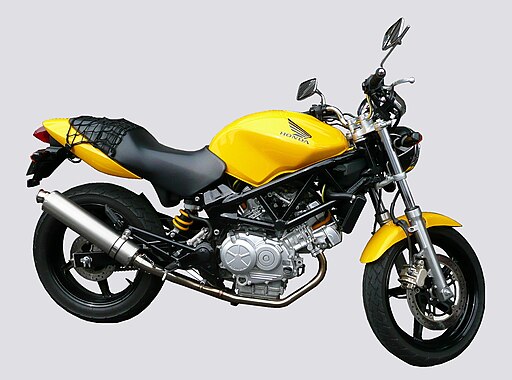
Honda VTR250
The Honda VTR250 stands out in the quarter-liter segment by blending sporty handling, reliable engineering, and minimalist styling. Launched in the late 1990s, it broke the mold of conventional small-displacement machines by adopting a 90° V-twin engine, steel trellis frame, and naked-bike ergonomics. Its approachable power delivery and crisp chassis dynamics make it equally at home carving canyon roads or commuting through urban traffic. Over two decades of production, the VTR250 earned a devoted following among riders seeking a machine that offers real motorcycle character without frightening performance.
Design and Styling
Bodywork and Aesthetics
The VTR250’s most distinctive visual element is its exposed steel trellis frame, painted red in many markets to accentuate its architectural form. A small under-seat tail fairing sweeps upward, giving the bike a poised, sporty stance. The fuel tank features sculpted knee indents that flow into brushed-aluminum side covers, creating a slender waist for confident cornering. Minimalist bodywork keeps overall weight low and facilitates quick changes in direction.
Rider Ergonomics
Riders sit upright, with handlebars positioned just above the top yoke for a neutral reach that balances control and comfort. The single, narrow seat provides a moderate degree of padding and measures 775 mm off the ground, making it accessible to shorter riders. Mid-mount footpegs strike a compromise between ground clearance for leaning and a relaxed knee angle for longer journeys. Together, these elements deliver an intuitive riding position that reduces fatigue in both city and back-road environments.
Engine and Performance
Engine Specifications
| Specification | Detail |
|---|---|
| Engine Type | 249 cc liquid-cooled DOHC 8-valve V-twin |
| Bore × Stroke | 60.0 mm × 44.2 mm |
| Compression Ratio | 11.2 : 1 |
| Fuel Delivery | PGM-FI electronic fuel injection |
| Ignition | Full transistorized CDI |
| Cooling System | Forced-circulation water jacket |
| Lubrication | Wet sump with trochoid pump |
Power Output and Torque
The VTR250’s V-twin configuration yields 30 PS (22 kW) at 11 000 rpm and 22 N·m of torque at 8 500 rpm. Unlike many single-cylinder competitors, the V-twin offers a broad, tractable midrange, with peak torque arriving well below redline. The engine revs eagerly past 10 000 rpm, rewarding riders who chase the high end of the rev spectrum. Spark timing and fuel mapping produce a satisfying exhaust burble at part-throttle openings and a crisp bark when the throttle is cracked wide.
Transmission and Final Drive
Power flows through a six-speed gearbox featuring a cable-actuated wet multi-plate clutch. Gear ratios are spaced to balance brisk acceleration in the lower gears with relaxed cruising in the top two ratios. Final drive is via a O-ring chain and a 13-tooth front/47-tooth rear sprocket combination, which can be tailored for quicker acceleration or taller cruising by swapping sprocket sizes.
Chassis and Handling
Frame
A steel tubular trellis frame underpins the VTR250, delivering torsional rigidity and lightweight construction. The engine serves as a semi-stressed member, further lowering overall mass and centralizing weight. Welded gussets around the steering head and swingarm pivot ensure structural integrity in high-stress zones.
Front Suspension
The front end uses conventional telescopic forks with 37 mm stanchions and 120 mm of travel. Internal damping is valved for a balanced response to both minor surface chatter and larger potholes. Sealed rubber gaiters protect the fork tubes from debris, helping maintain smooth action over years of use.
Rear Suspension
A preload-adjustable Pro-link single shock provides 110 mm of rear travel. Progressive linkage geometry offers a supple initial stroke for comfort over small bumps and firm mid-stroke support for spirited riding. The external preload collar lets riders fine-tune sag for solo or two-up riding without disassembly.
Brakes and Wheels
Braking System
At the front, a single 296 mm hydraulic disc is clamped by a dual-piston caliper, delivering strong initial bite and fade resistance. The rear brake is a 220 mm disc with single-piston caliper for balanced stopping power. A unified dual-cable actuation system provides consistent lever feel and distributes braking force to both ends in concert.
Wheels and Tires
17-inch cast aluminum wheels keep unsprung weight low. Stock tire sizes—110/70-17 front and 130/70-17 rear—use radial construction with sport-tuned compounds for confident grip in wet and dry conditions. Proper tire pressures (front 2.0 bar, rear 2.3 bar) ensure responsive steering and stable cornering feedback.
Electronics and Instrumentation
Instrument Cluster
The analog-digital hybrid gauge cluster pairs a large tachometer with a digital display for speed, odometer/trip meters, fuel gauge, and clock. Gear position indicator and shift light are standard, helping newer riders learn shift points quickly. Warning lamps for neutral, oil pressure, and high beam are grouped to reduce glance time.
Electrical System
A 12 V, 8 Ah maintenance-free battery supplies power to the full transistorized CDI ignition and lighting circuits. The stator and regulator assembly deliver up to 300 W of output, sufficient to run the 35 W/35 W halogen headlamp, LED tail lamp, and optional auxiliary accessories. Wiring harnesses employ automotive-style crimped connectors and protective loom for durability.
Dimensions, Weight, and Capacities
| Measurement | Value |
|---|---|
| Overall Length | 2 045 mm |
| Overall Width | 740 mm |
| Overall Height | 1 075 mm |
| Wheelbase | 1 360 mm |
| Rake / Trail | 24° / 96 mm |
| Seat Height | 775 mm |
| Ground Clearance | 135 mm |
| Curb Weight | 147 kg |
| Fuel Tank Capacity | 11 L |
| Oil Capacity | 2.2 L |
These compact dimensions and relatively low weight give the VTR250 flickable agility through tight corners and traffic, while the moderate seat height ensures confidence for riders of varying statures.
Fuel Efficiency and Range
Under mixed urban/highway riding, the VTR250 returns around 28 km/L. Steady cruising at 80–90 km/h can push efficiency above 30 km/L. With an 11 L tank (including a 1.5 L reserve), typical range between refueling stops exceeds 300 km, making it practical for day trips and longer commutes.
Maintenance and Reliability
Service Schedule
- Oil and filter change: every 5 000 km
- Valve clearance inspection: every 16 000 km
- Coolant flush: every 24 months
- Chain lubrication and adjustment: every 600 km
- Brake fluid replacement: every 2 years
Routine maintenance is simplified by easy access to the engine and major service points. Detachable side panels allow quick oil checks, while the radiator cap is positioned for straightforward coolant top-ups.
Common Issues and Tips
- Inspect throttle bodies for synchronization drift every 8 000 km to maintain smooth idling.
- Check fork gaiter seals for cracks, as torn boots can allow dirt to damage fork seals.
- Replace the drive chain and sprockets as a set to avoid uneven wear.
- Upgrade to stainless-steel braided brake lines to preserve consistent lever feel under repeated use.
Well-maintained VTR250s often exceed 100 000 km without major engine or frame issues, thanks to Honda’s robust design and conservative tuning.
Riding Experience and Model Variants
Riders often praise the V-twin’s character in a displacement class dominated by singles. The firing interval produces a pleasant rumble at idle and a distinct intake roar under hard acceleration. The chassis’s neutral handling invites corner-entry experimentation, while the suspension soaks up mid-corner bumps without upset.
Over its production run, Honda offered two variants:
- Standard Naked: exposed trellis frame, upright bars, minimalist bodywork
- VTR250 Moto:* with sport-focused aesthetics, including small fairings, stepped seat, and optional color accents
Both share identical powertrains and chassis geometry, differing mainly in styling and footpeg bracket positions.
Conclusion
The Honda VTR250 remains a benchmark for small-displacement motorcycles, combining the soul of a V-twin with the agility of a lightweight roadster. Its low maintenance demands, strong midrange torque, and nimble chassis make it an enduring choice for new riders and veterans alike. Whether you seek a daily commuter that brings a grin to each corner or a weekend canyon-carver that’s easy to trailer, the VTR250 delivers an engaging, reliable ride that has stood the test of time.
