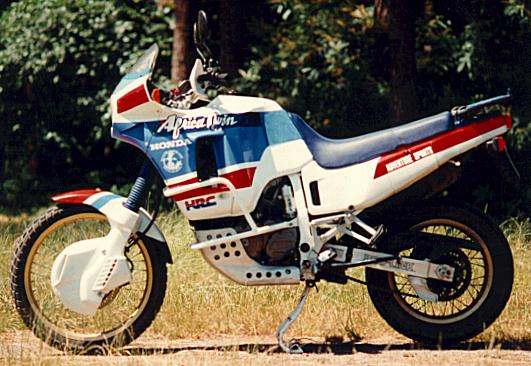
Honda XRV650
The Honda XRV650 Africa Twin stands as an icon in adventure motorcycling, blending desert-rally–inspired design with everyday versatility. Introduced in 1988, it offered rugged reliability, long-travel suspension, and a torquey V-twin engine that made it equally adept at off-road exploration and highway touring.
Historical Background
Racing Heritage and Genesis
Honda’s success with the water-cooled NXR750 in the Paris-Dakar Rally laid the groundwork for a production bike suited to extreme endurance events. Applying lessons learned from rally competition, Honda engineers created the XRV650 with a purpose-built 52° V-twin engine, a robust chassis, and suspension calibrated for desert conditions.
Production Years and Evolution
Manufactured from 1988 to 1989, the XRV650 served as the bridge between the XLV750R and the later XRV750 Africa Twin. Limited to two model years, its primary updates centered on color schemes and minor component refinements rather than major technical overhauls.
Engine & Powertrain
V-Twin Engine Architecture
The heart of the XRV650 is a 647 cm³, liquid-cooled 52° V-twin featuring SOHC and three valves per cylinder. Its bore and stroke of 79 × 66 mm and a compression ratio of 9.4 : 1 deliver a balance of midrange torque and high-rpm stability, ideal for both low-speed maneuvers and sustained freeway cruising.
Induction & Ignition
Fuel mixture is managed by twin 32 mm constant-velocity carburetors that ensure smooth throttle transition. Ignition duties fall to a digital transistorized system with electronic advance, providing reliable spark timing under shifting loads and environmental conditions.
Transmission & Final Drive
Power is routed through a five-speed manual gearbox optimized for off-road tractability and highway flexibility. A chain final drive, fitted with O-rings for reduced wear and extended maintenance intervals, transmits torque to the rear wheel with minimal power loss.
Chassis & Suspension
Frame Design
A single-downtube steel frame with a double-loop cradle section underpins the XRV650, offering robust torsional rigidity and resistance to flex under heavy loads. This architecture contributes to stable handling both on loose terrain and high-speed tarmac sections.
Front Suspension
Air-assisted telescopic forks provide 220 mm of wheel travel, blending plush absorption of ruts and rocks with enough damping control to maintain chassis geometry under heavy braking and rough surfaces.
Rear Suspension
The Pro-Link monoshock rear setup features rebound damping adjustment and 210 mm of travel. Its rising-rate linkage offers a progressive response—compliant over small bumps, firming up as compression deepens during hard cornering or loaded touring.
Brakes, Wheels & Tires
A single 296 mm front disc clamped by a two-piston caliper delivers strong stopping power, while a 210 mm rear disc provides balanced deceleration. Spoke wheels with aluminum rims accept a 90/90-21 front tire and a 130/80-17 rear tire, marrying off-road traction with highway stability.
Dimensions & Ergonomics
Rider Position & Seat Height
An 880 mm seat height gives riders commanding visibility while allowing enough room beneath for foot placement on uneven ground. Upright handlebars and mid-mounted foot controls create a neutral riding posture that reduces fatigue on long days in the saddle.
Ground Clearance & Weight
With 215 mm of ground clearance, the XRV650 can tackle rocky trails and deep ruts without risk of bottoming out. A dry weight of 185 kg (wet 220 kg) strikes a balance between chassis confidence off-road and manageable handling at low speeds.
Performance & Fuel Economy
The Africa Twin’s V-twin produces 57 hp (42.5 kW) at 8 000 rpm and 55 Nm of torque at 6 000 rpm, enabling a top speed near 165 km/h in unrestricted trim. Riders report fuel consumption in the 5.5–6.5 L/100 km range, yielding an impressive theoretical range of over 350 km on its 25 L tank.
Variants & Regional Differences
In certain European markets, power was restricted to approximately 50 hp to fit lower insurance categories, slightly reducing top speed and throttle response. Otherwise, mechanical specifications remained consistent across regions, preserving the bike’s core adventure capabilities.
Maintenance & Ownership
Routine service intervals include oil and filter changes every 6 000 km and valve clearance inspections every 24 000 km. The XRV650’s chain drive and simple twin-carburetor arrangement make it user-friendly for home mechanics, while the robust engine design has earned a reputation for exceptional longevity.
Conclusion
The Honda XRV650 Africa Twin remains a celebrated chapter in adventure motorcycling history. Its rally-inspired engineering, long-travel suspension, and versatile ergonomics laid the foundation for modern dual-sport machines. Even decades after its brief production run, the XRV650 endures as a testament to Honda’s rally pedigree and commitment to practical, reliable design.
