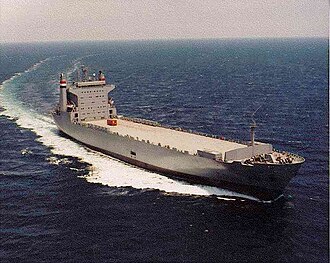
The modern United States military depends not only on combat power but also on something far less visible and often overlooked: the ability to move that power across the globe. Tanks, armored vehicles, engineering equipment, supply trucks, and support systems cannot reach overseas theaters on their own. They require ships—large, capable, and efficient transport platforms designed specifically for strategic sealift missions. One such vessel is the MV Cape Taylor (T-AKR-113), a roll-on/roll-off cargo ship that serves as part of the United States Maritime Administration’s Ready Reserve Force (RRF).
Although it does not appear in headlines or public discussions of naval power, Cape Taylor plays a critical logistical role. It exists to ensure that U.S. military forces can deploy rapidly when required, carrying vast quantities of equipment across oceans in a matter of days or weeks. Without ships like this, modern expeditionary warfare and large-scale humanitarian operations would be significantly slower, more expensive, and far more complex.
Originally built as a commercial vessel in Japan in the late 1970s, Cape Taylor spent years in civilian service before being acquired by the U.S. government and converted into a strategic sealift asset. Today, it remains one of the key surge-capable vessels in the RRF, maintained in a high state of readiness so it can be activated quickly whenever global events demand additional sealift capacity.
To understand the importance of MV Cape Taylor, it is necessary to explore not only its technical characteristics but also the broader strategic system it supports.
Origins and Early Commercial History
Construction in Japan and Design Context
The MV Cape Taylor was constructed in 1977 by Sasebo Heavy Industries in Japan, a shipyard well known for producing large commercial and specialized vessels. At the time, global maritime trade was undergoing significant transformation. The expansion of international vehicle transport and industrial supply chains created strong demand for roll-on/roll-off (Ro-Ro) cargo ships, which could dramatically reduce loading times and increase efficiency in port operations.
Cape Taylor was originally built under commercial ownership as a vehicle carrier. Its design reflected the engineering priorities of the era: large unobstructed cargo decks, stern ramp loading systems, and internal vehicle lanes that allowed cars, trucks, and heavy machinery to be driven directly aboard. This design philosophy marked a major shift away from traditional break-bulk cargo handling toward faster and more automated logistics systems.
Ro-Ro vessels like Cape Taylor were particularly valuable in the automotive and industrial shipping sectors, where efficiency and turnaround time directly affected profitability. The ship’s early design success would later make it an ideal candidate for military adaptation.
Commercial Service and Ownership Changes
Before entering U.S. government service, the vessel operated under several commercial identities. It was initially launched as MV Rabenfels, later renamed MV Cygnus, and eventually operated under additional commercial names as it changed ownership over time.
These transitions are typical in the maritime industry. Large cargo ships frequently move between operators, flags, and commercial registries depending on market demand and fleet restructuring. Despite these changes, Cape Taylor maintained a consistent operational profile throughout its commercial life: reliable long-distance transport of vehicles and heavy cargo.
Its durability, cargo efficiency, and engineering reliability allowed it to remain commercially viable for more than a decade before its eventual acquisition by the United States government.
Transition to Strategic Sealift Service
Acquisition by MARAD and Military Integration
In the early 1990s, following the end of the Cold War, the United States began expanding its strategic sealift capability to ensure rapid deployment flexibility in an increasingly unpredictable global environment. As part of this effort, the Maritime Administration (MARAD) acquired Cape Taylor in 1992, and the ship was formally taken into government service in 1993.
By 1994, the vessel had been fully integrated into the Ready Reserve Force (RRF) and assigned the designation T-AKR-113, where “T” indicates a U.S. Military Sealift Command auxiliary transport vessel and “AKR” denotes a vehicle cargo Ro-Ro ship.
This transition fundamentally changed the ship’s purpose. Instead of operating commercially, Cape Taylor became a strategic national asset maintained specifically to support military operations, humanitarian relief, and emergency response missions.
Ready Reserve Force Role
The Ready Reserve Force is a fleet of strategically maintained ships that can be activated rapidly during national emergencies or military operations. Ships in this fleet are kept in a reduced operating status (ROS-5), meaning they can typically be fully activated within approximately five days.
Cape Taylor is maintained in Houston, Texas, where it remains under continuous maintenance and periodic inspection.
This system allows the United States to maintain large-scale transport capability without incurring the cost of keeping every ship fully crewed and active at all times. Instead, a small caretaker crew preserves the vessel in a state of readiness until activation is required.
Technical Design and Engineering Features
Dimensions and Structural Layout
MV Cape Taylor is a large Ro-Ro vessel designed specifically for heavy transport operations. Its key dimensions include:
- Length: approximately 634 ft (193 m)
- Beam: approximately 88 ft (27 m)
- Draft: approximately 28 ft (8.6 m)
- Full load displacement: ~26,456 long tons
These dimensions make it large enough to transport entire military unit equipment sets while still being compatible with a wide range of global port facilities.
The ship’s internal structure consists of multiple vehicle decks connected by internal ramps, allowing vehicles to move between levels without external lifting equipment.
Propulsion and Performance
Cape Taylor is powered by two MAN 9L 52/55A medium-speed diesel engines, driving a single propeller shaft.
Key performance characteristics include:
- Installed power: approximately 18,980 bhp
- Maximum speed: around 20.5 knots
- Operational range: approximately 22,600 nautical miles at economical speed
This combination provides a balance of efficiency, endurance, and reliability—critical for long-distance strategic sealift missions.
Unlike naval combat vessels, Cape Taylor is not designed for high-speed maneuvering or tactical engagement. Instead, it prioritizes fuel economy, mechanical durability, and sustained ocean-going capability.
Cargo Capacity and Ro-Ro Systems
The defining feature of MV Cape Taylor is its roll-on/roll-off cargo system, which allows vehicles to be driven directly onto the ship via stern ramps.
The vessel is capable of transporting:
- Main battle tanks and armored vehicles
- Military transport trucks and trailers
- Engineering and construction machinery
- Containerized support equipment
- Mixed wheeled and tracked cargo formations
It provides approximately 88,000 square feet of cargo space, allowing it to carry hundreds of vehicles or large unit equipment packages in a single voyage.
This capability makes it particularly valuable for rapid deployment scenarios, where entire brigades or task forces must be moved quickly to overseas theaters.
Operational Role in the Ready Reserve Force
Readiness Status and Activation Model
Cape Taylor is maintained in a ROS-5 readiness status, meaning it can be fully activated within approximately five days of notification.
During reserve status, the ship is maintained by a small caretaker crew responsible for:
- Mechanical preservation
- System testing and inspections
- Safety equipment maintenance
- Periodic propulsion system checks
When activated, a full civilian mariner crew boards the vessel, and it transitions into operational status under the Military Sealift Command.
Activation Process
The activation of Cape Taylor involves several coordinated steps:
First, the ship’s engineering systems are brought online, including propulsion, electrical systems, and auxiliary machinery. Next, navigation and communication systems are fully tested and integrated into operational networks. Then, cargo loading begins, often involving military vehicles driven directly aboard the ship. Finally, operational readiness is verified before deployment.
This structured process ensures that the vessel can transition from reserve to active status quickly and safely.
Operational History and Military Contributions
Support for Overseas Operations
Cape Taylor has been activated in support of major U.S. military operations, including logistics missions associated with overseas deployments in the early 2000s. During these operations, it transported military vehicles and equipment required for sustained expeditionary activity.
Its role in such missions underscores the importance of sealift in modern warfare. Without ships like Cape Taylor, deploying heavy equipment overseas would require significantly more time and resources.
NATO Exercises and Training Operations
In addition to combat-related deployments, Cape Taylor has supported NATO exercises and multinational training operations. These missions often require transporting large volumes of military equipment to European training areas, where allied forces conduct joint readiness drills.
Such exercises are essential for maintaining interoperability among allied militaries and ensuring rapid deployment coordination in real-world scenarios.
Civilian Mariners and Operational Structure
Crew Composition
Cape Taylor is operated by civilian merchant mariners, not uniformed naval personnel. In reserve status, it typically requires around 10 personnel, while full activation increases crew size to approximately 26 or more. (Wikipedia)
These mariners are responsible for:
- Navigation and ship handling
- Engine room operations
- Cargo loading and securing
- Safety management and emergency response
- Coordination during military activation
This civilian-operated model is a defining feature of the U.S. strategic sealift system, balancing cost efficiency with operational readiness.
Strategic Importance in Modern Military Logistics
Why Cape Taylor Matters
Despite its lack of weaponry or combat systems, Cape Taylor plays a critical strategic role. Modern military forces depend heavily on armored vehicles, engineering equipment, and logistical infrastructure. Transporting these assets is essential to global military operations.
A single Ro-Ro vessel like Cape Taylor can carry enough equipment to support entire military formations, making it indispensable during the early stages of deployment.
Enduring Relevance of Sealift Capability
Even in an era of advanced airlift and rapid deployment technologies, maritime sealift remains unmatched in cargo capacity. Aircraft can move personnel quickly, but they cannot replicate the scale of transportation provided by ships like Cape Taylor.
As global security challenges evolve, the importance of flexible and scalable logistics continues to grow.
Conclusion
The MV Cape Taylor (T-AKR-113) is a powerful example of how commercial maritime engineering can be adapted into a strategic military asset. Built in Japan in 1977 as a Ro-Ro vehicle carrier, it later transitioned into U.S. government service as part of the Ready Reserve Force, where it continues to play a vital role in global military logistics.
Its design emphasizes efficiency, capacity, and reliability, enabling it to transport large volumes of military equipment across vast distances. Although it operates largely outside public view, its contribution to national defense and global mobility is substantial.
Cape Taylor represents the quiet but essential backbone of military power: logistics. Without ships like it, global military operations would not be possible at the scale and speed required in the modern world.
Technical Parameters of MV Cape Taylor (T-AKR-113)
| Parameter | Specification |
|---|---|
| Name | MV Cape Taylor |
| Hull Number | T-AKR-113 |
| Original Name | MV Rabenfels |
| Other Names | MV Cygnus, MV Thakwini |
| Type | Roll-on/Roll-off Cargo Ship |
| Builder | Sasebo Heavy Industries, Japan |
| Year Built | 1977 |
| Owner | U.S. Maritime Administration (MARAD) |
| Fleet | Ready Reserve Force (RRF) |
| Length | 634 ft (193 m) |
| Beam | 88 ft (27 m) |
| Draft | 28 ft (8.6 m) |
| Displacement | ~26,456 long tons |
| Propulsion | 2 × MAN diesel engines |
| Power Output | ~18,980 bhp |
| Propellers | Single screw |
| Maximum Speed | ~20.5 knots |
| Range | ~22,600 nautical miles |
| Cargo Type | Military vehicles, equipment, containers |
| Cargo System | Roll-on/Roll-off ramps |
| Cargo Capacity | ~88,000 sq ft vehicle space |
| Crew (Reserve) | ~10 civilians |
| Crew (Activated) | ~26 civilians |
| Readiness Status | ROS-5 (≈5-day activation) |
| Homeport | Houston, Texas |
| Military Role | Strategic sealift and logistics support |
.jpg)