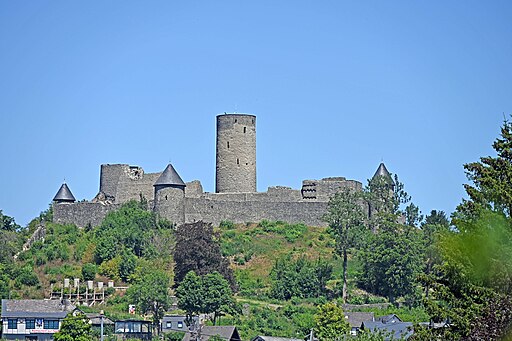
Poised dramatically above the rolling contours of the Eifel region, Nürburg rises as a commanding presence that has shaped the identity and historical consciousness of its surroundings for centuries. This small yet profoundly significant settlement is inseparable from the ruins of its medieval castle, whose elevated silhouette continues to define the horizon and evoke a sense of timeless authority. Nürburg is not merely a geographical point but a place where landscape, legend, and lived experience converge, forming a rich tapestry of memory that reflects the evolution of power, travel, and cultural life in western Germany. The environment surrounding Nürburg, rugged and atmospheric, reinforces its character as a place touched equally by nature and history, where every slope and stone seems to carry an echo of the past.
Origins and Strategic Importance
The emergence of Nürburg as a site of consequence is deeply rooted in its strategic positioning atop a volcanic spur, offering wide visibility over the surrounding terrain. In medieval times, this elevated location was essential for surveillance and defense, enabling control over trade routes and regional movement. The castle that crowned the summit served as both fortress and symbol, asserting dominance over the sweeping valleys below while providing refuge in times of unrest. Around this stronghold grew a community shaped by its proximity to power, where the rhythms of daily life were closely tied to the fortunes of the ruling elite. Nürburg thus developed as a settlement defined by vigilance, resilience, and a constant awareness of its role as a guardian point within a wider territorial network.
The Interplay Between Ruin and Continuity
Over centuries, the original grandeur of the Nürburg castle gradually yielded to the forces of time, conflict, and political change, leaving behind a dramatic ruin that narrates its own quiet story of decline and endurance. Rather than diminishing the significance of Nürburg, this transformation deepened its historical resonance, turning the remains into a powerful emblem of impermanence and continuity. The fragmented walls and weathered stone now stand as silent witnesses to the passage of generations, inviting reflection on the cycles of construction and decay that define human history. The village below has grown alongside this enduring monument, creating a dialogue between what once was and what continues to thrive.
Nürburg and the Character of the Eifel Landscape
The identity of Nürburg cannot be separated from the distinctive natural setting that envelops it. Dense forests, rolling hills, and mist-laden valleys lend the area an air of mystery and introspection, enhancing its sense of historical gravity. Seasonal changes dramatically alter the mood of the landscape, from the fresh vibrancy of spring to the subdued tones of winter, each phase revealing a different dimension of the region’s charm. The geographical isolation that once enhanced Nürburg’s defensive role now contributes to its appeal as a place of escape and contemplation, where the quiet continuity of nature complements the enduring presence of its historic core.
Cultural Significance and Modern Identity
While deeply rooted in medieval heritage, Nürburg has evolved to embrace a modern identity that reflects both tradition and innovation. Its proximity to the world-renowned Nürburgring has introduced a dynamic layer to the area’s character, intertwining ancient stone with contemporary motorsport culture. This coexistence of past and present creates a striking contrast, where the solemn elegance of historic ruins meets the vibrant energy of modern engineering and sport. Despite this transformation, Nürburg retains a strong connection to its origins, preserving a sense of authenticity that speaks to visitors seeking both historical depth and experiential excitement.
Memory, Presence, and Timeless Resonance
Nürburg stands today not merely as a relic of feudal dominance but as a living symbol of continuity, shaped by the cumulative layers of history and the steady pulse of present-day life. Its castle ruins, village structures, and surrounding landscapes together form a cohesive narrative that transcends simple chronology. Each pathway, stone, and panoramic view contributes to an atmosphere steeped in reflection and quiet strength. Through this enduring presence, Nürburg offers an intimate experience of place, where the past is not forgotten but integrated into the evolving fabric of modern existence, preserving its spirit for future generations to encounter and understand.
_01.jpg)