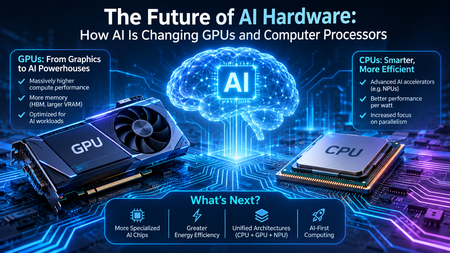
Artificial intelligence is rapidly transforming the technology industry, and one of the biggest changes is happening at the hardware level. From personal computers and smartphones to massive data centers, AI is creating new demands for faster, more powerful, and more energy-efficient computing systems.
For many years, traditional CPUs and GPUs were designed primarily to handle general computing tasks, graphics processing, and complex calculations. However, modern AI applications require a different approach. Training large language models, generating images, processing natural language, and running intelligent applications locally all require enormous computing power.
As a result, hardware manufacturers are rethinking how processors are designed and how computing resources are used. Graphics processing units are becoming increasingly important for AI workloads, while specialized processors such as Neural Processing Units (NPUs) are finding their way into everyday computers and mobile devices.
So, what does the future of AI hardware look like, and how will artificial intelligence change GPUs and computer processors?
1. Why Artificial Intelligence Is Changing Computer Hardware
Traditional computer hardware was developed around workloads that involved sequential instructions, multitasking, data storage, and graphics rendering. While these systems remain essential, AI introduces a different type of computing challenge.
Machine learning models perform enormous numbers of mathematical operations, particularly matrix multiplication and other parallel calculations. These operations are fundamental to training neural networks and running modern AI models.
A conventional CPU can perform these calculations, but it is not always the most efficient solution for large-scale AI workloads. This is where specialized hardware becomes important.
AI applications increasingly require processors that can:
- Perform thousands of calculations simultaneously.
- Process large datasets with low latency.
- Handle complex neural network operations.
- Consume less electricity while delivering high performance.
- Transfer data efficiently between memory and processing units.
These requirements are influencing the development of almost every major hardware component, including processors, graphics cards, memory systems, and cooling technologies.
2. GPUs Are Becoming the Foundation of Modern AI Computing
Graphics processing units were originally developed to accelerate graphics rendering, particularly in gaming, animation, and professional visualization.
Unlike CPUs, which generally contain a relatively small number of powerful processing cores, GPUs contain many smaller processing units designed to handle numerous calculations simultaneously.
This parallel architecture makes GPUs particularly suitable for AI workloads.
Modern AI models require billions or even trillions of mathematical operations during training and inference. GPUs can distribute many of these operations across their processing cores, significantly accelerating computation compared with conventional CPU-only systems.
Companies such as NVIDIA and AMD are investing heavily in GPUs designed for artificial intelligence, high-performance computing, and data centers.
Modern AI-focused GPUs also incorporate specialized features such as:
- Dedicated matrix acceleration hardware.
- High-bandwidth memory.
- Advanced interconnect technologies.
- Improved power management.
- Software frameworks optimized for machine learning.
The importance of GPUs is also extending beyond large technology companies. Developers, researchers, businesses, and individual users increasingly rely on powerful graphics cards to run AI models and applications.
In the coming years, GPU development will likely focus not only on raw computing performance but also on memory capacity, energy efficiency, and the ability to handle increasingly complex AI workloads.
3. The Rise of NPUs: Specialized Processors for Artificial Intelligence
One of the most interesting developments in AI hardware is the growing popularity of Neural Processing Units, commonly known as NPUs.
An NPU is a specialized processor designed to accelerate artificial intelligence tasks, particularly neural network operations.
Unlike a traditional CPU, which is designed for general-purpose computing, or a GPU, which handles highly parallel workloads, an NPU focuses on efficiently executing specific AI operations.
NPUs are increasingly appearing in modern laptops, smartphones, tablets, and other consumer devices.
They can accelerate tasks such as:
- Real-time voice recognition.
- Background noise removal during video calls.
- Image enhancement and object detection.
- Local language processing.
- AI-powered productivity features.
- Intelligent camera functions.
One major advantage of NPUs is energy efficiency. Instead of sending every AI task to a cloud server or using a power-hungry GPU, a device can perform suitable operations locally.
This approach is particularly valuable for laptops and smartphones, where battery life and thermal performance are important.
As AI applications become more common, NPUs could become a standard component of consumer processors.
4. CPUs Are Evolving to Support AI Workloads
Although GPUs receive much of the attention in discussions about AI hardware, CPUs remain an essential part of modern computing systems.
The CPU coordinates system operations, manages applications, processes instructions, and communicates with other hardware components.
In AI systems, CPUs often handle data preparation, application logic, scheduling, and communication between different processing units.
Processor manufacturers are therefore developing CPUs with improved AI capabilities.
Modern processor designs increasingly combine traditional CPU cores with integrated graphics and dedicated AI acceleration hardware. This approach allows computers to distribute workloads more efficiently.
For example, a computer might use:
- The CPU for operating system operations and general applications.
- The GPU for demanding AI calculations and graphics processing.
- The NPU for low-power AI tasks running continuously in the background.
This combination creates a more flexible computing architecture.
Instead of relying on a single processor for every task, future computers will increasingly use multiple specialized processing units working together.
5. AI PCs Will Transform the Personal Computer Market
AI-powered personal computers are becoming an important part of the hardware industry’s future.
Traditional computers mainly depend on CPUs and GPUs for everyday applications. AI PCs introduce additional hardware capabilities, particularly dedicated NPUs that can accelerate supported AI features.
These computers can perform certain AI operations directly on the device rather than relying entirely on internet-based services.
Local AI processing offers several advantages.
Better privacy: Sensitive information can remain on the user’s computer instead of being sent to external servers.
Lower latency: Certain AI operations can run without waiting for a remote server to respond.
Improved availability: Local AI features can continue working even when internet connectivity is limited.
Reduced cloud dependence: Businesses and individuals may be able to perform more AI tasks without constantly paying for cloud computing resources.
However, not every AI application will run efficiently on a consumer computer. Large models may still require powerful GPUs, substantial memory, or cloud-based infrastructure.
The future will likely involve a combination of local AI processing and cloud computing, with each handling the workloads it can perform most efficiently.
6. Memory Is Becoming Just as Important as Processor Performance
One important aspect of AI hardware that often receives less attention is memory.
AI models can require enormous amounts of data to be stored and accessed during computation. Even a powerful GPU may struggle to deliver its full performance if it cannot receive data quickly enough.
This is why memory bandwidth and capacity have become critical considerations in AI hardware development.
High Bandwidth Memory (HBM) is particularly important in advanced AI accelerators because it allows processors to access large amounts of data at extremely high speeds.
Meanwhile, conventional computer memory technologies such as DDR5 and newer generations of RAM remain important for workstations, servers, and consumer PCs.
Memory requirements will continue to increase as AI models become larger and more sophisticated.
Future hardware development will therefore focus on improving communication between processors and memory, reducing bottlenecks, and making data movement more energy-efficient.
In many AI systems, improving memory performance can be just as important as increasing the number of processor cores.
7. Energy Efficiency Will Become a Major Priority
AI computing requires substantial electrical power, particularly when training large models or operating thousands of GPUs in data centers.
As AI adoption increases, energy consumption and cooling requirements are becoming major challenges for hardware manufacturers and infrastructure providers.
Simply building faster processors is not enough. The industry also needs processors that can deliver more computing performance while consuming less electricity.
Several technologies are helping address this challenge:
- More efficient semiconductor manufacturing processes.
- Specialized AI accelerators.
- Improved chip architecture.
- Advanced power management.
- High-efficiency memory systems.
- Liquid cooling for high-density computing environments.
Energy efficiency is especially important for mobile devices and laptops, where excessive power consumption can reduce battery life and increase heat.
For data centers, efficient AI hardware can reduce operating costs and improve the sustainability of large-scale computing infrastructure.
Future processor development will increasingly be measured by performance per watt rather than raw processing speed alone.
8. Chiplet Architecture and Advanced Semiconductor Packaging
As semiconductor manufacturing becomes more complex, chip designers are exploring new ways to increase performance without relying entirely on larger individual chips.
One promising approach is chiplet architecture.
Instead of manufacturing an entire processor as one large piece of silicon, chiplet-based designs combine multiple smaller semiconductor components into a single package.
Different chiplets can perform different functions, including CPU processing, graphics acceleration, memory control, and specialized AI operations.
This approach offers several potential advantages:
- Greater design flexibility.
- Better manufacturing efficiency.
- Easier integration of specialized components.
- Improved scalability.
- Opportunities for higher overall performance.
Advanced semiconductor packaging also helps connect these components with high-speed communication pathways.
For AI hardware, this is particularly important because modern computing systems need to move enormous amounts of information between processors and memory.
As AI workloads continue to grow, chiplet designs and advanced packaging technologies could play an increasingly important role in the next generation of processors.
9. Will Cloud AI or Local AI Dominate the Future?
Another major question concerns where artificial intelligence will actually run.
Cloud AI relies on powerful remote servers to process requests. This approach allows users to access advanced AI models without owning expensive hardware.
Local AI, on the other hand, runs directly on personal computers, smartphones, or other devices.
Both approaches have advantages and limitations.
Cloud-based AI offers access to powerful computing infrastructure and large models, but it depends on internet connectivity and remote resources.
Local AI provides greater control over data, potentially lower latency, and reduced dependence on external services. However, device hardware limits the size and complexity of the models that can run efficiently.
The most practical future is likely to be a hybrid approach.
Smaller tasks, such as voice processing, image enhancement, and basic AI assistance, can run locally. More demanding operations, such as training large models or processing complex requests, can be handled by cloud infrastructure.
This combination will influence how future CPUs, GPUs, NPUs, and memory systems are designed.
10. What the Future of AI Hardware Means for Consumers
The transformation of AI hardware will have a direct impact on ordinary computer users.
Over the next several years, consumers can expect computers with more capable AI acceleration, better energy efficiency, and improved integration between different processing units.
For gamers, advances in GPUs could bring improved graphics technologies, smarter rendering techniques, and more sophisticated game environments.
For content creators, AI acceleration could make video editing, image generation, audio processing, and other demanding workflows faster.
For professionals, AI-powered computers could improve productivity by handling repetitive tasks and processing information more efficiently.
For everyday users, features such as intelligent search, voice assistants, real-time translation, and automatic image enhancement may become increasingly integrated into operating systems and applications.
However, buying the most powerful hardware will not always be necessary. The right configuration will depend on the applications a person actually uses.
For basic productivity, an efficient modern processor with integrated graphics and an NPU may be sufficient. Professionals working with advanced AI models may benefit from dedicated GPUs with substantial memory capacity.
Conclusion: AI Is Redefining the Future of Computer Hardware
Artificial intelligence is changing the hardware industry at every level.
GPUs are becoming essential tools for large-scale AI computation, CPUs are evolving to coordinate increasingly complex workloads, and NPUs are bringing specialized AI acceleration to everyday devices.
At the same time, memory technologies, semiconductor packaging, cooling systems, and energy-efficient architectures are becoming increasingly important.
The biggest change is that future computers will no longer depend on a single processor to handle every type of task. Instead, they will combine multiple specialized processing units that work together to deliver better performance and efficiency.
For consumers, businesses, and technology enthusiasts, this transformation will create new opportunities and reshape expectations about what computers can accomplish.
AI is not simply changing the software we use. It is fundamentally changing the hardware that makes modern computing possible.
The next generation of computers will be designed not just for traditional computing, but for an increasingly intelligent and AI-powered world.