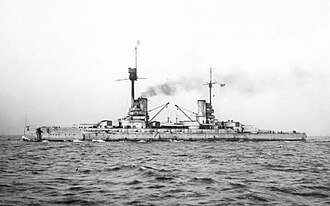
SMS Friedrich der Grosse (1911): The Kaiser-Class Battleship That Led Germany’s High Seas Fleet
The SMS Friedrich der Grosse, launched in 1911, was one of the most important battleships of the German Imperial Navy during the years immediately preceding and throughout the First World War. As the second ship of the Kaiser class, she represented a significant stage in the development of German dreadnought design, combining heavy armor, a powerful main battery, and modern steam-turbine propulsion. More than simply a formidable warship, Friedrich der Grosse served as the flagship of the German High Seas Fleet for much of the early war, participated in major naval operations, and ultimately shared the fate of the Imperial German Navy at Scapa Flow in 1919. Her career reflects the ambitions, technological advances, strategic limitations, and eventual collapse of Germany’s pre-1918 naval power.
Origins and Construction of SMS Friedrich der Grosse
The Kaiser-Class Dreadnought Program
The construction of Friedrich der Grosse emerged from Germany’s effort to build a modern battle fleet capable of challenging the Royal Navy. The naval rivalry between Germany and Britain had intensified during the early twentieth century, particularly after the launch of HMS Dreadnought in 1906 transformed battleship design. The dreadnought concept emphasized a uniform heavy-caliber main battery, improved armor protection, and greater speed, rendering many older pre-dreadnought battleships technologically obsolete almost overnight.
The German Imperial Navy responded with a succession of increasingly sophisticated battleship classes. The Kaiser class, authorized under Germany’s 1909 naval construction program, introduced several important changes over earlier German dreadnoughts. Most notably, the new ships adopted steam turbines rather than the traditional reciprocating steam engines used in many preceding designs. Turbines offered advantages in power delivery, machinery arrangement, and potentially speed, while also creating opportunities for more efficient placement of the main gun turrets. The Kaiser class consisted of five ships: SMS Kaiser, SMS Friedrich der Grosse, SMS Kaiserin, SMS König Albert, and SMS Prinzregent Luitpold.
Friedrich der Grosse was ordered under the provisional contract name Ersatz Heimdall, indicating that she was intended to replace the older coastal-defense vessel SMS Heimdall. Her name honored Frederick II of Prussia, commonly known as Frederick the Great, a monarch remembered for his military leadership and his role in the expansion of Prussian power. Naming a modern battleship after such a prominent historical figure reflected the close relationship between the Imperial German Navy, the Prussian military tradition, and the political symbolism of the German Empire.
Launch and Commissioning
The ship was built by AG Vulcan at Hamburg, one of Germany’s leading shipbuilding companies. Her keel was laid down on 26 January 1910, and she was launched on 10 June 1911. The launching ceremony was a significant public and political event, reflecting the prestige associated with the construction of a major capital ship. Following her launch, the battleship underwent fitting-out work, machinery installation, and trials before being transferred to the fleet.
Friedrich der Grosse was officially commissioned on 15 October 1912. After further preparation and exercises, she became ready for active fleet service in early 1913. Her entry into service came at a moment when European naval competition was reaching a dangerous peak. Germany possessed a powerful modern fleet, but Britain still held a substantial numerical advantage in battleships, battlecruisers, and global naval infrastructure. Consequently, Friedrich der Grosse was not designed to operate in isolation; she was intended to function as part of a battle fleet whose strength lay in concentration, disciplined maneuver, and coordinated gunnery.
Design and Technical Characteristics
Hull, Dimensions, and General Arrangement
Friedrich der Grosse was a large steel-hulled dreadnought measuring approximately 172.4 meters in overall length, with a beam of 29 meters. At full load, she displaced about 27,000 metric tons. Her draft was approximately 9.1 meters forward and slightly less aft, reflecting the substantial weight of her armor, machinery, ammunition, and fuel.
The ship’s appearance was characteristic of German dreadnought design of the period. She possessed a long forecastle extending over much of the hull, an inverted bow, a relatively compact superstructure, and two pole masts used for observation, signaling, and fire-control purposes. Two widely separated funnels discharged smoke from the boiler rooms. The arrangement gave the vessel a purposeful, functional appearance, emphasizing the need to combine seaworthiness with efficient fighting capability.
Unlike some earlier German battleships, Friedrich der Grosse avoided the less efficient hexagonal turret arrangement that had limited the firing arcs of previous designs. Instead, her main battery was arranged in five twin turrets. Three turrets were placed along the centerline, while two were mounted en echelon amidships. This arrangement allowed the ship to bring a substantial number of guns to bear on either broadside and improved the overall efficiency of her main armament.
Propulsion and Performance
One of the most important innovations of the Kaiser class was its adoption of steam-turbine propulsion. Friedrich der Grosse was powered by three sets of AEG-Curtis steam turbines, each driving one propeller shaft. Steam was generated by sixteen coal-fired water-tube boilers, whose exhaust was carried through the ship’s two funnels. The machinery produced approximately 27,600 indicated horsepower according to commonly cited technical references, while some contemporary or secondary sources provide higher power figures depending on the measurement method used.
During trials, the battleship reached a maximum speed of approximately 22.4 knots, equivalent to about 41.5 kilometers per hour. This speed gave her a useful combination of mobility and tactical flexibility for a ship of her size and protection. Her coal capacity was approximately 3,600 metric tons, and at a cruising speed of 12 knots she could achieve a range of roughly 7,900 nautical miles under favorable conditions. Her endurance was important because German fleet operations required long periods of steaming in the North Sea, often under conditions where replenishment opportunities were limited.
Coal-fired propulsion, however, also imposed practical burdens. Large quantities of fuel had to be stored, handled, and moved into the boiler rooms, while the process of firing boilers generated smoke and demanded considerable labor. The ship’s machinery spaces required a large engineering crew, and sustained high-speed operations could consume fuel rapidly. Nevertheless, for its time, Friedrich der Grosse’s propulsion system represented a major advance over earlier battleship machinery.
Armament and Armor Protection
Main and Secondary Batteries
Friedrich der Grosse carried ten 30.5-centimeter SK L/50 guns mounted in five twin turrets. These weapons formed the ship’s principal offensive armament and were intended for long-range combat against enemy battleships. The guns were powerful by contemporary standards, and their placement allowed the vessel to deliver a heavy broadside. Although the 12-inch caliber was smaller than the 13.5-inch and 15-inch weapons later adopted by some British battleships, German naval designers placed considerable emphasis on accuracy, armor protection, shell quality, and effective fire control.
The secondary battery consisted of fourteen 15-centimeter SK L/45 guns mounted in casemates along the sides of the hull. These weapons were intended primarily for use against enemy cruisers, destroyers, and other lighter vessels. Their placement in casemates was common among battleships of the era, although such positions could become vulnerable in heavy seas or during combat damage.
For defense against torpedo boats and destroyers, Friedrich der Grosse initially carried eight 8.8-centimeter guns in casemates. During the war, her lighter armament was modified, and four 8.8-centimeter anti-aircraft guns were also fitted to provide at least limited protection against aircraft. The ship was additionally equipped with five 50-centimeter torpedo tubes, including a bow tube and broadside-mounted tubes. These weapons offered a short-range offensive option, although battleship torpedoes were generally secondary to the main and secondary gun batteries.
Heavy Krupp Armor
Protection was a defining feature of Friedrich der Grosse and the Kaiser class as a whole. German battleship design placed particular emphasis on the ability to withstand enemy gunfire while preserving the fighting efficiency of the ship. The central armored citadel was protected by a main belt of Krupp cemented armor approximately 350 millimeters thick at its strongest sections. This belt protected vital machinery spaces, ammunition magazines, and other essential areas.
The main gun turrets were protected by armor reaching approximately 300 millimeters in thickness, while the conning tower received extremely heavy protection, with sides reported at around 400 millimeters. The conning tower was the central armored position from which the ship could be directed during combat, and its protection reflected the importance of preserving command and control even under intense fire.
The German approach to armor differed in emphasis from that of some foreign navies. Friedrich der Grosse was not designed merely to carry the largest possible guns; she was intended to remain operational after sustaining punishment. This philosophy contributed to the reputation of German battleships for resilience during the First World War. However, no armor scheme could eliminate the dangers posed by underwater explosions, plunging fire, or the cumulative effects of repeated hits.
Service During the First World War
Flagship of the High Seas Fleet
Following her entry into active service, Friedrich der Grosse became the flagship of the German High Seas Fleet in March 1913, replacing SMS Deutschland. A flagship served as the command center for a fleet’s senior leadership, carrying the admiral and staff responsible for planning and directing operations. Her role therefore extended beyond that of a heavily armed combat vessel: she was also a communications platform and a symbol of German naval authority.
As flagship, Friedrich der Grosse participated in training exercises, fleet maneuvers, and preparations for a potential conflict with Britain. Before the outbreak of war in 1914, the German fleet had to develop tactics suited to operating against a larger British force. These included concentrated battle formations, coordinated gunnery, torpedo attacks, and attempts to exploit local superiority in the North Sea.
When the First World War began, Friedrich der Grosse became part of the operational structure of the High Seas Fleet. Germany’s strategic position was difficult. The British Grand Fleet could generally rely on greater numerical strength, while Germany’s fleet was constrained by the geography of the North Sea and the danger of being blockaded. German naval planners therefore sought opportunities to weaken British forces through limited sorties, reconnaissance operations, and engagements conducted under favorable conditions.
The Battle of Jutland
Friedrich der Grosse’s most famous combat operation was the Battle of Jutland, fought on 31 May and 1 June 1916. This was the largest surface fleet engagement of the First World War and the only major battle in which the German High Seas Fleet and the British Grand Fleet confronted each other in substantial strength.
During the battle, Friedrich der Grosse operated with the German battle fleet and served as an important command and combat unit. The engagement involved complex maneuvers, long-range gunnery exchanges, torpedo attacks, and rapidly changing visibility. German battleships demonstrated strong tactical discipline and effective damage control, while British forces suffered significant losses despite ultimately retaining control of the strategic situation.
Friedrich der Grosse survived the battle without suffering the kind of catastrophic damage that destroyed several other capital ships. Her survival illustrated the effectiveness of German armor and damage-control practices, but the battle did not produce the decisive strategic victory Germany needed. Although the German fleet inflicted heavy losses on the British, the Grand Fleet remained operational and continued to enforce the broader naval balance. The High Seas Fleet would not again seriously challenge British command of the North Sea in a comparable fleet action.
Later Wartime Operations
Friedrich der Grosse continued to serve in German naval operations after Jutland, although the strategic value of large surface ships diminished as the war progressed. Submarine warfare, mines, coastal defenses, and the British blockade increasingly shaped the naval conflict. Battleships remained powerful, but their opportunities for decisive action were limited by the risks of engaging a stronger opponent and the political consequences of major losses.
In 1917, Friedrich der Grosse’s period as fleet flagship came to an end. She remained part of Germany’s naval forces, participating in training and operational activity. German naval units also supported operations in the Baltic Sea, including the campaign against Russian positions during Operation Albion in October 1917. These operations demonstrated that the Imperial German Navy could still project force in regional waters, even as the wider war placed increasing pressure on Germany’s military and economic resources.
The End at Scapa Flow
Internment After the Armistice
The collapse of Imperial Germany in late 1918 brought an abrupt end to the active career of Friedrich der Grosse. Under the terms associated with the armistice, a large portion of the German High Seas Fleet was required to surrender and be interned. The ships were taken to Scapa Flow, a major British naval anchorage in the Orkney Islands, where they were placed under Allied supervision.
Friedrich der Grosse arrived at Scapa Flow with other German capital ships in November 1918. The internment was an extraordinary episode in naval history: an entire fleet that had been built to challenge British sea power now lay immobilized under foreign guard. The ships’ crews were reduced, and the vessels remained in an uncertain legal and political position while negotiations over the postwar settlement continued.
Scuttling on 21 June 1919
On 21 June 1919, German crews began scuttling the interned ships at Scapa Flow. The operation was intended to prevent the fleet from being distributed among the victorious Allied powers. Friedrich der Grosse was among the battleships deliberately sunk, going down in Gutter Sound.
The scuttling became one of the most dramatic acts of naval denial in modern history. Rather than allowing their ships to be seized and incorporated into foreign fleets, the German sailors rendered them unusable. The event also symbolized the final destruction of the Imperial German Navy as a major independent battle fleet.
Friedrich der Grosse was later raised and broken up for scrap during the 1930s. Her dismantling reflected the changing practical and political value of First World War battleships, many of which were rendered obsolete by newer naval technology, treaty restrictions, and the development of air power and submarines.
Historical Significance and Legacy
SMS Friedrich der Grosse occupies an important place in the history of dreadnought development and German naval strategy. Her design demonstrated how the Imperial German Navy sought to balance offensive firepower with speed, protection, and tactical endurance. The use of steam turbines and the improved main-battery arrangement represented meaningful advances over earlier battleships, while her thick armor reflected Germany’s emphasis on survivability.
Her wartime career also illustrates the difference between tactical success and strategic achievement. At Jutland, German battleships performed effectively and inflicted serious losses on their opponents. Yet the battle did not break Britain’s naval dominance, and the High Seas Fleet remained largely constrained for the rest of the war. Friedrich der Grosse’s survival did not translate into a decisive strategic role.
Her final fate at Scapa Flow is equally significant. The battleship began her career as a symbol of imperial ambition and technological progress, but she ended it as part of a defeated fleet whose crews chose to sink their own vessels. Today, Friedrich der Grosse is remembered not only as a powerful Kaiser-class battleship but also as a representative of the naval arms race, the industrial scale of the First World War, and the dramatic transformation of maritime warfare in the early twentieth century.
Technical Specifications of SMS Friedrich der Grosse (1911)
| Specification | Details |
|---|---|
| Ship name | SMS Friedrich der Grosse |
| Ship type | Kaiser-class dreadnought battleship |
| Nation | German Empire |
| Namesake | Frederick II of Prussia, Frederick the Great |
| Builder | AG Vulcan, Hamburg |
| Keel laid down | 26 January 1910 |
| Launched | 10 June 1911 |
| Commissioned | 15 October 1912 |
| Fate | Scuttled at Scapa Flow on 21 June 1919 |
| Length overall | 172.4 meters |
| Beam | 29 meters |
| Draft | Approximately 9.1 meters forward |
| Normal displacement | Approximately 24,724 metric tons |
| Full-load displacement | Approximately 27,000 metric tons |
| Propulsion | Three AEG-Curtis steam turbines |
| Boilers | Sixteen coal-fired water-tube boilers |
| Propeller shafts | Three |
| Propellers | Three |
| Trial speed | Approximately 22.4 knots |
| Range | Approximately 7,900 nautical miles at 12 knots |
| Coal capacity | Approximately 3,600 metric tons |
| Main armament | Ten 30.5 cm SK L/50 guns in five twin turrets |
| Secondary armament | Fourteen 15 cm SK L/45 guns |
| Anti-torpedo-boat guns | Eight 8.8 cm guns, with wartime modifications |
| Anti-aircraft armament | Four 8.8 cm anti-aircraft guns |
| Torpedo armament | Five 50 cm torpedo tubes |
| Main belt armor | Up to approximately 350 mm |
| Turret armor | Up to approximately 300 mm |
| Conning tower armor | Up to approximately 400 mm |
| Typical crew | Approximately 1,084 officers and enlisted personnel |
Note: Technical figures can vary slightly between naval reference works, particularly for installed horsepower, crew strength, displacement measurements, and wartime armament configurations.
