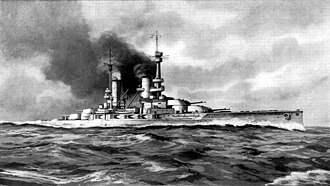
SMS König: The German Dreadnought That Led the High Seas Fleet at Jutland
SMS König was one of the most important battleships of the Imperial German Navy during the First World War. The lead ship of the four-vessel König class, she represented a significant refinement of the German dreadnought concept, combining ten 30.5-centimeter guns, heavy Krupp armor, modern turbine machinery, and a carefully arranged main battery designed to maximize broadside fire. Launched in 1913 and commissioned shortly after the outbreak of the First World War, König entered service at a moment when the German High Seas Fleet was preparing for a conflict against the numerically superior British Grand Fleet. Her career was unusually active for a German battleship: she participated in the Battle of Jutland in 1916 as the leading ship of the German battle line, fought in the Baltic during Operation Albion, and played a major role in the Battle of Moon Sound against Russian naval forces in 1917. After Germany’s defeat, König was interned at Scapa Flow and deliberately scuttled by her crew on 21 June 1919. Unlike most of the other major German wrecks there, she was never raised, and her remains still lie beneath the waters of the Orkney Islands.
The Birth of a New German Battleship
From the Kaiser Class to the König Class
The König class was the logical successor to the Kaiser class and formed part of the rapid evolution of German battleship design before the First World War. Germany’s naval program had been driven by the desire to build a battle fleet capable of posing a serious threat to Britain, whose Royal Navy remained the dominant naval force in the world. The appearance of HMS Dreadnought in 1906 had revolutionized capital-ship construction, and Germany responded with increasingly sophisticated dreadnoughts of its own. The Kaiser class introduced turbine propulsion and a more efficient arrangement of its main battery, while the subsequent König class refined these ideas further. Four ships were completed: SMS König, SMS Grosser Kurfürst, SMS Markgraf, and SMS Kronprinz. The class retained the same ten-gun main battery as its predecessors but altered the arrangement of those guns so that all five turrets were positioned on the centerline, a layout that offered improved firing arcs and represented a cleaner solution than the mixed centerline-and-en-echelon arrangement of the Kaiser class.
The König class also incorporated a revised propulsion system. Instead of relying exclusively on coal-fired boilers, the ships were equipped with a combination of coal- and oil-fired water-tube boilers. This allowed the German designers to experiment with oil as a supplementary fuel while retaining the established coal-burning infrastructure of the Imperial German Navy. Three sets of Parsons steam turbines drove three propeller shafts, providing enough power for the battleships to reach approximately 21 knots. Although that speed was slightly lower than the maximum achieved by some earlier German dreadnoughts, the König class emphasized protection, firepower, and tactical efficiency rather than simply pursuing the highest possible speed.
Construction and Naming
König was ordered under the provisional designation “S”, rather than a replacement name, and was constructed at the Kaiserliche Werft in Wilhelmshaven. Her keel was laid down in October 1911, and the completed hull was launched on 1 March 1913. The launch ceremony was conducted by Albrecht, Duke of Württemberg, reflecting the ship’s connection to the southern German monarchy. She was named in honor of King William II of Württemberg, one of the rulers of the federal German Empire. The name König, meaning “King,” was therefore both a direct reference to the ship’s royal namesake and an expression of the political culture of imperial Germany.
Fitting-out proceeded rapidly, but the international situation deteriorated even faster. When König was commissioned into the High Seas Fleet on 9 August 1914, Germany was already at war. She entered service just days after the outbreak of the conflict and initially had to complete her trials and prepare her crew while the naval war was already underway. Her sea trials were completed in November 1914, after which she became operational with the III Battle Squadron. This timing meant that König never enjoyed the extended peacetime training period available to some earlier German dreadnoughts. Instead, her crew had to learn the complexities of operating a modern capital ship under wartime conditions.
Design and Engineering of SMS König
Dimensions and Hull
König measured approximately 175.4 meters in length and 29.5 meters in beam, making her slightly longer and wider than the Kaiser-class ships. Her normal displacement was approximately 25,800 metric tons, while full-load displacement approached 28,600–29,700 tons depending on the measurement standard and configuration used. Her draft was roughly 9.2 meters. These dimensions gave her the mass necessary to carry a powerful battery and heavy armor while maintaining adequate stability for North Sea operations.
The hull was divided into numerous watertight compartments and incorporated an extensive underwater protection system. German naval architects had learned from earlier battleship designs that survival depended not simply on thick side armor but also on preventing flooding from spreading through the ship. The König class therefore used a combination of armored decks, internal bulkheads, a torpedo bulkhead, and carefully subdivided machinery and ammunition spaces.
Visually, König possessed the unmistakable profile of an early twentieth-century German dreadnought. Her superstructure was relatively compact compared with later battleships, while two large funnels discharged exhaust from the boiler rooms. Two tall masts supported observation and signaling equipment and contributed to the ship’s fire-control system. Beneath this relatively simple exterior was an exceptionally complex warship containing thousands of mechanical and electrical components and accommodation for more than 1,100 officers and sailors.
Turbine Power
König was propelled by three sets of Parsons steam turbines, each driving its own propeller shaft. Steam was generated by fifteen water-tube boilers: three were oil-fired and twelve were coal-fired. The machinery produced approximately 43,300 shaft horsepower in many published specifications and gave the battleship a maximum speed of around 21 knots. Her fuel capacity included approximately 3,000 tons of coal and 600 tons of oil, while her operational range was approximately 8,000 nautical miles at economical cruising speed.
The combination of coal and oil was particularly significant because it represented a transitional stage in naval propulsion. Oil could be handled and burned more efficiently than coal and could provide rapid increases in steam production, but Germany lacked the secure petroleum resources enjoyed by some other naval powers. The König class consequently retained a large coal capacity while using oil as a supplementary fuel. This arrangement reflected both technological experimentation and the strategic realities of Germany’s resource position.
The turbines themselves were an important part of the ship’s performance. Compared with traditional reciprocating engines, turbines could provide high power with relatively smooth operation and made it easier to achieve sustained high speeds. The three-shaft arrangement also provided a degree of redundancy: damage to one propulsion unit did not necessarily mean complete loss of propulsion, an important consideration for a battleship expected to operate under fire.
The Weapons of König
Ten 30.5-Centimeter Main Guns
König’s main battery consisted of ten 30.5-centimeter SK L/50 guns mounted in five twin turrets. The most important difference from the preceding Kaiser class was the positioning of all five turrets along the ship’s centerline. Two turrets were forward, two were aft, and the fifth was located amidships. This arrangement meant that the heavy guns could be concentrated more effectively along the centerline and gave the ship excellent broadside capability.
The centerline arrangement also improved the ship’s ability to fire forward and aft compared with the earlier German layouts. More importantly, it simplified the tactical use of the battery because the guns did not have to rely on en-echelon turrets whose firing arcs could be affected by the ship’s superstructure. König could bring a powerful concentration of artillery against an enemy battle line while maneuvering in formation.
The 30.5-centimeter gun was a formidable weapon, although by the middle of the First World War some British battleships were carrying substantially larger 13.5-inch and 15-inch guns. Germany compensated to some extent through effective ammunition, fire control, gunnery training, and the strong protection of its battleships. König’s main guns were therefore only one part of a larger combat system in which armor, range-finding, observation, maneuver, and disciplined fire control were equally important.
Secondary Guns and Torpedoes
The secondary battery consisted of fourteen 15-centimeter guns mounted in casemates. These weapons were intended primarily for engaging cruisers, destroyers, torpedo boats, and other lighter vessels. They could also contribute to the battle line’s overall firepower when conditions allowed. The ship carried ten 8.8-centimeter weapons in her anti-torpedo and anti-aircraft battery, although the exact wartime arrangement changed as the ship was modified. Five 50-centimeter torpedo tubes provided another weapon against enemy capital ships.
The inclusion of torpedoes on a battleship reflected prewar naval doctrine, which expected major surface battles to include attacks by destroyers and torpedo craft. A battleship might use its own torpedoes during a close-range encounter, although in practice the main battery remained the principal offensive weapon. The secondary guns were equally important for keeping smaller vessels away from the battle line and defending the ship against torpedo attacks.
Armor and Survivability
A Battleship Built to Take Punishment
German battleship design emphasized protection to an exceptional degree. König’s main belt reached approximately 350 millimeters in its thickest central sections, while the upper belt was about 180 millimeters. Her armored decks varied from roughly 60 to 100 millimeters, depending on location. The main turrets were protected by armor reaching approximately 300 millimeters, and the forward conning tower had sides approximately 300 millimeters thick. Casemate armor reached about 170 millimeters.
This armor was intended to protect the ship’s most valuable components: magazines, machinery, steering equipment, and command positions. A battleship could survive a considerable number of hits if its vital systems remained intact, and German designers sought to maximize that possibility. The armor belt was therefore not simply a thick wall around the entire vessel; it formed part of a carefully planned protective system that worked together with internal subdivision and underwater defenses.
The strength of König’s protection became particularly evident during the Battle of Jutland. She was hit repeatedly by British heavy shells but survived, demonstrating the resilience of the German battle line. However, survival came at a cost: a battleship could absorb enormous amounts of punishment while still suffering damage to secondary weapons, superstructure, communications equipment, and other systems. Armor could prevent immediate destruction, but it could not make a ship immune to the cumulative effects of a major battle.
SMS König in the First World War
Joining the High Seas Fleet
After completing her trials, König joined the III Battle Squadron, V Division of the High Seas Fleet. Her sister ships joined her as they became operational, creating one of the most powerful homogeneous groups of dreadnoughts in the German Navy. The German naval strategy depended on the ability of the High Seas Fleet to concentrate its modern battleships for operations against the British Grand Fleet.
Germany’s problem was that Britain possessed more battleships and could sustain a prolonged blockade of the German coast. The High Seas Fleet therefore could not simply sail out and seek a decisive battle whenever it wished. German commanders instead attempted to create favorable opportunities through reconnaissance, fleet sorties, and operations designed to isolate portions of the British force. König became a central component of this strategy.
The Battle of Jutland
Leading the German Battle Line
König’s defining combat experience came during the Battle of Jutland, fought from 31 May to 1 June 1916. As the leading battleship of the German battle line, she occupied an extremely exposed position during the confrontation. The leading ships were among the first to engage British forces, and König came under heavy fire from several British battleships.
During the battle, König was struck by approximately ten large-caliber shells. Despite the severity of the engagement, her heavy armor and internal protection prevented the damage from becoming fatal. The ship continued to operate with the fleet and survived the battle, although she suffered casualties and damage that required subsequent repairs.
Her position at the front of the German line was tactically important. A battleship at the head of the formation had to absorb enemy fire while maintaining course and speed so that the ships behind could bring their guns into action. König’s performance demonstrated both the resilience of the ship and the effectiveness of German battle-line tactics. The German fleet inflicted severe losses on British forces, but the strategic result was less decisive. The Grand Fleet remained intact and Britain continued to control the wider naval situation.
Jutland therefore became a classic example of the distinction between tactical and strategic success. Germany could claim important battlefield achievements, but the British naval blockade remained in place and the High Seas Fleet did not obtain permanent command of the North Sea.
Operation Albion and the Battle of Moon Sound
German Intervention in the Baltic
König’s second major combat episode came in 1917, when German forces launched Operation Albion against Russian positions in the Baltic. The operation sought to seize strategic islands and establish control of the approaches to the Gulf of Riga. Germany committed substantial naval forces, including several modern battleships, to support the operation.
König became involved in the fighting around the Moon Sound area. The German force encountered Russian naval units attempting to prevent German control of the waterways. Among the Russian defenders was the pre-dreadnought battleship Slava, whose shallow draft prevented her from escaping through some of the deeper strategic routes available to the German ships.
On 17 October 1917, König and her sister ship Kronprinz engaged Russian forces in the Battle of Moon Sound. König played a central role in the action and inflicted serious damage on Slava. The Russian battleship was eventually forced into a position where she could no longer withdraw and was scuttled by her crew.
The action demonstrated the enormous advantage that modern dreadnoughts possessed over older pre-dreadnought battleships when operating in favorable conditions. König’s heavy guns and armor allowed her to dominate the engagement, while German minesweepers and supporting vessels helped clear routes through dangerous minefields. The success of the operation strengthened Germany’s position in the Baltic at a time when the Russian Empire was being destabilized by revolution.
The End of König
Internment at Scapa Flow
Germany’s defeat in 1918 brought an abrupt end to König’s active career. Under the terms of the armistice, much of the High Seas Fleet was ordered into internment. König and her sister ships were among the German warships sent to Scapa Flow in the Orkney Islands. The ships were placed under Allied supervision while negotiations proceeded over the final peace settlement.
The situation was humiliating for the German Navy. König had been designed to fight Britain’s Royal Navy, yet she was now effectively a prisoner in a British anchorage. Her weapons were disabled, her crew was drastically reduced, and her future remained uncertain. German commanders feared that the ships would be divided among the victorious powers and incorporated into foreign fleets.
Rear Admiral Ludwig von Reuter eventually decided that the fleet should be scuttled rather than surrendered. On 21 June 1919, while the British guard fleet was away conducting exercises, the German crews opened the necessary valves and began sinking their vessels. König went down at approximately 14:00.
A Battleship That Became an Underwater Monument
Unlike most of the major German warships sunk at Scapa Flow, König was never raised for scrap. Her wreck remains on the seabed in Scapa Flow, making her one of the most important surviving examples of a German dreadnought. The wreck lies largely upside down and has been extensively affected by both natural deterioration and salvage operations. Archaeological surveys have documented the remains of the hull, armor, machinery spaces, and other features.
The wreck is now protected as part of the historic maritime landscape of Scapa Flow. Together with SMS Markgraf and SMS Kronprinz, König is among the surviving German battleship wrecks that preserve tangible evidence of the end of the Imperial German Navy. Her survival underwater is especially valuable because most battleships of the dreadnought era were subsequently scrapped, modernized beyond recognition, or destroyed during later conflicts.
The Legacy of SMS König
SMS König occupies a special position in the history of First World War naval warfare. She was not merely a representative example of the German dreadnought fleet; she was one of its leading combat vessels. As the first ship of her class, she embodied the German Navy’s effort to improve upon the Kaiser-class design and create a more efficient and tactically flexible battleship. Her centerline arrangement of five twin turrets, heavy armor, mixed-fuel turbine machinery, and 21-knot speed made her a formidable capital ship by the standards of 1914.
Her wartime record was equally significant. At Jutland she led the German battle line into the largest surface fleet action of the First World War and endured heavy enemy fire. In the Baltic she participated in the defeat of Russian naval resistance at Moon Sound and demonstrated the effectiveness of modern dreadnought artillery against older battleships. Yet her career also illustrates the limitations of battleship power. Even the survival and tactical effectiveness of König could not overcome the broader strategic realities facing Germany: British numerical superiority, the blockade, limited access to overseas resources, and the inability of the High Seas Fleet to secure lasting control of the North Sea.
Her final fate gives the ship an additional historical dimension. König began life as a symbol of German imperial ambition and ended it upside down on the seabed of Scapa Flow, deliberately sunk by the very navy that had built her. Unlike her sister ships, she was never recovered and dismantled, leaving her as a permanent underwater reminder of the dramatic end of the German Empire’s naval ambitions.
Today, SMS König is therefore important both as a warship and as an archaeological relic. Her wreck connects the technological revolution of the dreadnought era with the political collapse that followed the First World War. From the shipyards of Wilhelmshaven to the battlefields of Jutland and Moon Sound, and finally to the quiet waters of Scapa Flow, König’s career traces the rise, combat, and disappearance of one of the most ambitious battle fleets of the early twentieth century.
Technical Specifications of SMS König
| Specification | Details |
|---|---|
| Ship name | SMS König |
| English meaning | “King” |
| Ship type | Dreadnought battleship |
| Class | König class |
| Nation | German Empire |
| Namesake | King William II of Württemberg |
| Builder | Kaiserliche Werft, Wilhelmshaven |
| Construction number | 33 |
| Keel laid down | October 1911 |
| Launched | 1 March 1913 |
| Commissioned | 9 August 1914 |
| Sea trials completed | November 1914 |
| Fate | Scuttled at Scapa Flow, 21 June 1919 |
| Wreck status | Still on the seabed; never raised |
| Normal displacement | Approximately 25,797 metric tons |
| Full-load displacement | Approximately 29,669 metric tons |
| Length overall | Approximately 175.4 m |
| Beam | Approximately 29.5 m |
| Draft | Approximately 9.2 m |
| Propulsion | 3 Parsons steam-turbine sets |
| Propeller shafts | 3 |
| Boilers | 12 coal-fired + 3 oil-fired water-tube boilers |
| Machinery output | Approximately 43,300 shp |
| Maximum speed | Approximately 21 knots |
| Fuel capacity | Approximately 3,000 tons coal + 600 tons oil |
| Range | Approximately 8,000 nautical miles at economical speed |
| Crew | Approximately 41 officers + 1,095 enlisted personnel |
| Main armament | 10 × 30.5 cm SK L/50 guns |
| Main turrets | 5 × twin turrets |
| Secondary armament | 14 × 15 cm guns |
| Anti-torpedo/AA armament | 8.8 cm guns, modified during the war |
| Torpedo armament | 5 × 50 cm submerged torpedo tubes |
| Main belt armor | Up to approximately 350 mm |
| Upper belt armor | Approximately 180 mm |
| Deck armor | Approximately 60–100 mm |
| Turret armor | Up to approximately 300 mm |
| Conning tower armor | Approximately 300 mm |
| Casemate armor | Approximately 170 mm |
| Major battle | Battle of Jutland, 1916 |
| Major Baltic action | Battle of Moon Sound, 1917 |
| Final location | Scapa Flow, Orkney, Scotland |
Technical figures vary somewhat between historical references, particularly for displacement, fuel capacity, crew strength, and the exact wartime configuration of the secondary and anti-aircraft batteries. The surviving wreck has also been extensively surveyed, providing archaeological evidence that complements the historical specifications.
