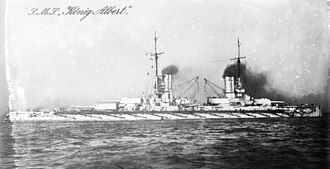
SMS König Albert: The Kaiser-Class Dreadnought of Imperial Germany
SMS König Albert was one of the most powerful battleships of the Imperial German Navy when she entered service in 1913. The fourth ship of the Kaiser class, she belonged to a generation of dreadnoughts created during the intense Anglo-German naval arms race that preceded the First World War. Although she shared the basic design of her sisters SMS Kaiser, SMS Friedrich der Grosse, SMS Kaiserin, and SMS Prinzregent Luitpold, König Albert combined heavy armor, ten 30.5-centimeter guns, turbine propulsion, and a speed of more than 22 knots into a formidable fleet unit. Her career, however, was unusual because she was undergoing maintenance when the Battle of Jutland was fought in 1916 and consequently became the only operational German battleship of the High Seas Fleet that did not participate in that enormous confrontation. She later took part in Operation Albion in the Baltic, survived the First World War, was interned at Scapa Flow, and was deliberately scuttled there in June 1919. Raised more than a decade later, she was eventually broken up for scrap, bringing to an end the career of a battleship that had been built as a symbol of German imperial power.
The Origins of SMS König Albert
Germany and the Dreadnought Revolution
The construction of König Albert was a direct consequence of the transformation of battleship design during the first decade of the twentieth century. Germany had already begun building modern dreadnoughts when Britain launched HMS Dreadnought in 1906, but the British ship dramatically accelerated the naval arms race. Dreadnought’s combination of an all-big-gun battery, turbine propulsion, heavy armor, and high speed established a new standard for capital ships. Older pre-dreadnought battleships suddenly appeared technologically inferior, and major naval powers were compelled to invest enormous resources in new classes of ships.
For Imperial Germany, naval expansion was closely associated with the policies of Kaiser Wilhelm II and Grand Admiral Alfred von Tirpitz. Germany’s rapidly growing industrial economy, overseas commercial interests, and increasingly assertive foreign policy encouraged the creation of a fleet capable of challenging Britain’s naval dominance. The German objective was not necessarily to destroy the Royal Navy outright but to construct a force powerful enough that Britain could not attack Germany’s coastline or interfere with German interests without accepting potentially catastrophic losses.
The Kaiser class emerged from this strategy. Five battleships were built: Kaiser, Friedrich der Grosse, Kaiserin, König Albert, and Prinzregent Luitpold. They incorporated several important advances over preceding German dreadnoughts, including turbine propulsion and a more efficient arrangement of their main artillery. The ships were approximately 172.4 meters long, displaced around 27,000 tons at full load, and carried ten 30.5-centimeter guns. König Albert was the fourth member of the class and became one of the last German dreadnoughts to enter service before the outbreak of the First World War.
Construction and Naming
König Albert was constructed by Schichau-Werke at Danzig. Her keel was laid down on 17 July 1910, and she was launched on 27 April 1912. Following fitting-out and trials, she was commissioned into the Imperial German Navy on 31 July 1913. The ship cost approximately 45.76 million marks, an enormous investment that reflected the complexity of constructing a modern battleship.
Her name honored Albert, King of Saxony, who had ruled the Kingdom of Saxony from 1873 until his death in 1902. The naming was politically significant because the German Empire was a federal monarchy composed of several kingdoms, grand duchies, duchies, principalities, and other states. Although ultimate imperial authority belonged to the German emperor, individual dynasties retained considerable prestige. A major battleship carrying the name König Albert therefore symbolized both German imperial unity and the continuing importance of Saxony within the empire.
By the time she entered service, however, the international political situation had become increasingly dangerous. Germany and Britain were locked in a naval competition, France and Russia were expanding their military capabilities, and European alliances had divided the continent into opposing blocs. König Albert entered the fleet only about a year before the assassination of Archduke Franz Ferdinand and the outbreak of the First World War.
Design and Engineering
Hull and General Characteristics
König Albert measured approximately 172.4 meters in overall length and 29 meters in beam. Her draft was approximately 9.1 meters, while her full-load displacement was around 27,000 metric tons. These dimensions made her a substantial warship, but she was still designed to operate in the relatively confined waters of the North Sea rather than as a global cruiser. Her long forecastle and inverted bow were characteristic of contemporary German battleship design, while the two masts and two funnels gave her a recognizable dreadnought silhouette.
The ship’s internal organization reflected the enormous complexity of a twentieth-century battleship. Beneath the armored exterior were boiler rooms, turbine compartments, ammunition magazines, fuel bunkers, crew accommodations, electrical equipment, steering machinery, pumps, ventilation systems, and numerous watertight compartments. A battleship of this type had to function as a self-contained military community for weeks at sea, with hundreds of sailors and officers operating machinery and weapons under difficult conditions.
One of the most important features of the Kaiser-class design was the arrangement of its main gun turrets. Earlier German dreadnoughts had used a hexagonal arrangement that limited the number of heavy guns that could fire in certain directions. The Kaiser class adopted a more efficient configuration with three turrets on the centerline and two mounted en echelon amidships. Two of the centerline turrets were positioned in a superfiring arrangement toward the stern. This arrangement allowed the ship to deliver a powerful broadside while reducing some of the limitations associated with earlier German layouts.
Turbine Propulsion
König Albert was powered by three sets of steam turbines driving three propeller shafts. Steam was produced by sixteen water-tube boilers, and the machinery developed approximately 39,800 horsepower in the ship’s operational configuration. Her maximum speed was approximately 22.1 knots, or roughly 41 kilometers per hour. The combination of speed and armor allowed the battleship to maneuver effectively with the main German battle line.
Her propulsion system represented an important step forward for the German Navy. Steam turbines were smoother and more compact than the reciprocating machinery used in many earlier battleships, and their adoption allowed German designers to make more efficient use of internal space. The Kaiser class was the first group of German battleships to rely on turbines as its primary propulsion system.
König Albert carried approximately 3,600 metric tons of coal and had a theoretical range of about 7,900 nautical miles at 12 knots. That endurance was sufficient for extended operations, although coal consumption increased dramatically at high speed. The limitations of coal-fired machinery also meant that the High Seas Fleet depended heavily on German naval bases and carefully planned logistics.
Armament of König Albert
The Ten-Gun Main Battery
König Albert’s primary armament consisted of ten 30.5-centimeter SK L/50 guns mounted in five twin turrets. These guns were the battleship’s principal offensive weapons and were designed to engage enemy capital ships at long range. A full broadside could place ten heavy shells on an enemy formation, giving the ship considerable striking power.
The 30.5-centimeter caliber was not the largest available to battleship designers of the period. Several British battleships eventually carried 13.5-inch and 15-inch weapons. German naval planners nevertheless considered the 30.5-centimeter gun an effective compromise between firepower, ammunition weight, turret size, armor protection, and rate of fire. German designers also placed considerable emphasis on gunnery training, range-finding, fire control, and the ability to maintain accurate fire under difficult conditions.
The five turrets were distributed so that three were on the centerline and two were positioned amidships in en-echelon positions. This arrangement allowed both amidships turrets to fire across the ship’s broadside. The two aft centerline turrets were arranged one behind the other, with the higher turret able to fire over the lower one. Such an arrangement increased tactical flexibility and helped the battleship make more effective use of its ten heavy guns.
Secondary and Anti-Torpedo Armament
The secondary battery consisted of fourteen 15-centimeter SK L/45 guns mounted in armored casemates. These weapons were intended to engage enemy cruisers, destroyers, torpedo boats, and other lighter targets. Their relatively high rate of fire made them particularly useful in situations where smaller enemy vessels attempted to approach the battle line.
König Albert also carried 8.8-centimeter weapons for close-range defense. Her wartime armament included four dedicated 8.8-centimeter anti-aircraft guns, reflecting the growing realization that aircraft would become a significant threat to naval forces. Aircraft in 1914–1918 were still relatively primitive compared with later generations, but they were increasingly capable of reconnaissance, artillery spotting, and attacks against ships.
Five 50-centimeter torpedo tubes completed the ship’s offensive armament. One tube was installed in the bow and four were mounted on the broadside. Although the torpedoes were secondary to the ship’s artillery, they provided a potentially lethal weapon at close range. The existence of torpedo armament on a battleship illustrates how naval doctrine before the First World War anticipated complex engagements involving multiple weapon systems rather than pure artillery duels.
Armor and Survivability
Protection of the Vital Areas
König Albert was built around a heavy armor scheme intended to preserve her ability to fight after receiving enemy fire. Her main armored belt reached approximately 350 millimeters in thickness around the central citadel. This protected the machinery, ammunition magazines, and other critical spaces. The use of Krupp cemented armor provided considerable resistance to contemporary armor-piercing shells.
Her main gun turrets were protected by armor up to approximately 300 millimeters thick, while the conning tower received protection of around 400 millimeters. The conning tower was particularly heavily armored because it served as the command position during combat. Preserving the officers responsible for steering, gunnery, and tactical decisions was essential to keeping a heavily damaged battleship operational.
The armor protection was complemented by internal subdivision and underwater protection. Designers understood that a battleship could be defeated not only by direct hits on its guns and machinery but also by flooding caused by torpedoes or shells striking below the waterline. Watertight compartments, armored decks, and protective bulkheads therefore formed an important part of the ship’s defensive system.
The German approach to battleship protection became particularly respected during the First World War. German capital ships were generally capable of absorbing substantial punishment and continuing to operate. Nevertheless, no armor scheme could make a battleship invulnerable. A sufficiently powerful shell, a magazine explosion, repeated flooding, or multiple underwater hits could still result in catastrophic damage.
Service Before and During the First World War
Early Fleet Service
After commissioning in July 1913, König Albert joined the High Seas Fleet. She initially served with the III Battle Squadron, alongside other Kaiser-class battleships. Her first period of service was devoted largely to exercises, gunnery practice, fleet maneuvers, and the development of tactics suitable for operations against the British Grand Fleet.
Before the war, König Albert also participated in a long-distance cruise with her sister ship SMS Kaiser. The voyage took the German battleships to South America and South Africa, demonstrating that the vessels could operate far from their home bases and giving their crews experience with extended deployments. The cruise also had a diplomatic dimension, allowing Germany to display its naval strength abroad while demonstrating the growing reach of its modern fleet.
When the First World War began in August 1914, König Albert became part of Germany’s main naval force in the North Sea. German commanders faced a difficult strategic problem. The British Grand Fleet possessed a numerical advantage, while Britain could use its geographical position and worldwide network of bases to sustain a blockade. Germany therefore had to balance the desire to challenge British naval power against the danger of losing irreplaceable capital ships.
Why König Albert Missed Jutland
One of the most remarkable facts about König Albert’s wartime career is that she did not participate in the Battle of Jutland, despite being an active member of the High Seas Fleet. Jutland was fought on 31 May and 1 June 1916 and became the largest surface naval engagement of the First World War.
The reason for König Albert’s absence was not strategic withdrawal or mechanical failure during the battle. She was undergoing maintenance in dry dock when the fleet sailed for the operation. The Jutland 1916 Centenary Initiative records that she entered dry dock on 29 May, just two days before the battle, and consequently missed the engagement entirely.
This circumstance gave König Albert an unusual place in the history of the Kaiser class. Her sister ships fought in the battle, while she remained safely in harbor. Had she been available, she would have added another ten 30.5-centimeter guns to the German battle line. Her absence therefore illustrates how maintenance schedules could have strategic consequences for fleet operations. Even the most powerful battleship was useless in battle if she was unavailable when the fleet needed her.
Operation Albion
König Albert later took part in Operation Albion, a major German amphibious and naval offensive against Russian-held positions in the Baltic Sea in October 1917. The operation targeted islands and strategic positions in the Gulf of Riga and was intended to secure German control of important waterways while weakening Russian military power.
For König Albert, the Baltic campaign provided an opportunity to perform the kind of direct naval-support mission for which battleships were particularly valuable. Her heavy guns could bombard coastal positions, while her presence helped protect German transports and other vessels involved in the operation. German forces achieved significant success, and the campaign demonstrated that the High Seas Fleet could still exert substantial regional power even though it had not broken British naval dominance in the North Sea.
The operation also took place during a period when Russia was descending into political revolution. The Russian military was increasingly affected by political instability, declining morale, and logistical problems. Germany’s success in the Baltic therefore reflected both its own naval capabilities and the deteriorating condition of its opponent.
The End of the Imperial German Navy
Armistice and Internment
By late 1918, Germany was militarily and economically exhausted. The High Seas Fleet remained a powerful collection of warships, but Germany’s overall strategic position had deteriorated beyond recovery. The armistice of November 1918 required the bulk of the German fleet to be interned.
König Albert was among the German capital ships sent to Scapa Flow, the great British naval anchorage in the Orkney Islands. The internment was a humiliating conclusion to a naval program that had once been intended to challenge British maritime supremacy. German battleships that had been built at enormous expense were now effectively prisoners, their crews reduced and their weapons disabled.
The ships remained at Scapa Flow while the Allies negotiated the final peace settlement. German naval officers feared that the vessels would ultimately be divided among the victorious powers and incorporated into foreign fleets. Rear Admiral Ludwig von Reuter, who commanded the interned German ships, eventually decided that the fleet should be destroyed rather than surrendered intact.
The Scuttling of König Albert
On 21 June 1919, German crews began opening the sea valves and scuttling their ships. König Albert was among the battleships sunk that day. According to historical accounts, she capsized and sank at approximately 12:54. The event was extraordinary: an entire modern fleet, created through decades of industrial investment and naval planning, was deliberately destroyed by its own personnel.
The scuttling did not mean the end of König Albert’s physical existence. Unlike some of the deeper German wrecks at Scapa Flow, she was eventually recovered. The wreck was sold for salvage in 1934, raised on 31 July 1935, and later towed to Rosyth. Dismantling continued through the mid-1930s, and the ship was ultimately broken up for scrap.
Her recovery demonstrated the enormous technical capabilities of interwar salvage companies. Raising a battleship that had spent more than sixteen years underwater required large quantities of compressed air, pumping equipment, divers, temporary sealing arrangements, and careful control of the wreck’s buoyancy. Once raised, the steel and other materials were valuable enough to justify the considerable expense of the operation.
The Historical Legacy of SMS König Albert
SMS König Albert occupies an interesting position in naval history because her career combined the impressive capabilities of a modern dreadnought with an unusually quiet combat record. She was a powerful battleship that never fired her main guns in the Battle of Jutland because maintenance placed her in dry dock at precisely the moment the High Seas Fleet fought its greatest battle. Yet she still participated in other major operations, particularly in the Baltic, where her heavy artillery and substantial armor could be employed in support of amphibious warfare.
Her design illustrates the priorities of German naval engineering before the First World War. The ship combined ten heavy guns with thick armor, turbine propulsion, and a speed exceeding 22 knots. German designers were seeking a balanced warship that could survive heavy punishment while operating effectively as part of a battle fleet. König Albert’s construction also demonstrates how enormous the financial and industrial commitment to naval power had become. Her steel hull, turbines, armor, guns, boilers, and supporting systems represented the combined work of thousands of industrial workers and a huge network of German factories.
Perhaps the most striking aspect of her history is the contrast between her beginning and her end. König Albert entered service as a symbol of imperial confidence, carrying the name of a German king and representing the technological strength of the Kaiserreich. Six years later, she lay at the bottom of Scapa Flow, deliberately sunk by her own crew after Germany’s defeat. Her eventual salvage and scrapping ensured that almost nothing remained of the physical vessel, but her historical significance survived.
König Albert therefore represents more than one battleship in a long list of First World War warships. She embodies the naval arms race, the rise of the dreadnought, Germany’s attempt to challenge British sea power, the strategic limitations of the High Seas Fleet, the transformation of naval warfare during the First World War, and the collapse of the German Empire. Her career is also a reminder that technological superiority alone cannot determine the outcome of a war: strategy, geography, economics, logistics, politics, and human decisions are equally important.
Technical Specifications of SMS König Albert
| Specification | Details |
|---|---|
| Ship name | SMS König Albert |
| Ship type | Kaiser-class dreadnought battleship |
| Nation | German Empire |
| Namesake | Albert, King of Saxony |
| Builder | Schichau-Werke, Danzig |
| Construction number | 857 |
| Keel laid down | 17 July 1910 |
| Launched | 27 April 1912 |
| Commissioned | 31 July 1913 |
| Fate | Scuttled at Scapa Flow on 21 June 1919 |
| Wreck raised | 31 July 1935 |
| Scrapping | 1936–1937 |
| Length overall | 172.4 m |
| Length at waterline | Approximately 171.8 m |
| Beam | 29.0 m |
| Draft | Approximately 9.1 m |
| Design displacement | 24,724 metric tons |
| Full-load displacement | Approximately 27,000 metric tons |
| Propulsion | Three Parsons steam-turbine sets |
| Boilers | 16 marine water-tube boilers |
| Propeller shafts | 3 |
| Propellers | 3 |
| Machinery output | Approximately 39,800 shp |
| Maximum speed | Approximately 22.1 knots |
| Coal capacity | Approximately 3,600 metric tons |
| Range | Approximately 7,900 nautical miles at 12 knots |
| Crew | Approximately 41 officers and 1,043 enlisted personnel |
| Main armament | 10 × 30.5 cm SK L/50 guns |
| Main turrets | 5 × twin turrets |
| Secondary armament | 14 × 15 cm SK L/45 guns |
| Light/anti-torpedo armament | 12 × 8.8 cm guns, with wartime modifications |
| Anti-aircraft guns | 4 × 8.8 cm guns |
| Torpedo armament | 5 × 50 cm torpedo tubes |
| Main belt armor | Up to 350 mm |
| Main turret armor | Up to 300 mm |
| Conning tower armor | Up to 400 mm |
| Deck armor | Approximately 60–100 mm |
| Casemate armor | Approximately 170 mm |
| Primary wartime formation | III Battle Squadron, High Seas Fleet |
| Major operation | Operation Albion, 1917 |
| Battle of Jutland | Missed while undergoing maintenance in dry dock |
| Scapa Flow sinking | 21 June 1919 |
Technical figures can vary slightly among historical references, particularly for machinery output, displacement, fuel capacity, and wartime armament. The major characteristics—172.4-meter length, 29-meter beam, 27,000-ton full-load displacement, ten 30.5-centimeter guns, three turbine-driven shafts, and approximately 22.1-knot maximum speed—are consistently associated with König Albert.
