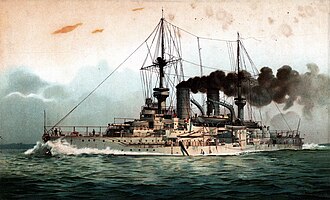
SMS Mecklenburg: The Forgotten Battleship of Imperial Germany
SMS Mecklenburg was one of the five Wittelsbach-class pre-dreadnought battleships built for the Imperial German Navy during a period when Germany was transforming itself into a major naval power. Commissioned in 1903, she represented the cutting edge of German battleship design for only a few years before the rapid development of dreadnoughts made her generation of warships obsolete. Nevertheless, Mecklenburg enjoyed a remarkably varied career. She served with the German battle fleet during peacetime, took part in training cruises and fleet exercises, was mobilized during the First World War, operated in the Baltic and North Sea, and later served in the much less glamorous roles of prison ship and floating barracks. Finally struck from the naval register in 1920, she was dismantled for scrap in 1921.
Although Mecklenburg never became famous for a decisive naval battle, her career illustrates one of the most important periods in naval history. Her story begins with the rise of the German Imperial Navy under Alfred von Tirpitz and ends with the destruction of the old German fleet after the First World War. Between those points, she demonstrates how quickly advances in naval artillery, propulsion, and ship design could turn an expensive battleship into a second-line vessel.
The Birth of SMS Mecklenburg
A Battleship for the Expanding Kaiserliche Marine
The Wittelsbach class was closely connected with the German naval expansion program of the late nineteenth century. In 1898, the German government adopted the first Naval Law associated with Admiral Alfred von Tirpitz, laying the foundations for a permanent battle fleet that could challenge the naval strength of other European powers. The five Wittelsbach-class ships were among the first battleships authorized under this program. They were similar in many respects to the preceding Kaiser Friedrich III class but featured a more comprehensive armor arrangement.
Mecklenburg was ordered under the contract name “D” and constructed by AG Vulcan at Stettin, one of the important shipbuilding centers of Imperial Germany. Her keel was laid down on 15 May 1900, and she was launched on 9 November 1901. She was completed considerably faster than her sister Schwaben and entered service on 25 June 1903. Her construction cost approximately 22.3 million marks, a substantial investment that reflected both the financial commitment of the German state and the enormous industrial resources required to build a modern battleship.
The name Mecklenburg referred to the historic German region and the House of Mecklenburg, a dynastic family whose territories lay in northern Germany along the Baltic coast. Her four sister ships were Wittelsbach, Wettin, Zähringen, and Schwaben, giving the class a distinctly historical and dynastic naming theme.
Design of the Wittelsbach-Class Battleships
When Mecklenburg entered service, she was a formidable warship. She measured approximately 126.8 meters in length, had a beam of about 22.8 meters, and displaced roughly 12,800 metric tons at full load. Three vertical triple-expansion steam engines drove three propeller shafts, with steam supplied by twelve coal-fired boilers. The machinery was rated at approximately 14,000 horsepower and gave the battleship a maximum speed of about 18 knots. Her economical cruising range was approximately 5,000 nautical miles at 10 knots.
The design emphasized a combination of heavy armor, respectable speed, and a substantial secondary battery. The Wittelsbach class was regarded as maneuverable and relatively stable, qualities that were valuable during fleet operations and gunnery exercises. Contemporary assessments nevertheless noted some shortcomings, including a wet bow and significant vibration at high speed.
Her armor reflected the naval thinking of the pre-dreadnought period. The main belt was approximately 225 mm thick over the central protected area and was backed by teak. The armored deck was about 50 mm thick, while the main gun turrets had armor reaching approximately 250 mm. The conning tower was similarly heavily protected. Such protection was intended to keep the ship’s vital machinery, magazines, and command facilities functioning even after receiving heavy enemy fire.
The Main Battery
Mecklenburg carried four 24 cm SK L/40 guns as her main battery. They were mounted in two twin turrets, with one turret forward and one aft of the central superstructure. The arrangement gave the ship a heavy gun at both ends while allowing a substantial portion of the secondary armament to be positioned amidships.
For the period in which the ship was designed, these weapons represented considerable firepower. Yet the choice of four 24 cm guns also reveals one of the central weaknesses of pre-dreadnought battleship design. Rather than relying almost exclusively on heavy guns, naval architects divided the offensive battery between heavy and medium-caliber weapons.
Mecklenburg consequently carried an impressive eighteen 15 cm SK L/40 guns as her secondary battery. Twelve 8.8 cm quick-firing guns provided additional protection against smaller targets, while six 45 cm torpedo tubes supplied a close-range offensive capability. The resulting armament was designed for a period in which battleship combat was expected to involve a mixture of long-range heavy artillery, medium-range gunfire, and torpedoes.
Peacetime Service With the German Fleet
After commissioning, Mecklenburg joined the I Squadron of the German fleet. Her early years were dominated by the routine that characterized the peacetime German battle fleet: training cruises, gunnery exercises, fleet maneuvers, and visits to different ports. These activities were not merely ceremonial. The Kaiserliche Marine was attempting to build a professional fleet capable of conducting large-scale operations, and constant training was essential to achieving that objective.
The annual fleet exercises were particularly important. Germany’s naval planners understood that their fleet would potentially have to operate against a numerically superior opponent, especially Britain, and therefore emphasized tactical coordination, disciplined maneuvering, and gunnery proficiency. Mecklenburg spent much of her useful life practicing precisely these skills.
Her career therefore belonged to an interesting transitional period. She was sufficiently modern to be an important component of Germany’s battle fleet, but the ships being constructed around her were rapidly becoming larger and more heavily armed. The German Navy itself was evolving so quickly that a ship could move from the front rank toward the reserve within only a few years.
The Dreadnought Revolution
How SMS Mecklenburg Became Obsolete
The single most important event affecting Mecklenburg’s military value was the arrival of HMS Dreadnought in 1906. Britain’s revolutionary battleship introduced an “all-big-gun” configuration combined with turbine propulsion and high speed. Instead of using a small number of heavy guns alongside a large secondary battery, Dreadnought concentrated its offensive power in numerous large-caliber weapons.
The consequences were profound. A ship like Mecklenburg, which had been a modern capital ship only a few years earlier, suddenly belonged to an older generation. The German response was the construction of its own dreadnoughts, beginning with the Nassau class. The Wittelsbach ships could still perform useful duties, but they no longer represented the future of German naval power. Sources describing the class note that the ships were already obsolete by the outbreak of the First World War and were removed from active fleet service by 1916.
This rapid obsolescence is one of the most fascinating aspects of Mecklenburg’s history. Naval ships were enormously expensive and could require several years to design and construct, yet technological developments could dramatically reduce their military value during that same period. The ship was not badly designed by the standards of 1903; rather, the standards themselves were changing.
SMS Mecklenburg in the First World War
Mobilization in 1914
When the First World War began in August 1914, Mecklenburg was brought back into an active wartime role as part of the IV Battle Squadron of the High Seas Fleet. The squadron consisted largely of older battleships, which were no longer suitable for the most dangerous encounters between modern capital ships but could still provide useful firepower in secondary operations.
The older German battleships initially saw service in both the North Sea and Baltic. Mecklenburg participated in operations connected with the Baltic, where German forces faced the Russian Baltic Fleet, and she was subsequently used as a guard ship in the North Sea. These duties were considerably less spectacular than the fleet engagements involving Germany’s modern dreadnoughts, but they were strategically important. Guarding coastal waters and supporting operations in the Baltic allowed the newer capital ships to be employed where their capabilities were most valuable.
The Baltic was especially significant because Germany needed to protect its northern coastline and maintain pressure on Russian naval forces. The Wittelsbach-class battleships could bring considerable artillery power to such operations despite their technological limitations.
Withdrawal From Front-Line Service
By 1915 and early 1916, however, the disadvantages of operating older battleships had become increasingly clear. Mines and submarines presented serious threats to surface vessels, while modern enemy battleships possessed enormous advantages in range and firepower. Germany was also experiencing manpower pressures as the war consumed resources on an unprecedented scale.
As a result, Mecklenburg was withdrawn from active fleet service in January 1916. Her armament was reduced, and her career as an operational battleship effectively ended. This was consistent with the fate of the other Wittelsbach-class ships, which were also removed from active fleet service during 1916.
From Battleship to Prison Ship
The end of Mecklenburg’s combat career did not mean the end of her usefulness. Instead, she underwent one of the transformations that became increasingly common among obsolete warships. After being removed from active fleet duties, she was converted into a prison ship.
This was a remarkably different function from that for which the vessel had been designed. Her armored hull, spacious internal compartments, and large size made her suitable for accommodation rather than combat. Instead of carrying hundreds of sailors into fleet exercises and wartime operations, the former battleship now served as a stationary facility.
The conversion demonstrates the practical reality faced by the German Navy during the later years of the war. A large number of vessels that were no longer suitable for modern combat could still provide useful accommodation and logistical space. Rather than immediately dismantling an expensive ship, the navy could adapt it to another purpose.
Mecklenburg continued in this secondary role until the end of the war and subsequently became associated with Kiel, one of the principal naval centers of Germany.
The Postwar Years
A Floating Barracks
After Germany’s defeat in 1918, the political and military world surrounding Mecklenburg changed completely. The Imperial German Navy disappeared, and the new German naval force, the Reichsmarine, was subjected to severe restrictions under the Treaty of Versailles.
For Mecklenburg, this meant that there was no realistic possibility of returning to service as a battleship. Instead, she continued to be used in auxiliary roles. Historical sources describe her as serving as a submarine tender and floating barracks, extending her useful life beyond the period in which she could have served as a warship.
The use of a former battleship as a barracks ship was particularly practical. Large naval vessels offered extensive accommodation, workshops, storage areas, electrical systems, and other facilities that could be useful even after their guns and combat equipment had become obsolete. Mecklenburg had effectively changed from a mobile instrument of national power into a stationary piece of naval infrastructure.
Her postwar existence also highlights the extraordinary contrast between the world of 1903 and that of the early 1920s. At the beginning of her career, Germany was building a fleet intended to influence the balance of power in Europe. At the end, the surviving remnants of that fleet were being used under severe international restrictions.
The End of SMS Mecklenburg
Mecklenburg was formally struck from the German naval list on 25 January 1920. Her final fate was determined soon afterward, and she was sold for scrap in 1921. The dismantling of the vessel brought an end to a career that had lasted less than two decades.
Her sister ships experienced somewhat different fates. Some became training or depot vessels, while Zähringen survived for decades longer after being transformed into a radio-controlled target ship. Mecklenburg, by contrast, disappeared relatively early from the postwar naval landscape.
Her scrapping was not simply the disposal of an old ship. It represented the final physical disappearance of one of the battleships built during Germany’s first major naval expansion. The steel that had once formed her armor, turrets, machinery spaces, and hull was recycled, while the rapidly changing political and technological world that had produced her was already disappearing into history.
Why SMS Mecklenburg Still Matters
A Snapshot of Naval Technological Change
The importance of Mecklenburg lies less in individual battles than in what her career reveals about the evolution of naval warfare. When she was ordered, the pre-dreadnought battleship was the supreme expression of naval power. By the time she was scrapped, the dreadnought had become the accepted standard and aviation, submarines, mines, and wireless communications were transforming maritime warfare.
Her career demonstrates just how quickly military technology could overturn established assumptions. The four 24 cm guns that represented serious battleship firepower in 1903 were already inadequate for first-line service only a decade later. Her 18-knot speed, respectable when she entered service, was no longer enough to compensate for her smaller main battery and older propulsion system.
At the same time, Mecklenburg demonstrates the importance of adaptability. She moved from front-line battleship to wartime guard ship, then to prison ship, submarine tender, and floating barracks. Each new role extracted some remaining value from an increasingly obsolete hull.
A Forgotten Member of the Imperial Fleet
Compared with famous German battleships such as Bismarck, Tirpitz, Scharnhorst, or Gneisenau, Mecklenburg receives relatively little attention. Yet this obscurity makes her particularly useful for understanding the broader history of the Kaiserliche Marine. Most naval forces were not composed exclusively of celebrated flagship vessels. They also depended on older ships performing routine duties, training crews, guarding harbors, supporting operations, and providing logistical infrastructure.
Mecklenburg spent most of her career doing precisely these things. Her history therefore offers a more representative view of naval service than a narrative focused exclusively on famous battles.
Technical Specifications of SMS Mecklenburg
| Specification | Details |
|---|---|
| Ship name | SMS Mecklenburg |
| Type | Pre-dreadnought battleship; later auxiliary vessel |
| Class | Wittelsbach class |
| Builder | AG Vulcan, Stettin |
| Keel laid | 15 May 1900 |
| Launched | 9 November 1901 |
| Commissioned | 25 June 1903 |
| Decommissioned / withdrawn from active service | January 1916 |
| Struck from naval list | 25 January 1920 |
| Fate | Sold and scrapped in 1921 |
| Length | 126.8 m |
| Beam | 22.8 m |
| Draft | Approximately 7.95 m |
| Full-load displacement | Approximately 12,798 metric tons |
| Propulsion | 3 vertical triple-expansion steam engines |
| Boilers | 12 coal-fired boilers |
| Propeller shafts | 3 |
| Power | Approximately 14,000 PS |
| Maximum speed | Approximately 18 knots |
| Range | Approximately 5,000 nautical miles at 10 knots |
| Main armament | 4 × 24 cm SK L/40 guns |
| Secondary armament | 18 × 15 cm SK L/40 guns |
| Light armament | 12 × 8.8 cm SK L/30 guns |
| Torpedo armament | 6 × 45 cm torpedo tubes |
| Main belt armor | Up to approximately 225 mm |
| Main turret armor | Up to approximately 250 mm |
| Armored deck | Approximately 50 mm |
| Crew | Approximately 683 personnel |
| Wartime formation | IV Battle Squadron, High Seas Fleet |
| Postwar roles | Prison ship, submarine tender, floating barracks |
Figures vary slightly between historical references, particularly in displacement, draft, machinery output, fuel capacity, and armor descriptions. The specifications above represent commonly cited figures for SMS Mecklenburg and the Wittelsbach class.
Conclusion
SMS Mecklenburg was never the most famous or technologically revolutionary warship of Imperial Germany, but her career captures the dramatic transformation of naval warfare in the early twentieth century. Built as part of the first major battleship program authorized under Tirpitz’s naval expansion, she entered service as a powerful pre-dreadnought and spent her early years training with the German battle fleet. Yet the arrival of the dreadnought transformed the naval landscape so rapidly that Mecklenburg was already a second-line battleship by the time Europe entered the First World War.
Her wartime service in the Baltic and North Sea was followed by withdrawal from active duty in 1916, after which she found an entirely different existence as a prison ship, submarine tender, and floating barracks. Finally struck from the naval register in 1920 and scrapped in 1921, she disappeared only a few years after the Imperial German Navy itself had ceased to exist.
The story of Mecklenburg is ultimately a story about obsolescence and adaptation. Her designers could not have known how quickly the battleship would be transformed by the dreadnought revolution, nor could they have predicted that their heavily armored capital ship would eventually become a stationary naval facility. Yet that changing role is precisely what makes her history worthwhile. Mecklenburg was a product of Imperial Germany’s naval ambitions, a participant in the uncertain years of the First World War, and finally a relic of an empire that had vanished. Her career provides a vivid example of how even the most formidable warships can be overtaken by technological and political change.
