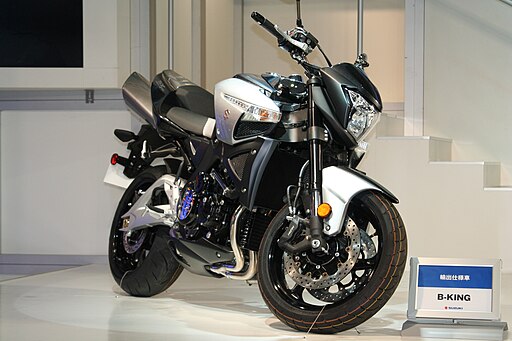
Suzuki B-King
Suzuki B-King: The Muscle Bike That Rewrote the Rules
The Suzuki B-King stands as one of the most iconic and controversial motorcycles of the 21st century. Built to intimidate, impress, and dominate, the B-King represents a bold experiment by Suzuki, blending superbike power with streetfighter aesthetics. Introduced in 2007 and discontinued just a few years later, the B-King left a lasting impact on motorcycle enthusiasts, especially those who crave high displacement naked bikes with extreme performance capabilities.
Origin and Concept
The B-King started life as a concept motorcycle unveiled at the 2001 Tokyo Motor Show. The prototype garnered immediate attention for its futuristic design, supercharged engine, and aggressive streetfighter stance. At the time, it was powered by a supercharged version of the Suzuki Hayabusa’s 1299cc engine, a setup that was widely praised but ultimately deemed too ambitious for mass production.
After years of speculation and fan anticipation, Suzuki released a production version of the B-King in 2007, minus the supercharger, but still equipped with a variant of the mighty Hayabusa engine, making it one of the most powerful naked bikes of its time.
Design and Aesthetics
The design of the B-King is polarizing — it exudes raw aggression and futuristic styling. Its massive dual exhausts, bulky fuel tank, and wide tail section make it one of the most visually distinctive motorcycles ever made. While some riders love its “Transformer”-like appearance, others found it excessively bulky.
Ergonomically, the B-King is well-suited for larger riders. The upright seating position, wide handlebars, and well-padded seat make it comfortable for long-distance riding, a rarity in the muscle-naked category. Despite its size, the bike maintains surprisingly nimble handling, aided by its low center of gravity and balanced chassis geometry.
Engine and Performance
At the heart of the B-King lies a 1340cc inline-four engine, derived from the second-generation Suzuki Hayabusa (GSX1300R). This liquid-cooled, DOHC powerplant is tuned specifically for more tractable torque and midrange performance rather than outright top speed.
Key Engine Specifications:
- Engine Type: 1340cc, 4-stroke, liquid-cooled, DOHC, inline-4
- Bore x Stroke: 81.0 mm x 65.0 mm
- Compression Ratio: 12.5:1
- Fuel System: Suzuki Dual Throttle Valve (SDTV) fuel injection
- Max Power: ~181 hp (135 kW) @ 9,500 rpm
- Max Torque: ~146 Nm (108 lb-ft) @ 7,200 rpm
- Transmission: 6-speed constant mesh
- Final Drive: Chain
These numbers place the B-King among the elite of naked bikes. Its real-world performance is blistering — it can accelerate from 0 to 60 mph in under 2.9 seconds, with a quarter-mile time in the low 10-second range. Although it lacks the aerodynamic profile of the Hayabusa, its naked frame and upright riding posture still enable a top speed exceeding 155 mph (250 km/h).
Chassis and Handling
Suzuki did not compromise on handling. The B-King’s aluminum alloy twin-spar frame is rigid and offers excellent feedback. Suspension duties are handled by high-spec components:
- Front Suspension: Inverted telescopic, coil spring, oil-damped (adjustable)
- Rear Suspension: Link-type, coil spring, oil-damped (fully adjustable)
- Front Brake: Dual 310 mm discs with radial-mount Tokico 4-piston calipers
- Rear Brake: Single 260 mm disc
- Wheelbase: 1,520 mm
- Seat Height: 805 mm
- Wet Weight: Approx. 262 kg (578 lbs)
- Fuel Tank Capacity: 16.5 liters
Despite its weight, the B-King handles remarkably well for its class. The suspension is tuned to be sportbike-firm without compromising street comfort, making it suitable for spirited canyon runs and city commutes alike.
Electronics and Features
In 2007, electronic aids were not as common as they are today, but the B-King did come with selectable engine maps via a switch on the handlebar. Riders could choose between two different fuel maps for varying throttle responses — a rare feature at the time and a nod toward rider customization.
Instrumentation was fully digital, featuring a multi-function LCD display for speed, gear position, fuel gauge, trip meters, and clock, alongside a large, centrally positioned analog tachometer. It lacked modern rider aids like traction control or ride-by-wire throttle, but purists appreciated the mechanical rawness.
Market Reception and Legacy
The B-King was critically acclaimed for its performance and engineering excellence. However, its commercial success was limited. Several factors contributed to its short production run:
- High price point for a naked bike
- Unconventional styling that divided opinion
- Timing — it entered the market during a financial downturn
As a result, production ceased by 2012, and Suzuki never offered a direct successor. Despite its brief market life, the B-King has developed a strong cult following. Owners praise its durability, unique design, and brutal power delivery. Today, it is considered a collector’s item and one of the last true hyper-naked motorcycles without electronic interference.
Tuning and Customization Potential
Because the B-King shares its engine with the Hayabusa, it enjoys a wide aftermarket support base. Common modifications include:
- Performance exhaust systems (to replace the massive stock cans)
- ECU remapping or reflashing
- Supercharger kits (throwback to the original concept)
- Suspension upgrades
- Custom fairings and bodywork
With minimal effort, many owners report performance gains exceeding 200 hp at the crank, transforming the B-King into a true superbike slayer.
Conclusion
The Suzuki B-King is a rare blend of engineering brilliance and daring design. It dared to be different and succeeded in creating a unique niche — the unapologetically powerful naked bike. While it never reached mainstream popularity, its cult status is well-earned. For riders who crave brute force, distinctive style, and mechanical purity, the B-King remains a legendary machine in the annals of motorcycle history.
