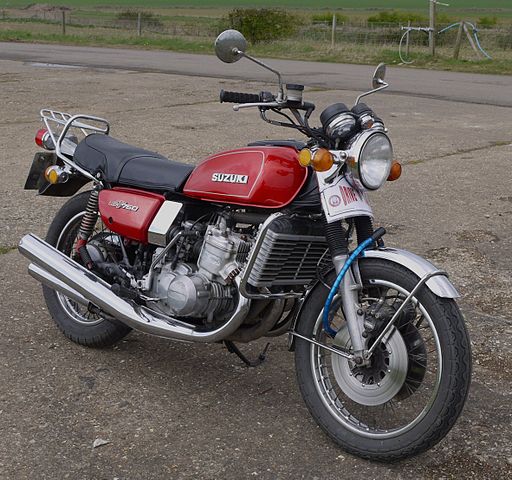
Suzuki GT750
Suzuki GT750: The Legendary Water-Cooled Two-Stroke Triple
The Suzuki GT750, affectionately known as the “Water Buffalo” in the United States and “Kettle” in the United Kingdom, was a groundbreaking motorcycle in the early 1970s. Introduced in 1971 and produced until 1977, it was Suzuki’s first large-capacity multi-cylinder motorcycle and also the first mass-produced Japanese bike with liquid cooling.
Designed as a sport-touring motorcycle, the GT750 combined smooth performance, reliability, and long-distance comfort, making it a significant player in the motorcycle industry of the time. Competing against Honda’s four-stroke CB750 and Kawasaki’s two-stroke H2 Mach IV, the GT750 offered a balance of power, technology, and refinement, standing out in the era of high-performance motorcycles.
This article delves into the history, technical specifications, performance, and legacy of the Suzuki GT750, a true classic in the world of motorcycles.
Development and Design Philosophy
During the late 1960s, motorcycle manufacturers were in a race to develop larger and more powerful multi-cylinder motorcycles. Honda had already introduced the CB750 Four in 1969, and Kawasaki followed with the H1 Mach III, a two-stroke triple.
Suzuki, known for its reliable two-stroke engines, decided to take a different approach by introducing water cooling to improve engine durability and efficiency. The GT750 was unveiled at the 1970 Tokyo Motor Show and officially released in 1971, making history as the first water-cooled Japanese motorcycle.
With a three-cylinder, two-stroke engine, comfortable riding ergonomics, and a heavy-duty chassis, the GT750 was designed as a high-speed touring motorcycle rather than a pure sportbike. It quickly gained a reputation for smooth power delivery, reliability, and comfortable long-distance travel.
Technical Specifications
Engine and Performance
The heart of the Suzuki GT750 was its 738cc liquid-cooled two-stroke inline-three-cylinder engine, a unique setup that set it apart from its competitors.
- Engine Type: Two-stroke, liquid-cooled, inline three-cylinder
- Displacement: 738cc
- Bore x Stroke: 70.0 mm × 64.0 mm
- Compression Ratio: 6.7:1
- Maximum Power Output: 67 hp (50 kW) at 6,500 rpm
- Maximum Torque: 76 Nm at 5,500 rpm
- Carburetion: Three Mikuni VM32SC carburetors
- Fuel System: Suzuki Crankcase Cylinder Injection (CCI) oil system
- Cooling System: Liquid-cooled (“Water Buffalo” nickname)
- Ignition System: Battery-powered coil ignition
The liquid cooling system was a major technological advancement at the time, as most motorcycles were still air-cooled. This system allowed the GT750 to run at a consistent temperature, reducing engine wear and increasing longevity.
Additionally, the CCI oil injection system eliminated the need for pre-mixing fuel and oil, making the bike more convenient to operate.
Transmission and Drivetrain
The GT750 was equipped with a five-speed gearbox, providing a smooth and progressive powerband suitable for both touring and spirited riding.
- Clutch: Multi-plate, wet clutch
- Transmission: 5-speed manual
- Final Drive: Chain
The gear ratios were well-spaced, offering strong acceleration in lower gears and relaxed cruising ability at higher speeds.
Chassis, Suspension, and Handling
Suzuki engineered the GT750’s frame for stability and comfort, making it well-suited for long-distance touring.
- Frame Type: Steel double-cradle frame
- Front Suspension: Telescopic forks with hydraulic damping
- Rear Suspension: Swingarm with dual shock absorbers
Despite its heavy weight, the GT750 handled well for a two-stroke motorcycle of its time. The long wheelbase and weight distribution made it stable at high speeds, though it was not as agile as smaller sportbikes.
Brakes, Wheels, and Tires
Suzuki introduced the GT750 with drum brakes, but later models received a front disc brake, improving stopping power significantly.
- Front Brake: Single 295 mm disc brake (early models had drum brakes)
- Rear Brake: 180 mm drum brake
- Wheels: Spoked 19-inch front, 18-inch rear
- Tires: 3.25-19 front, 4.00-18 rear
The front disc brake was a significant upgrade, enhancing the GT750’s safety and braking performance.
Dimensions and Weight
- Overall Length: 2,260 mm
- Overall Width: 865 mm
- Overall Height: 1,165 mm
- Wheelbase: 1,450 mm
- Seat Height: 800 mm
- Curb Weight: 230 kg (wet weight)
- Fuel Tank Capacity: 17 liters
At 230 kg, the GT750 was quite heavy, making it more stable on highways but slightly harder to maneuver in tight city streets.
Performance and Riding Experience
The Suzuki GT750 was known for its smooth power delivery and comfortable touring capability.
- Top Speed: 190 km/h (118 mph)
- 0-100 km/h (0-62 mph): 5.8 seconds
- Fuel Consumption: 7.5 L/100 km (31 mpg)
With 67 hp, the GT750 was powerful enough to compete with four-stroke motorcycles, while its liquid cooling system provided unmatched reliability in the two-stroke category.
Market Reception and Legacy
Upon its release, the GT750 received praise for its innovative liquid cooling system, smooth performance, and comfortable ride.
Strengths:
✔ First Japanese liquid-cooled motorcycle
✔ Smooth and reliable two-stroke engine
✔ Comfortable for long-distance touring
✔ Front disc brake improved braking performance
✔ Excellent mid-range torque
Weaknesses:
✖ Heavy compared to competitors
✖ Fuel consumption was relatively high
✖ Not as fast as Kawasaki’s H2 Mach IV
Despite its high weight and fuel consumption, the GT750 developed a cult following, especially among touring enthusiasts and collectors.
Conclusion
The Suzuki GT750 was a pioneering motorcycle, offering liquid cooling, smooth two-stroke performance, and solid touring capabilities. While it was eventually overshadowed by more advanced four-stroke motorcycles, the GT750 remains one of Suzuki’s most iconic models.
Today, the GT750 is a sought-after classic, appreciated for its technological innovations, smooth ride, and unique character. Restored models are popular among collectors, keeping the legend of the “Water Buffalo” alive.
For those who love vintage two-stroke motorcycles, the Suzuki GT750 remains an unforgettable piece of motorcycle history.
.jpg)