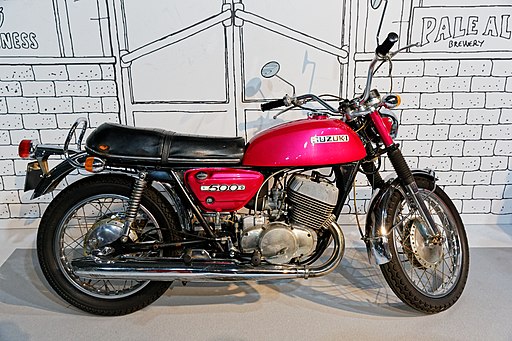
Suzuki T500
Suzuki T500: The Legendary Two-Stroke Twin
The Suzuki T500, also known as the Suzuki Cobra in its early production years, is an iconic motorcycle that helped establish Suzuki as a serious contender in the large-capacity road bike market. First introduced in 1968, the T500 was revolutionary for its time, featuring a powerful two-stroke, air-cooled parallel twin engine with excellent reliability and performance. Unlike many of its contemporaries, the T500 demonstrated that a two-stroke motorcycle could be durable, practical, and capable of high-speed touring.
This article delves into the design, development, specifications, and lasting impact of the Suzuki T500, highlighting its technical parameters and performance capabilities.
Development and Evolution
During the 1960s, Japanese manufacturers were increasingly challenging British and American motorcycle companies. Suzuki, primarily known for its smaller two-stroke motorcycles, saw an opportunity to enter the 500cc class, dominated at the time by four-stroke bikes like the Triumph Bonneville and BSA A50.
Suzuki engineers developed an all-new 496cc two-stroke parallel-twin engine, featuring piston-port induction and a robust bottom-end design that gave the bike both impressive performance and longevity. The T500 quickly gained a reputation for its smooth power delivery, excellent reliability, and comfortable ride, making it a popular choice among riders looking for a fast yet practical motorcycle.
Over the years, the T500 underwent multiple refinements, including improved carburetion, frame modifications, and updated styling. Later versions, such as the T500 Titan, continued Suzuki’s legacy in the high-performance two-stroke category until the model was discontinued in 1977.
Technical Specifications and Features
Engine and Performance
At the heart of the Suzuki T500 lies a 496cc two-stroke, air-cooled parallel-twin engine, which was a major leap forward for Suzuki at the time.
- Engine Type: Two-stroke, air-cooled parallel twin
- Displacement: 496cc
- Bore x Stroke: 70.0 mm × 64.0 mm
- Compression Ratio: 6.6:1
- Maximum Power Output: Approximately 46 hp at 7,000 rpm
- Maximum Torque: Around 54 Nm at 6,000 rpm
- Carburetion: Twin Mikuni VM32 carburetors
- Fuel Delivery: Pre-mix (early models) or oil-injection system
- Lubrication System: Posi-Force automatic oil injection
- Ignition System: Coil and points (later models switched to CDI for improved reliability)
The Posi-Force oil injection system was one of the defining features of the T500, eliminating the need for riders to manually mix oil and fuel. This innovation contributed to better reliability and smoother operation.
Despite being a two-stroke, the engine was remarkably durable, capable of covering long distances with minimal maintenance—a rarity for high-performance two-stroke motorcycles of that era.
Transmission and Drivetrain
The Suzuki T500 featured a 5-speed constant-mesh gearbox, which provided smooth and responsive shifting.
- Clutch: Multi-plate, wet
- Transmission: 5-speed manual
- Final Drive: Chain
The gear ratios were optimized for both quick acceleration and comfortable highway cruising, making the T500 a versatile machine suited for different riding conditions.
Chassis, Suspension, and Handling
Suzuki engineered the T500’s chassis with a double-cradle steel frame, designed to provide stability at high speeds while maintaining agility.
- Frame Type: Steel double-cradle
- Front Suspension: Telescopic forks with oil damping
- Rear Suspension: Dual shock absorbers with adjustable preload
Although the early models had some issues with high-speed stability, Suzuki addressed this by reinforcing the frame and improving the front-end geometry, leading to better handling and cornering performance in later versions.
Brakes, Wheels, and Tires
Braking performance was adequate for its time, with a drum brake setup on both wheels.
- Front Brake: 200 mm drum brake
- Rear Brake: 180 mm drum brake
- Wheels: 19-inch front, 18-inch rear spoked wheels
- Tires: 3.25-19 front, 4.00-18 rear
Although drum brakes were standard in the late 1960s, later competitors started using disc brakes, which offered superior stopping power. However, the T500’s large drum brakes were still effective for everyday use.
Dimensions and Weight
- Overall Length: 2,140 mm
- Overall Width: 850 mm
- Overall Height: 1,140 mm
- Wheelbase: 1,430 mm
- Seat Height: 810 mm
- Curb Weight: Around 187 kg (dry weight)
- Fuel Tank Capacity: 15 liters
The low seat height and comfortable ergonomics made the T500 easy to ride for a wide range of motorcyclists. Its weight distribution was well-balanced, contributing to stable handling on long rides.
Performance and Riding Characteristics
The Suzuki T500 was known for its smooth power delivery and strong mid-range torque. Unlike many high-strung two-strokes of its time, which required high RPMs for peak performance, the T500 had a broad and usable powerband, making it more rider-friendly.
- Top Speed: Approximately 180 km/h (112 mph)
- 0-100 km/h (0-62 mph): Around 6.0 seconds
- Fuel Economy: Approximately 5.5 L/100 km (43 mpg)
The T500’s lightweight chassis and responsive engine made it an exciting ride, whether on city streets or open highways. The vibration levels were relatively low for a two-stroke twin, thanks to its well-designed crankshaft balancing.
Market Reception and Legacy
The Suzuki T500 was a commercial success, particularly in Europe and North America, where it was seen as a reliable alternative to British and American motorcycles.
Strengths:
✔ Powerful yet reliable two-stroke engine
✔ Good fuel economy for its class
✔ Strong mid-range torque
✔ Comfortable for long-distance touring
✔ Well-built frame and suspension
Weaknesses:
✖ Drum brakes became outdated by the mid-1970s
✖ Oil consumption was higher than four-strokes
✖ Some early models had frame flex issues
Despite its eventual discontinuation in 1977, the T500 remains a cult classic among vintage motorcycle enthusiasts. Today, well-maintained examples are highly sought after by collectors, and many are still on the road thanks to Suzuki’s durable engineering.
Conclusion
The Suzuki T500 was a groundbreaking motorcycle that proved two-stroke engines could be powerful, durable, and practical for long-distance touring. With a 496cc parallel-twin engine, 46 hp output, and excellent mid-range performance, it stood out as a serious competitor against larger four-stroke motorcycles.
While its drum brakes and frame design were eventually surpassed by more modern motorcycles, the T500 remains a legendary machine, cherished for its smooth ride, robust build, and exhilarating performance. Even decades after its production ended, the T500 continues to capture the hearts of motorcycle enthusiasts worldwide.
