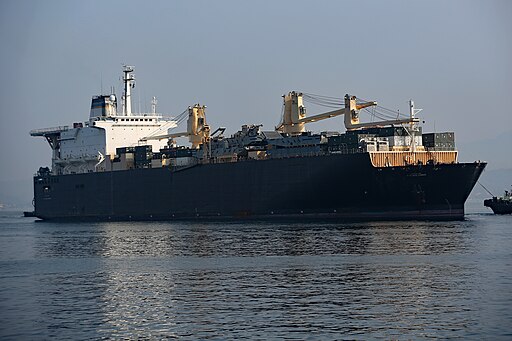
USNS 1st Lt. Jack Lummus (T-AK-3011)
USNS 1st Lt. Jack Lummus serves as a prepositioning dry cargo ship in the Military Sealift Command’s Maritime Prepositioning Ship Squadron 3. As a 2nd Lt. John P. Bobo-class vessel, she operates as a floating logistics depot, forward-staging vehicles, fuel, water, and sustainment stores to support Marine Air-Ground Task Forces in critical regions. Her robust design, extensive cargo handling systems, and austere-port capabilities enable rapid force deployment ashore.
Namesake and Mission Profile
Namesake
The ship honors First Lieutenant Jack Lummus, USMCR, a Medal of Honor recipient for valor during the Battle of Iwo Jima. His sacrifice and leadership symbolize the vessel’s commitment to delivering life-saving supplies under combat and humanitarian conditions.
Prepositioning Role
Assigned to prepositioning duties in the Western Pacific, 1st Lt. Jack Lummus maintains readiness to offload combat equipment and sustainment stocks within 72 hours of arrival. Operating primarily between Guam and Saipan, she supports exercises such as Cobra Gold, Balikatan, Freedom Banner, and real-world contingency operations.
Construction and Acquisition
Shipyard and Keel Laying
Fore River Shipyard in Quincy, Massachusetts laid her keel in June 1984. Built using block-modular techniques, major hull sections, machinery zones, and deck houses were assembled in parallel to accelerate completion and facilitate future upgrades.
Launch and Service Entry
She launched on February 22, 1986 and entered service as MV 1st Lt. Jack Lummus later that year under American Overseas Marine. In January 2006 Military Sealift Command purchased and reclassified her as USNS 1st Lt. Jack Lummus (T-AK 3011), integrating her into the prepositioning fleet.
Hull Design and Structure
Hull Form and Construction
A welded steel monohull provides structural strength and damage tolerance. The flared bow, full stern transom, and continuous outer plating optimize seakeeping and reduce slamming in high-speed transits. Internal longitudinal stiffeners and transverse bulkheads support heavy loads and compartmentalization for damage control.
Dimensions and Displacement
At full load she displaces 44,330 metric tons. Overall length reaches 204.98 meters, beam spans 32.31 meters, and maximum draft measures 8.97 meters. Light displacement stands at approximately 19,588 tons, allowing deep load capacity for vehicles and bulk cargo.
Propulsion and Performance
Main Propulsion Plant
Two Werkspoor 16TM410 medium-speed diesel engines deliver a combined output of 27,000 horsepower. A single fixed-pitch propeller shaft converts engine power into a service speed of 18 knots and a maximum speed approaching 19 knots under light load.
Auxiliary Maneuvering Systems
A 1,000-horsepower bow thruster enables precise station-keeping during roll-on/roll-off operations in constrained harbors. Three diesel generator sets provide hotel power, cargo-system hydraulics, and emergency lighting when main engines are offline.
Cargo Capacity and Handling Systems
Vehicle and Container Storage
The internal Ro-Ro deck offers 162,500 square feet of clear space for armored vehicles, trucks, and palletized loads. Cell-guide stacks on deck accommodate up to 522 TEU, enabling flexible stowage of standard containers and flatracks.
Bulk Liquid Stowage
Her dedicated tankage holds 1,605,000 gallons of marine diesel fuel and 81,700 gallons of potable water. Tie-down fittings and baffled compartments ensure safe transport of liquids across open ocean transits.
Cargo Handling Equipment
One 35-ton and two 18-ton electro-hydraulic deck cranes allow independent load and discharge operations without shore-based gear. Integrated ramp panels and causeway stowage support roll-on/roll-off connectors and modular lighterage units.
Aviation and Specialized Facilities
A reinforced flight deck certified for CH-53E heavy-lift helicopters provides vertical replenishment capability. Aviation fuel hydrant outlets, deck lighting, and securing points sustain day-night helicopter operations during amphibious support and contingency missions.
Sensor and Communications Suite
Navigation and Radar
Multi-band surface search and navigation radars furnish collision avoidance and close-in situational awareness. Integrated GPS and inertial navigation systems deliver precise track-keeping for open-ocean and littoral transits.
Communications and Data Links
SATCOM terminals support global voice and data exchange. Tactical Link-11/Link-16 interfaces enable secure sharing of operational information with embarked Marine Air-Ground Task Force elements and allied commands.
Crew Organization and Habitability
Merchant Crew and Military Detachment
A civilian mariner crew of approximately 55 operates propulsion, navigation, and cargo functions. Embarked military detachment of up to 18 specialists manages logistic planning, maintenance oversight, communications, and cargo accounting.
Living Spaces and Amenities
Berthing compartments feature two- to four-person staterooms, separate officers’ quarters, and a small squad bay. A self-service mess, recreation lounge with multimedia access, and fitness station support crew welfare during extended deployments.
Operational Employment
Throughout her service, 1st Lt. Jack Lummus has demonstrated rapid offload performance during major exercises and real-world crises. Her ability to establish a floating supply base ashore has supported Marine expeditionary operations, humanitarian relief after natural disasters, and large-scale logistics interoperability drills.
Technical Specifications
| Parameter | Specification |
|---|---|
| Class & Type | 2nd Lt. John P. Bobo-class dry cargo ship |
| Displacement (light/full) | 19,588 t / 44,330 t |
| Length | 204.98 m |
| Beam | 32.31 m |
| Draft | 8.97 m |
| Propulsion | 2 × Werkspoor 16TM410 diesels; 27,000 hp |
| Shaft & Propeller | 1 × fixed shaft; single fixed-pitch propeller |
| Bow Thruster | 1,000 hp |
| Speed | 18 knots service |
| Range & Endurance | several thousand nautical miles at cruising speed |
| Vehicle Deck Area | 162,500 ft² |
| Container Capacity | up to 522 TEU |
| Fuel & Water Capacity | 1,605,000 gal diesel; 81,700 gal water |
| Cargo Cranes | 1 × 35 t; 2 × 18 t |
| Aviation Facilities | CH-53E-certified flight deck; aviation fuel outlets |
| Crew Complement | ~55 civilian mariners; up to 18 military detachment specialists |
| Homeport | Operating between Guam and Saipan in MPSRON 3 |
_arrives_at_Subic_Bay_on_29_March_2016.JPG)