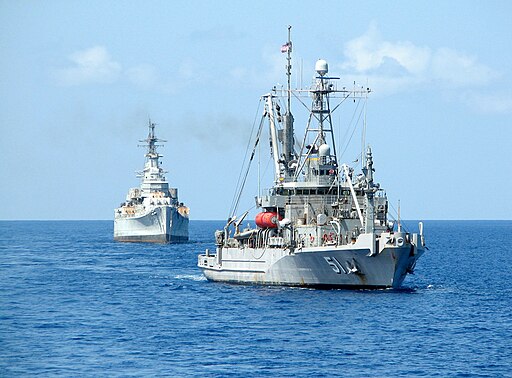
USNS Grasp (T-ARS-51) is a highly specialized naval auxiliary vessel classified as an ocean-going salvage ship, designed to recover, repair, and assist naval and civilian ships in distress while also conducting deep-ocean salvage, towing, and submarine rescue support operations. Operated by the Military Sealift Command and crewed primarily by civil service mariners augmented by Navy personnel for technical missions, Grasp represents a critical enabler of maritime recovery infrastructure. Unlike frontline combatants, its value lies in its ability to restore operational readiness to damaged vessels, retrieve sunken objects of strategic importance, and provide engineering solutions in hostile maritime environments. Its role extends beyond military utility into disaster recovery, search and rescue, and underwater engineering support, often forming the backbone of complex recovery missions following accidents or combat incidents.
Design Philosophy and Hull Construction
USNS Grasp is a Safeguard-class salvage ship, a design specifically engineered for durability, stability, and sustained operations in adverse sea conditions. The hull is constructed of high-strength steel with reinforced framing to withstand the tension loads imposed during heavy-tow and salvage lift operations. The ship was designed with a broad beam and low center of gravity to provide excellent stability when deploying heavy salvage gear or conducting precision operations over a fixed work site.
The ship measures approximately 255 feet (77.7 meters) in length, with a beam of 49 feet (14.9 meters) and a full-load draft nearing 16 feet (4.9 meters). Displacement at full load reaches approximately 2,950 long tons, giving it the mass and inertia necessary for stable platform operations in turbulent sea states. The hull form emphasizes seakeeping and deck space rather than speed, allowing the ship to remain fixed or semi-stationary through dynamic positioning and controlled propulsion adjustments during complex recoveries.
Propulsion and Maneuverability Systems
Power is supplied by two main diesel engines driving a twin-shaft propulsion system, delivering a combined output of roughly 2,700 shaft horsepower. This system provides a maximum speed of approximately 14 knots, with an economical cruising speed near 12 knots. While modest compared to modern combatants, this speed profile is more than adequate for its intended role, as Grasp prioritizes torque and endurance over rapid deployment.
To enhance maneuverability during salvage operations, the ship is equipped with bow and stern thrusters. These thrusters allow for fine station keeping in close proximity to damaged vessels or submerged targets. Combined with precision rudder control, the vessel can maintain position in variable currents and rough seas without excessive drift, making it capable of conducting technically demanding recoveries even in unstable weather conditions.
Salvage and Towing Equipment Capabilities
The defining feature of USNS Grasp lies in its extensive salvage apparatus. The ship is fitted with a 50-ton boom crane capable of lifting heavy machinery, wreckage components, and structural sections during underwater recovery. Additionally, it possesses heavy towing winches and capstans engineered to apply sustained pulling force to disabled vessels or submerged objects, allowing for the controlled relocation or refloating of grounded ships.
High-capacity towing systems enable Grasp to assist large naval vessels, including destroyers and amphibious ships, in open-ocean environments. The ship also carries specialized rigging, chain, and hydraulic lifting gear, enabling it to handle complex structural recoveries without the need for external crane barges. This self-contained capability allows the vessel to operate independently in remote regions far from shore-based infrastructure.
Deep-Ocean Salvage and Submarine Support Role
USNS Grasp is fully equipped for deep-sea operations, with the ability to deploy remotely operated vehicles and deep-diving equipment. It supports submarine rescue missions by acting as a surface platform for tethered escape systems and specialized diving teams. While not a dedicated submarine rescue ship, its modular configuration allows it to integrate with rescue assets and provide stabilizing logistics during underwater emergencies.
The vessel also plays an essential role in recovering downed aircraft, lost ordnance, and classified material from the ocean floor. This capability is critical for national security, as rapid retrieval limits the risk of sensitive technology falling into hostile hands. The onboard salvage control center coordinates sonar mapping, underwater navigation, and lifting calculations to ensure precise and secure recovery.
Onboard Systems and Operational Layout
The interior layout of USNS Grasp is optimized for coordination, engineering, and mission control. The operations center serves as the command hub for salvage planning, integrating sonar data, dive team telemetry, and crane operations into a cohesive workflow. Dedicated compartments house decompression chambers, machine shops, and electronic maintenance facilities, allowing repairs and servicing to be conducted while underway.
Crew accommodations are designed for sustained deployments lasting several weeks, with climate-controlled living quarters, galley facilities, and recreation areas. The ship supports a complement of approximately 80 personnel, including civil mariners, Navy salvage engineers, divers, medical staff, and mission specialists. This mixed crew structure allows for specialized operational capability without the overhead of a fully commissioned warship.
Endurance, Range, and Support Capabilities
USNS Grasp is engineered for long-duration missions, with sufficient fuel and stores to remain at sea for extended periods without resupply. Its range at cruising speed exceeds 10,000 nautical miles, enabling strategic deployment to distant theaters without reliance on continuous port support. The ship is capable of limited self-repair and maintenance, reducing downtime and ensuring operational continuity during salvage missions that may extend over weeks or months.
Freshwater generation systems, robust storage facilities, and redundant power systems contribute to sustained endurance. These systems allow the ship to remain effective even when operating in isolated regions or disaster zones where shore-based support is fragmented or unavailable.
Mission History and Operational Significance
Throughout its service life, USNS Grasp has participated in numerous high-profile salvage and recovery operations, ranging from missile recovery to aircraft extraction and maritime disaster response. It has routinely supported fleet operations by towing disabled vessels, stabilizing damaged hulls, and recovering submerged hardware following accidents or combat incidents.
Beyond military missions, the vessel has been instrumental in humanitarian response efforts, assisting in maritime disaster zones, oil spill recovery, and underwater infrastructure repair. Its adaptability and resilience have made it a valued asset not only for the U.S. Navy but also for international cooperative recovery operations.
Structural Strength and Survivability Characteristics
Unlike combat vessels designed for offensive engagement, Grasp emphasizes structural durability and survivability through engineering redundancy. Its heavy steel construction allows it to absorb stress loads and operate under tension conditions that would compromise lighter vessels. Fire suppression systems, watertight compartmentalization, and redundant bilge pumping systems further enhance its resilience in emergency conditions.
The ship’s design ensures it can continue operational duties even if minor damage is sustained during heavy towing or salvage operations. This survivability philosophy is central to its mission profile, as it must often operate close to unstable wreckage or in harsh seas.
Role in Modern Naval Logistics and Engineering Support
In the modern naval ecosystem, USNS Grasp functions as a critical engineering and recovery component. While combat ships project power, salvage vessels preserve that power by returning damaged assets to operational status or retrieving critical technology. This indirect but essential role makes salvage ships indispensable for sustained maritime operations during both peacetime and conflict scenarios.
Its existence reflects a strategic understanding that naval superiority is not solely about firepower, but also about resilience, recovery, and continuity of force operations.
Conclusion: A Silent Backbone of Naval Operations
USNS Grasp (T-ARS-51) stands as a testament to the importance of recovery and engineering support in naval strategy. Though rarely in the spotlight, its contribution to fleet readiness, operational security, and maritime safety is profound. Through its advanced salvage capabilities, heavy towing strength, and deep-ocean operational capacity, it has embodied the principle that naval power is as much about preservation as it is about projection.
_tows_USS_Des_Moines_(CA-134)_to_the_scrapyard,_in_October_2006.jpg)