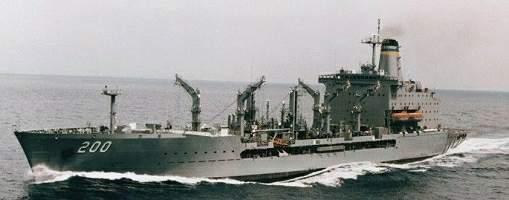
USNS Guadalupe (T-AO-200) is a fleet replenishment oiler belonging to the Henry J. Kaiser-class, a cornerstone group of logistics vessels designed to sustain the United States Navy’s global operational presence. Unlike combat ships that project power through weapons, Guadalupe projects endurance by delivering the fuel, lubricants, and limited dry cargo that allow carrier strike groups and surface action groups to remain at sea for prolonged periods. Operated by the Military Sealift Command and crewed primarily by civilian mariners with embarked Navy personnel for specialized functions, the vessel is engineered to conduct underway replenishment operations in demanding sea conditions while maintaining a high degree of safety and efficiency. Its mission profile centers on the continuous transfer of petroleum products to warships, effectively acting as a mobile offshore fuel depot capable of accompanying fleets across entire oceans.
Design Philosophy and Hull Architecture
The design of USNS Guadalupe reflects a practical balance between cargo capacity, stability, and survivability. The hull is constructed from high-strength steel and follows a conventional single-hull form with extensive internal subdivision to reduce the risk of catastrophic flooding. Its dimensions provide the volume required for large fuel storage while enabling controlled hydrodynamic performance during replenishment maneuvers. The ship measures approximately 677 feet (206 meters) in length, with a beam of around 97 feet (29.5 meters) and a full-load draft of roughly 37 feet (11.3 meters). At full load, displacement exceeds 40,000 tons, underscoring its role as a heavy logistics platform rather than a fast-moving combatant.
The hull form prioritizes longitudinal strength and lateral stability, both critical when multiple replenishment rigs are deployed. Reinforced framing supports the stresses generated by fuel transfer hoses, tension lines, and connected ships operating in parallel motion. The broad deck layout ensures enough space for cargo handling equipment, helicopter operations, and safe movement of crew during complex replenishment operations.
Propulsion System and Performance Envelope
USNS Guadalupe is powered by a diesel propulsion plant configured for reliability and economical long-term operation rather than high speed. The propulsion system typically consists of two medium-speed diesel engines driving a single controllable-pitch propeller through reduction gearing. This arrangement delivers sufficient power to maintain an operational speed of approximately 20 knots, allowing the vessel to effectively keep pace with most naval formations during transoceanic movements.
The ship’s maneuverability is enhanced by bow thrusters, which provide fine control during port operations and low-speed replenishment evolutions. While not designed for rapid acceleration or agile combat maneuvers, the propulsion system ensures steady, predictable movement, which is essential when steam-powered or gas-turbine warships are connected alongside for fuel transfer in open seas.
Fuel Storage and Transfer Capacity
The defining technical feature of USNS Guadalupe is its immense fuel-carrying capacity. It is capable of transporting over 180,000 barrels of fuel, including F-76 naval diesel and JP-5 aviation fuel. These fuels are stored in segregated tanks equipped with advanced pumping and filtration systems that ensure clean and safe delivery to receiving vessels.
The ship is equipped with multiple replenishment stations on both port and starboard sides, allowing simultaneous fueling of two or more ships while underway. Underway replenishment rigs utilize tensioned span wires and pressurized hoses to transfer fuel at high flow rates, often exceeding several thousand gallons per minute. The system is engineered to maintain stable transfer despite the relative motion of vessels caused by waves, wind, and minor course changes.
Underway Replenishment Systems and Operational Methodology
USNS Guadalupe is specifically configured to perform underway replenishment, a complex choreography that allows warships to refuel without entering port. This process involves precise navigation, constant communication, and the mechanical reliability of transfer systems. The ship uses a combination of connected replenishment rigs and probe fueling systems for aviation fuel, enabling supply to aircraft carriers, destroyers, cruisers, and amphibious vessels.
High-capacity pumps, flow meters, and automated control systems maintain steady pressure and monitor volume delivery with extreme accuracy. Safety interlocks and emergency shutdown systems minimize the risk of spills or hose rupture, preserving both operational readiness and environmental safeguards.
Aviation Handling and Support Facilities
The aft section of USNS Guadalupe features a flight deck and hangar facilities designed to support vertical replenishment operations using naval helicopters. These aircraft extend the ship’s logistics reach by transferring pallets, spare parts, and limited dry cargo to ships operating outside the immediate alongside replenishment envelope.
The flight deck is reinforced to accommodate medium-lift helicopters, and fueling stations allow the ship to support aviation operations during extended missions. Helicopter handling crews coordinate closely with logistics officers to manage the rapid movement of supplies, enhancing the flexibility and efficiency of fleet operations.
Crew Composition and Living Arrangements
The ship is operated by a mixed crew structure consisting of civilian mariners employed by the Military Sealift Command and a contingent of U.S. Navy personnel responsible for communications, aviation coordination, and operational integration. Total crew complement generally ranges between 80 and 100 personnel, depending on mission requirements.
Living quarters are designed for extended deployments, with climate-controlled accommodations, medical facilities, recreation areas, and dining services. The ship’s internal layout prioritizes habitability alongside operational efficiency, ensuring crew endurance during weeks or months at sea.
Navigation, Command, and Control Systems
USNS Guadalupe is equipped with modern navigation systems, including advanced radar arrays, electronic chart display systems, GPS integration, and automated collision avoidance technology. The bridge features centralized control consoles that allow precise control of speed, heading, and positioning during replenishment operations.
Communications systems integrate with fleet command networks, ensuring that the vessel operates as an organic component of naval task forces. Redundant power and control systems ensure continuous operation even in the event of localized technical failures.
Survivability and Structural Integrity
While not designed for direct combat engagement, Guadalupe incorporates survivability features essential for operating in potentially hostile environments. These include compartmentalized fuel tanks, fire suppression systems, watertight bulkheads, and reinforced structural sections around critical machinery spaces.
Damage control systems are designed to isolate affected compartments and prevent cascading failures. These features ensure that the vessel can continue its mission or withdraw safely even after sustaining limited damage.
Operational History and Strategic Importance
Throughout its service life, USNS Guadalupe has supported carrier strike groups and naval operations across multiple theaters, providing critical refueling services during long-duration deployments. Its contribution has been central to maintaining uninterrupted naval presence, whether during conflict operations, deterrence patrols, or humanitarian support missions.
The vessel’s ability to sustain high-tempo operations underscores its role as a strategic enabler, transforming naval task forces into self-sustaining entities capable of operating far from home ports for extended periods.
Contribution to Modern Naval Logistics Doctrine
USNS Guadalupe exemplifies the modern logistics doctrine that naval power projection is inseparable from sustainment capability. Without ships of its class, the operational reach of aircraft carriers and surface combatants would be severely limited. Its design and operational concept demonstrate the importance of fuel and supply logistics in maintaining naval superiority across global maritime domains.
Conclusion: An Essential Lifeline of the Fleet
USNS Guadalupe (T-AO-200) stands as a vital link in the chain of naval operational sustainability. Through its immense fuel capacity, advanced replenishment systems, and robust engineering design, it ensures that frontline warships remain fueled, operational, and mission-ready across vast distances. While it may not carry weapons or command headlines, its contribution is fundamental to the strategic endurance and global presence of the United States Navy, embodying the principle that logistics is the true backbone of sustained maritime power.
