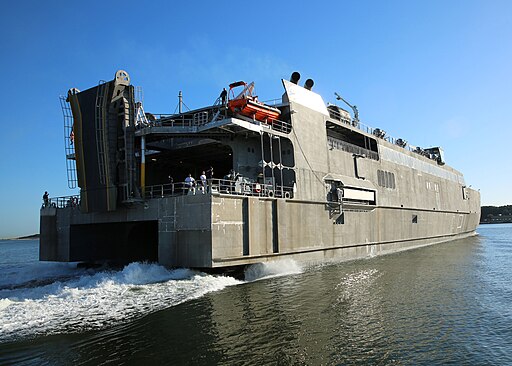
USNS Guam (T-HST-1) represented a pivotal step in the United States Navy’s experimentation with ultra-fast, shallow-draft logistics and intra-theater lift. Conceived as a Joint High Speed Transport, the vessel was designed to move personnel, vehicles, and critical equipment rapidly between forward operating bases and coastal hubs where conventional sealift would be too slow or constrained by port limitations. Its mission profile emphasized speed, flexibility, and access rather than traditional blue-water endurance, placing it in a unique niche between airlift and standard amphibious shipping. The design philosophy centered on maximizing operational tempo by enabling frequent, high-speed shuttle runs that could support humanitarian response, expeditionary warfare, and time-sensitive military logistics with minimal port infrastructure.
Hull Design and Structural Engineering
The ship employed a wave-piercing catamaran hull form constructed primarily from marine-grade aluminum alloy, focusing on weight reduction without compromising structural integrity. The dual-hull configuration delivered superior stability at high speeds while maintaining a shallow operational draft that allowed entry into austere and poorly developed ports. The overall length measured approximately 98 meters with a beam of roughly 27 meters, resulting in a wide stance that contributed to its expansive internal deck space. Draft typically remained under four meters even at full operational load, enabling close-to-shore operations that traditional supply ships could not safely achieve. Structural reinforcement was strategically integrated into high-stress zones to accommodate vehicle ramps, mission modules, and heavy rolling stock while minimizing hull flex during sustained high-speed transits.
Propulsion and Performance Characteristics
Power was generated by a combination of high-output diesel engines driving multiple waterjet propulsion units, allowing for rapid acceleration and exceptional maneuverability. This propulsion arrangement enabled the ship to achieve sustained speeds exceeding 35 knots under operational conditions, with burst capabilities pushing even higher during favorable sea states. Cruising range was optimized for regional operations, allowing approximately 1,200 to 1,500 nautical miles at economic speed, striking a balance between speed and fuel efficiency. The waterjet system enhanced shallow-water usability and significantly reduced the risk of damage from submerged hazards, while also offering precise handling at congested ports and during high-speed docking evolutions.
Cargo Handling and Mission Flexibility
USNS Guam was equipped with a large open mission bay optimized for roll-on/roll-off vehicle transport and modular cargo systems. The internal vehicle deck could support a payload capacity in excess of 600 tons, including tactical vehicles, Humvees, engineering equipment, and palletized supplies. A stern-mounted vehicle ramp enabled direct transfer between ship and shore, even when port facilities were minimal or degraded. The internal layout allowed rapid reconfiguration, making the vessel suitable for military logistics, humanitarian relief, special operations support, and disaster response scenarios. This adaptability defined its operational significance as a fast-response multipurpose platform.
Aviation and Troop Accommodation
The flight deck was engineered to support medium-lift helicopters such as the MH-60 series, facilitating aviation-based logistics transfer and medical evacuation operations. Although the vessel lacked a permanent hangar, its deck configuration allowed temporary helicopter staging and high-tempo landing evolutions. Internally, berthing and support facilities were designed to transport up to 300 embarked personnel in austere comfort, including seating for short-duration transits and basic habitability systems for extended missions. This combination of aviation interface and troop carriage expanded Guam’s operational envelope beyond simple freight movement.
Navigation, Command, and Systems Integration
The bridge and command spaces incorporated advanced navigation and vessel management systems, including radar suites, electronic chart display systems, GPS integration, and automated engine controls. The design prioritized high-speed situational awareness with ergonomic control layouts that supported continuous operations during complex littoral missions. Communication systems enabled integration with joint command networks, allowing the ship to operate seamlessly within expeditionary strike groups or independent logistics taskings. System redundancy and automation minimized crew workload while maintaining operational reliability under demanding conditions.
Strategic Contribution and Legacy
USNS Guam served as a proving platform for the concept that high-speed maritime transport could dramatically reshape operational logistics in expeditionary environments. It demonstrated that speed, shallow draft, and modular mission capability could significantly reduce response times in crisis zones while maintaining logistical throughput. The lessons learned from its operational deployment directly influenced the development of later expeditionary fast transport vessels, refining design standards, mission architecture, and logistical doctrines for modern naval support operations. Through its innovative engineering and operational flexibility, USNS Guam established a technical and strategic benchmark for future high-speed military transport vessels.
.jpg)