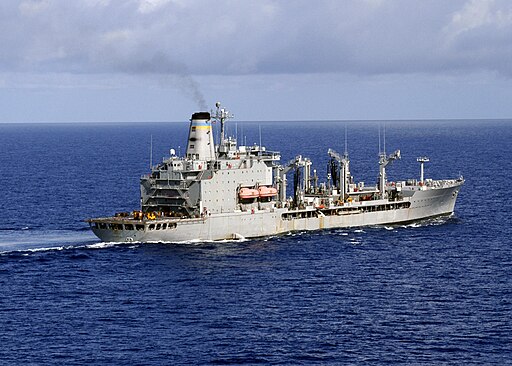
USNS John Lenthall (T-AO-189) is a Henry J. Kaiser-class fleet replenishment oiler serving in the United States Navy’s Military Sealift Command. The vessel plays an essential role in extending the operational endurance of naval forces by providing underway replenishment (UNREP) of fuel and other essential supplies. As a non-commissioned support ship crewed by civilian mariners and a small Navy detachment, John Lenthall exemplifies the logistical backbone required for sustained naval power projection. Its capabilities enable aircraft carriers, surface combatants, and amphibious groups to remain at sea for extended periods, maximizing fleet readiness and flexibility.
Class and Design Background
The Henry J. Kaiser-class oilers, to which John Lenthall belongs, were developed in the 1980s and 1990s to replace aging oilers dating back to World War II. These ships incorporate a blend of commercial tanker design principles with naval operational requirements. The class focuses on efficiency in fuel transport and transfer, reliable underway replenishment capabilities, and integration with fleet command and control systems. Designed primarily for the delivery of petroleum products, the class also supports limited dry cargo and aviation fuel, emphasizing the multi-fuel demands of modern naval vessels. John Lenthall’s design supports rapid and simultaneous fuel transfer operations alongside multiple ships, significantly enhancing fleet logistics.
Construction and Dimensions
John Lenthall was constructed at the Avondale Shipyard in Louisiana, with keel laying occurring in the late 1980s and the ship entering service in the early 1990s. The vessel’s overall length is approximately 206 meters (677 feet), with a beam measuring about 28.5 meters (93.5 feet). Its full-load displacement exceeds 40,000 tons, reflecting the large volume of liquid cargo it carries. The hull’s structural design emphasizes stability and seakeeping to facilitate underway replenishment in a range of sea states. The superstructure is positioned forward, optimizing the working deck area for replenishment rigs and cargo handling.
Propulsion and Performance Specifications
USNS John Lenthall is powered by two large diesel engines driving a single propeller shaft. These engines deliver a combined output sufficient to propel the ship at a cruising speed of roughly 20 knots, enabling it to maintain pace with carrier strike groups and other naval formations. Diesel propulsion was chosen for its fuel efficiency, reliability, and ease of maintenance, crucial for a vessel expected to operate continuously over long deployments. The ship also features auxiliary generators providing electrical power for onboard systems, including cargo handling equipment, navigation, and habitability systems.
Cargo Capacity and Replenishment Systems
John Lenthall is designed primarily to transport and transfer large quantities of fuel to naval vessels. It carries multiple types of fuel, including naval distillate fuel, marine diesel, and aviation fuel, stored in segregated tanks to allow simultaneous delivery of different grades. The ship’s total liquid cargo capacity is approximately 180,000 barrels. Underway replenishment is conducted via multiple fueling stations located along both port and starboard sides, enabling the servicing of one or more ships simultaneously. High-capacity pumping systems allow fuel transfer rates exceeding 2,000 barrels per hour, ensuring rapid resupply. In addition to liquid cargo, John Lenthall has limited capacity for dry stores and limited ordnance, supporting broader logistics requirements.
Underway Replenishment Equipment and Capabilities
The ship is equipped with standard connected replenishment (CONREP) rigs, including span wires, fueling hoses, and cargo transfer systems. These allow it to perform fuel transfers while underway, maintaining a steady course and speed alongside receiving vessels. The replenishment stations are configured for flexibility, accommodating various ship types and refueling configurations. Specialized rigging and safety systems ensure secure transfer in challenging sea conditions. The vessel’s crew is trained to conduct complex replenishment evolutions with high efficiency and safety, a critical capability for sustained fleet operations.
Crew and Habitability
USNS John Lenthall operates with a civilian crew of approximately 80 to 90 personnel under the Military Sealift Command, supplemented by a small contingent of Navy personnel tasked with coordination and communications for underway replenishment operations. The ship’s living quarters and support facilities are designed for extended deployments, with accommodations offering private or semi-private berths, mess halls, recreational areas, and medical facilities. The ship’s layout reflects a balance between functionality and habitability, acknowledging the long periods the crew spends at sea.
Defensive Measures and Survivability Features
While USNS John Lenthall is a non-combatant ship, it incorporates design features to enhance survivability in operational environments. The vessel’s hull structure includes compartmentalization and damage control systems such as fire suppression and flooding control to mitigate the effects of potential onboard incidents. The ship is typically unarmed but can be equipped with small arms and crew-served weapons during heightened threat conditions. Its defense relies heavily on escorting naval combatants and the tactical protection provided by the fleet.
Operational History and Deployment
Since commissioning, John Lenthall has operated extensively with U.S. Navy carrier strike groups and amphibious forces in both the Atlantic and Pacific theaters. Its role has been pivotal in supporting naval task forces during major operations, exercises, and routine deployments. The ship’s endurance and replenishment capabilities have enabled naval forces to maintain presence and readiness without returning to port frequently. The vessel has participated in humanitarian missions, contingency operations, and joint exercises, demonstrating versatility beyond its primary fueling mission.
Future Outlook and Legacy
As part of the Henry J. Kaiser-class, USNS John Lenthall represents a generation of naval auxiliaries that effectively bridged the gap between commercial tanker technology and naval operational needs. While the class continues to serve reliably, the evolving nature of naval warfare and logistics is driving the development of newer classes with enhanced multi-mission capabilities and automation. Nonetheless, John Lenthall’s service underscores the indispensable role of replenishment oilers in modern naval strategy, providing the lifeline that keeps combat and support vessels operationally effective across the globe. Its legacy will endure as a testament to the critical importance of maritime logistics in sustaining U.S. naval power projection.
