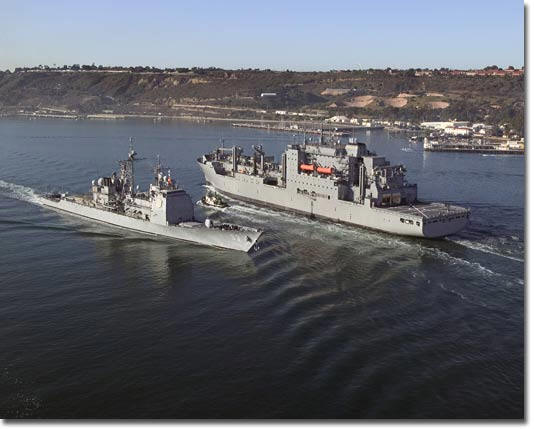
USNS Sacagawea (T-AKE-2) is a dry cargo and ammunition ship operated by the U.S. Navy’s Military Sealift Command (MSC), built to keep modern naval forces continuously supplied while deployed far from shore infrastructure. As a Lewis and Clark-class vessel, Sacagawea is designed to deliver the high-consumption essentials that carrier strike groups, amphibious forces, and independent surface combatants burn through every day: food, repair parts, medical stores, general supplies, and large volumes of ordnance. Unlike older logistics concepts that split these missions across separate ship types, Sacagawea represents a modern, integrated replenishment platform capable of sustaining multiple combatants at sea through a combination of alongside cargo transfer, fueling support, and helicopter vertical replenishment. The ship is named for Sacagawea, the Shoshone interpreter and guide associated with the Lewis and Clark expedition, which aligns directly with the class naming tradition and the ship’s mission of enabling long-range journeys.
Class Purpose and Operational Concept
The Lewis and Clark-class was developed to replace legacy ammunition ships and combat stores ships with a single hull that could support the fleet more efficiently. In practical fleet operations, this means Sacagawea is a hybrid logistics ship: it carries large dry stores inventories, substantial ammunition loads, and limited liquid cargo while being equipped with the gear to transfer these supplies at sea in a steady, repeatable cycle. The operational concept centers on minimizing the time combat ships spend away from their mission areas by bringing the supply chain directly to them, even in the middle of the ocean. Sacagawea supports sustained naval presence by enabling replenishment without a port visit, which is increasingly important in a world where access to forward bases can be politically constrained or tactically risky.
Construction and Hull Engineering
USNS Sacagawea was built by National Steel and Shipbuilding Company (NASSCO) in San Diego, California, a shipyard with extensive experience producing large auxiliary ships for the U.S. Navy. The vessel uses a welded steel hull designed around long-duration deployments, high cargo density, and the structural demands of underway replenishment. The internal arrangement is engineered for safe segregation of ammunition magazines, controlled-access cargo holds, refrigerated and dry storage, and high-throughput cargo staging areas near transfer stations. The ship’s deck plan is shaped by its mission: open working deck space is prioritized for replenishment rigs, cranes, and cargo movement routes, while the superstructure is configured to provide strong visibility and safe control during close-quarters alongside operations.
Dimensions, Displacement, and Core Characteristics
USNS Sacagawea is approximately 210 meters (about 689 feet) long with a beam of roughly 32 meters (about 106 feet), giving it the footprint needed to carry large stores inventories while remaining stable during transfer operations. Full-load displacement is typically around 41,000 tons, which reflects a ship built for endurance and capacity rather than minimal size. Draft varies with loading but generally falls in the 9 to 11 meter range, deep enough to support cargo stability and magazine safety while still allowing access to many major naval ports. The hull form is optimized for predictable handling and station-keeping, because replenishment at sea demands steady relative motion and controlled ship behavior in varying sea states, especially when transferring ammunition and heavy pallet loads.
Propulsion System and Performance Specifications
Sacagawea is powered by a diesel propulsion plant designed for reliability, fuel economy, and long service intervals, rather than the high-speed sprint performance of combat ships. The ship uses medium-speed diesel engines driving twin shafts, giving it a top speed of about 20 knots, which is sufficient to keep pace with most replenishment schedules and to reposition efficiently across operational theaters. Twin-screw propulsion improves low-speed control, which matters enormously during alongside replenishment, where the ship must maintain tight station with a receiving vessel for extended periods. The ship also incorporates maneuvering aids such as thrusters, enhancing control during docking, close-quarter positioning, and precision handling in restricted waters. Its operational range exceeds 9,000 nautical miles at economical speeds, enabling long transits and sustained forward deployment without constant dependence on shore infrastructure.
Cargo Capacity and Load Management
The defining feature of USNS Sacagawea is its ability to carry multiple categories of fleet-critical cargo at once. Dry cargo capacity is typically in the range of 6,000 to 7,000 tons, including packaged food, ship store items, medical supplies, repair parts, and general consumables. Ammunition is carried in dedicated magazine spaces designed for safety, controlled handling, and compatibility with modern ordnance storage requirements. Sacagawea also carries limited quantities of liquid cargo, including potable water and small volumes of fuel products, which increases its flexibility when supporting ships that need more than just dry stores. The cargo management system is built around palletized and containerized logistics, with internal elevators, conveyors, and staging zones that allow rapid movement from storage holds to transfer points, because replenishment is ultimately a throughput mission: the faster and safer the ship can move cargo, the more ships it can sustain in a given time window.
Underway Replenishment Systems and Transfer Stations
Sacagawea is equipped for connected replenishment, the traditional alongside method where two ships steam together while cargo and fuel move across tensioned span wires and hoses. Multiple replenishment stations along the ship’s sides allow it to transfer cargo to more than one ship during a replenishment evolution or to quickly reconfigure for successive deliveries. The ship is fitted with high-capacity transfer rigs and cargo handling cranes designed to move heavy loads, including palletized supplies and ammunition, in a controlled and continuous flow. In addition to cargo, Sacagawea can support limited fuel and water transfer, enabling a more complete replenishment package when paired with dedicated oilers in a strike group logistics plan. Safety is a constant engineering priority in these systems, with specialized handling equipment, procedural control points, and shipboard damage control infrastructure designed to reduce risk during ordnance transfer.
Aviation Facilities and Vertical Replenishment Capability
USNS Sacagawea includes a flight deck and aviation support features that enable vertical replenishment, typically using Navy logistics helicopters such as the MH-60S. Vertical replenishment is critical because it allows rapid delivery of high-priority cargo without requiring ships to come alongside, and it also enables resupply in sea states or tactical situations where connected replenishment is less desirable. Sacagawea’s aviation facilities include refueling support, deck handling equipment, and cargo staging areas configured for sling-load operations. This capability significantly expands the ship’s operational usefulness, especially when supporting dispersed naval forces, where multiple ships may need smaller, frequent deliveries rather than a single large alongside replenishment event.
Crew, Command Structure, and Daily Operations
Sacagawea is operated by a civilian mariner crew under Military Sealift Command, typically around 120 personnel, with additional Navy detachments embarked as needed for communications, replenishment coordination, and mission oversight. This model allows the Navy to field a large logistics fleet without consuming the manpower required for combat ship operations. The crew is responsible for navigation, engineering, cargo handling, flight deck operations support, and ship maintenance during extended deployments. In daily practice, the ship’s work is demanding and highly procedural, involving precise ship handling, heavy cargo movement, hazardous material control, and complex coordination with receiving ships. The operational tempo can be intense, because a single AKE ship may be tasked to replenish multiple combatants in rapid succession across a wide geographic area.
Communications, Navigation, and Defensive Provisions
Although Sacagawea is not designed as a warship, it carries modern navigation radars, secure communications, and coordination systems required to operate safely within carrier strike groups and other fleet formations. Replenishment operations demand reliable ship-to-ship communications, precise navigation, and the ability to integrate with task force command structures. The ship also incorporates survivability features such as robust fire suppression, magazine safety systems, damage control design, and redundancy in critical ship services. Like other MSC auxiliaries, it can be fitted with force protection measures including small arms mounts and embarked security teams when operating in higher-risk environments. These measures do not make it a combatant, but they support the reality that logistics ships often operate close to contested regions and must be able to protect themselves long enough to withdraw or be defended by escorting forces.
Conclusion
USNS Sacagawea (T-AKE-2) is a purpose-built fleet logistics ship that embodies the modern Navy’s approach to sustained operations: fewer port visits, longer deployments, and supply chains that travel with the force. With a large dry cargo and ammunition capacity, an efficient diesel propulsion plant, robust replenishment stations, and helicopter vertical replenishment support, Sacagawea functions as a floating distribution center for deployed combat ships. Its technical design is centered on throughput, safety, and endurance, and while it may not carry the glamour of a destroyer or carrier, it delivers something those ships cannot operate without for long: continuous, reliable sustainment at sea.
