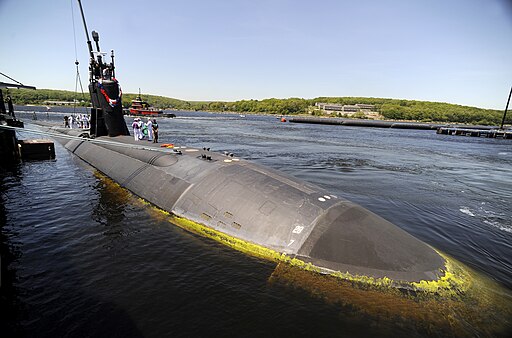
USS Hartford (SSN-768)
The USS Hartford (SSN-768) stands as one of the United States Navy’s exemplary Los Angeles-class fast attack submarines. Launched with a mission of ensuring undersea dominance and strategic deterrence, she embodies decades of naval innovation, stealth technology, and advanced combat capabilities. This article delves into her history, design, and the technical specifications that make the USS Hartford a formidable underwater asset.
Historical Background
Commissioned in the mid-1990s, the USS Hartford was named in honor of Connecticut’s capital, reflecting a proud tradition of naval excellence and commitment to national defense. Built by Newport News Shipbuilding, she entered service during a period when technological advancements were rapidly reshaping submarine warfare. Over the years, Hartford has participated in numerous exercises and covert operations, contributing to the evolution of modern undersea tactics and maintaining a presence in both the Atlantic and Pacific theaters.
Design and Construction
The USS Hartford was engineered with a primary focus on stealth, agility, and versatility. Her design incorporates a number of features aimed at reducing acoustic signatures and maximizing operational efficiency in deep and complex maritime environments. The pressure hull, built from high-strength steel, and an array of advanced noise reduction techniques enable the submarine to navigate silently while remaining undetectable by enemy sensors. These design principles ensure that Hartford can execute missions ranging from intelligence gathering and surveillance to offensive strikes with precision and reliability.
Technical Specifications
Dimensions and Displacement
- Length: Approximately 362 feet (110 meters)
- Beam: Roughly 33 feet (10 meters)
- Draft: About 32 feet (9.8 meters)
- Full Load Displacement: Nearly 6,900 tons when submerged
These dimensions provide the USS Hartford with a balanced blend of maneuverability and space to house advanced systems and a skilled crew, ensuring stability even in the most challenging underwater conditions.
Propulsion and Performance
At the heart of the USS Hartford is a robust nuclear propulsion system that delivers both speed and endurance:
- Propulsion System: Powered by one S6G nuclear reactor
- Shaft Power: Drives two propeller shafts, delivering an estimated 30,000 shaft horsepower
- Maximum Speed: In excess of 25 knots when submerged
- Endurance: The nuclear reactor allows for extended deployments with virtually unlimited range, only limited by food and crew endurance
This propulsion configuration not only provides the submarine with impressive acceleration and speed but also enables quiet operation—a critical attribute for covert underwater missions.
Armament and Combat Systems
The USS Hartford is outfitted with a versatile array of weaponry designed for both offensive and defensive operations:
- Torpedo Tubes: Four 21-inch torpedo tubes capable of launching a variety of munitions
- Missile Capability: Able to deploy Tomahawk Land Attack Missiles (TLAM) for precision strike missions
- Torpedoes: Equipped to fire advanced Mark 48 torpedoes, which serve as the primary weapon for anti-ship and anti-submarine warfare
These armaments are integrated into a sophisticated combat management system that enables rapid target identification, tracking, and engagement, ensuring that the submarine remains effective in high-threat environments.
Advanced Sensor and Navigation Systems
A key aspect of USS Hartford’s operational superiority lies in her state-of-the-art sensor suites and navigation systems:
- Sonar Systems: An integrated array of passive and active sonar sensors provides comprehensive situational awareness. These sensors detect and track potential adversaries while maintaining a low acoustic profile.
- Navigation and Communication: Advanced digital systems facilitate secure communication and real-time data processing. This network of systems supports rapid decision-making and precise maneuvering even in the depths of the ocean.
- Electronic Warfare: Modern electronic countermeasure capabilities help to detect, analyze, and neutralize incoming threats, reinforcing the vessel’s defensive posture.
Crew and Operational Capacity
The success of the USS Hartford is as much a product of her cutting-edge technology as it is of her dedicated crew:
- Crew Complement: Typically around 130 highly trained personnel, including specialists in nuclear propulsion, sonar operations, and tactical warfare.
- Living and Operational Quarters: Designed to support long-duration missions, the submarine provides accommodations and workspaces that enhance crew efficiency and morale under extended deployments.
- Training and Readiness: Rigorous training programs ensure that the crew remains proficient in managing the complex systems aboard the vessel, from reactor operations to emergency procedures.
Modernization and Upgrades
Throughout her service life, the USS Hartford has benefited from several modernization programs. These upgrades have enhanced her combat systems, sonar processing, and overall operational efficiency. Continuous improvements in digital warfare, communication networks, and noise reduction technology have allowed Hartford to remain at the forefront of submarine capabilities, adapting to evolving threats and mission requirements.
Strategic Role and Operational Impact
The USS Hartford plays a pivotal role in maintaining U.S. naval superiority beneath the waves. As a fast attack submarine, she is tasked with:
- Intelligence Gathering: Operating covertly to collect critical data on adversary movements and undersea activities.
- Offensive Operations: Launching precision strikes against high-value targets with stealth and accuracy.
- Force Projection: Serving as a deterrent in geopolitical hotspots, ensuring rapid response capabilities in times of crisis.
- Maritime Security: Protecting sea lanes and supporting allied naval forces in joint operations.
Her versatility, stealth, and advanced technology make the USS Hartford an indispensable component of America’s strategic undersea warfare capabilities.
Conclusion
The USS Hartford (SSN-768) exemplifies the blend of advanced engineering, tactical innovation, and operational excellence that has come to define modern submarine warfare. With her formidable nuclear propulsion system, state-of-the-art sensors, and an arsenal of precision weaponry, Hartford not only secures the nation’s underwater front but also stands as a testament to the United States Navy’s enduring commitment to maritime security. As threats evolve and new challenges emerge in the deep, the USS Hartford continues to adapt and excel, remaining a silent guardian beneath the waves and a critical asset in ensuring national defense.
.jpg)