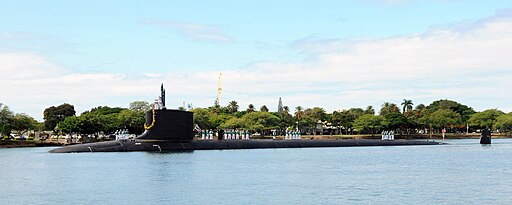
USS Hawaii (SSN-776)
The USS Hawaii (SSN-776) is a distinguished example of American undersea engineering and a proud member of the Los Angeles-class nuclear-powered attack submarines. Bearing the name of the 50th state, this vessel not only represents the technological prowess of the U.S. Navy but also carries a legacy of operational excellence and strategic deterrence. This article explores the rich history, design philosophy, and detailed technical specifications of the USS Hawaii, offering insights into the systems and innovations that make her a formidable force beneath the waves.
Historical Background
Commissioned in the mid-1990s, the USS Hawaii (SSN-776) entered service during a period of significant transformation in naval warfare. As global maritime challenges evolved, so did the need for stealth, speed, and versatility in submarine design. The USS Hawaii was built to meet these demands and has since participated in numerous covert operations, intelligence missions, and joint exercises around the world. Her name, evoking the beauty and resilience of the Pacific state, symbolizes both a deep connection to American heritage and a commitment to safeguarding national security on a global scale.
Design and Construction
Constructed at one of the nation’s premier shipyards, the USS Hawaii benefits from decades of refinement in submarine technology. The design of this Los Angeles-class submarine emphasizes low acoustic signatures, robust structural integrity, and enhanced operational capabilities. Key elements of her construction include:
- Advanced Hull Design: The pressure hull is forged from high-strength steel, engineered to withstand the immense pressures of deep-sea operations while ensuring optimal quieting characteristics.
- Stealth Technology: Innovative sound-dampening techniques and refined hydrodynamic shaping reduce noise emissions, making the USS Hawaii exceptionally difficult to detect by enemy sonar.
- Integrated Combat Systems: A state-of-the-art command and control suite ties together sensor data, navigation, and weapons systems, ensuring rapid decision-making and operational responsiveness.
Technical Specifications
A detailed look at the technical parameters of the USS Hawaii reveals a vessel built for both power and precision.
Dimensions and Displacement
- Length: Approximately 362 feet (110 meters)
- Beam: Around 33 feet (10 meters)
- Draft: Roughly 32 feet (9.8 meters)
- Full Load Displacement: Nearly 6,900 tons when submerged
These dimensions provide a balanced profile, ensuring the submarine remains agile and stable while accommodating an extensive array of systems and a highly trained crew.
Propulsion and Performance
At the heart of the USS Hawaii lies a cutting-edge nuclear propulsion system, designed to offer unmatched endurance and rapid maneuverability.
- Propulsion System: Powered by a single S6G nuclear reactor, which generates steam to drive two propeller shafts.
- Shaft Power: Approximately 30,000 shaft horsepower, enabling brisk acceleration and sustained high-speed operations.
- Maximum Speed: Capable of exceeding 25 knots when submerged, which is crucial for both evasion and tactical positioning.
- Operational Endurance: The nuclear reactor allows for virtually unlimited range during deployments, with the primary constraints being crew endurance and logistical support rather than fuel supply.
Armament and Combat Systems
The USS Hawaii is outfitted with an impressive suite of armaments and combat systems designed to assert dominance in multiple combat scenarios.
- Torpedo Tubes: Four 21-inch torpedo tubes form the backbone of the submarine’s offensive capability. These tubes can deploy an array of munitions, including:
- Mk 48 Advanced Torpedoes: High-performance torpedoes designed for both anti-ship and anti-submarine warfare.
- Tomahawk Land Attack Missiles (TLAM): When equipped with vertical launch systems or compatible canister launchers, these missiles extend the vessel’s strike range to land-based targets.
- Combat Management System: An integrated digital suite processes sensor data, manages weapons deployments, and coordinates tactical responses. This system ensures that the USS Hawaii can react swiftly to evolving threats while maintaining stealth and precision.
Sensors and Navigation
A sophisticated sensor suite underpins the USS Hawaii’s operational effectiveness in complex underwater environments.
- Sonar Systems: A combination of passive and active sonar arrays provides comprehensive situational awareness. These systems detect, track, and classify contacts in the underwater domain while preserving the submarine’s low noise profile.
- Navigation: Advanced inertial navigation systems (INS) are augmented by satellite-based technologies, ensuring accurate positioning and course tracking even during deep-dives or in GPS-denied environments.
- Electronic Warfare and Countermeasures: The submarine is equipped with electronic support measures (ESM) and countermeasure systems that help detect, jam, or misdirect enemy sensors and communications, further enhancing her survivability.
Crew and Habitability
The operational success of the USS Hawaii is supported by a dedicated crew trained to manage and optimize the submarine’s complex systems.
- Crew Complement: Typically, the USS Hawaii carries around 130 highly trained personnel, including officers and enlisted specialists in areas such as nuclear propulsion, sonar operations, and tactical warfare.
- Living Quarters: The submarine is designed for extended missions, featuring compact but efficient accommodations that support the crew’s operational needs and well-being during prolonged underwater deployments.
- Training and Readiness: Continuous training programs ensure that all crew members are proficient in handling both routine operations and emergency procedures, reinforcing the vessel’s overall readiness.
Modernization and Upgrades
Throughout her service life, the USS Hawaii has undergone several modernization initiatives to keep pace with evolving technological advancements and emerging threats. Key upgrades include:
- Digital System Enhancements: Improvements in digital signal processing and combat management software have increased the accuracy and responsiveness of the submarine’s sensor suite.
- Stealth Upgrades: Continuous refinement of noise reduction measures and hull coatings has ensured that the USS Hawaii remains at the forefront of stealth technology.
- Weapon System Updates: Integration of new missile and torpedo variants has broadened the tactical options available to the crew, ensuring that the submarine can respond to a diverse range of operational scenarios.
Operational Role and Strategic Impact
The USS Hawaii (SSN-776) plays a vital role in the U.S. Navy’s global strategy, serving as a versatile platform capable of executing a wide range of missions:
- Anti-Submarine Warfare (ASW): Leveraging its advanced sonar and stealth capabilities, the submarine actively hunts enemy submarines, ensuring maritime dominance in contested environments.
- Anti-Surface Warfare (ASuW): With its armament and precision strike capabilities, the USS Hawaii is well-equipped to engage surface vessels and support naval task forces.
- Intelligence, Surveillance, and Reconnaissance (ISR): The vessel’s sensor suite and covert operational profile allow it to gather critical intelligence on adversary movements and strategic assets.
- Special Operations Support: The USS Hawaii can serve as a platform for deploying and recovering special forces, adding a versatile capability to U.S. expeditionary operations.
Conclusion
The USS Hawaii (SSN-776) exemplifies the pinnacle of Los Angeles-class submarine design, merging powerful nuclear propulsion, advanced stealth technology, and a comprehensive suite of offensive and defensive systems into a single, highly capable vessel. As an integral asset of the U.S. Navy, she embodies the commitment to technological innovation and strategic deterrence that defines modern undersea warfare. Whether engaging in anti-submarine patrols, launching precision strikes, or gathering vital intelligence, the USS Hawaii continues to set the standard for excellence in naval operations, ensuring that American maritime interests remain secure beneath the waves.
_as_she_pulls_into_her_new_homeport_at_Naval_Station_Pearl_Harbor.jpg)