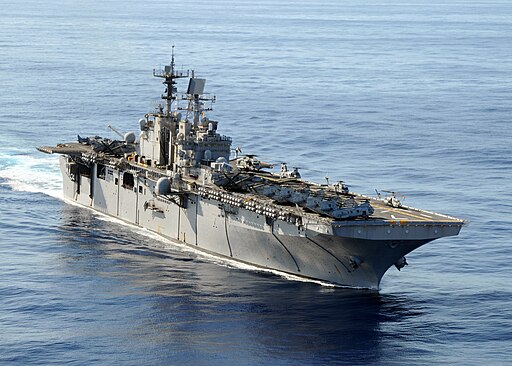
USS Iwo Jima (LHD-7)
USS Iwo Jima (LHD-7) – Amphibious Assault Ship of the U.S. Navy
The USS Iwo Jima (LHD-7) is a key vessel in the United States Navy’s amphibious warfare fleet, serving as a landing helicopter dock (LHD) ship. Commissioned on 30 March 2001, the Iwo Jima is named after the historic Battle of Iwo Jima, which was a turning point in the Pacific campaign of World War II. As an LHD, Iwo Jima is designed to support amphibious assault operations, enabling the U.S. Navy to project power from the sea to land in a variety of combat and humanitarian settings. With its advanced capabilities, large flight deck, and versatility, the USS Iwo Jima remains a crucial asset for the United States Navy’s global operations.
Design and Development
The USS Iwo Jima is part of the Wasp-class amphibious assault ships, which are the largest ships in the U.S. Navy’s amphibious warfare fleet. These ships are designed to carry out a wide range of missions, from amphibious assaults to humanitarian assistance. The Iwo Jima was constructed by the Ingalls Shipbuilding division of Huntington Ingalls Industries, with the keel laid in 1996 and the ship officially launched in 1999.
The Wasp-class ships were developed to replace the older Tarawa-class amphibious assault ships, providing enhanced capacity for landing forces, including Marines, vehicles, and equipment. Unlike earlier amphibious ships, the Wasp-class combines the capabilities of a traditional amphibious assault ship and an aircraft carrier, thanks to its expansive flight deck and well-deck for landing craft. This combination makes the USS Iwo Jima highly adaptable to various mission requirements, including combat operations, humanitarian aid, and disaster relief.
Key Specifications of USS Iwo Jima (LHD-7)
- Length: 844 feet (257 meters)
- Beam: 106 feet (32 meters)
- Draft: 28 feet (8.5 meters)
- Displacement: 40,500 tons (full load)
- Speed: 22 knots (40.7 km/h or 25.3 mph)
- Range: 9,500 nautical miles (17,600 km) at 20 knots
- Crew: Approximately 1,000 sailors, with additional personnel when embarked
- Air Wing: Up to 30 aircraft (including helicopters, tiltrotors, and fixed-wing aircraft)
- Armament:
- 2 x RIM-116 Rolling Airframe Missile (RAM) systems for point defense
- 2 x 20mm Phalanx CIWS (Close-In Weapon Systems) for defense against anti-ship missiles and aircraft
- 3 x 25mm Mk 38 machine guns
- Various small arms for security and defense
- Flight Deck: Capable of carrying up to 30 aircraft (MH-53E Sea Dragon helicopters, CH-46 Sea Knight helicopters, MV-22 Osprey tiltrotors, and AV-8B Harrier jet)
- Well Deck: Can carry up to four Landing Craft Air Cushion (LCACs) or Amphibious Assault Vehicles (AAVs)
- Sensor Suite:
- AN/SPS-48E 3D radar for air surveillance
- AN/SPS-49(V)5 radar for air search
- AN/SPQ-9B radar for surface surveillance
- AN/SLQ-32(V)3 electronic warfare system for threat detection and defense
Design and Hull
The USS Iwo Jima has a hull designed to meet the demanding requirements of amphibious assault operations. The ship’s hull is constructed using steel and is reinforced for stability in heavy seas, with the ability to navigate shallow coastal waters where amphibious operations are typically conducted. The ship’s flight deck, which extends 844 feet in length, provides a large, unobstructed area for launching and recovering aircraft, while the well-deck allows for the rapid deployment of landing craft.
The flight deck of the Iwo Jima supports both rotary-wing aircraft, such as helicopters, and fixed-wing aircraft, such as the AV-8B Harrier jet, which is capable of vertical/short takeoff and landing (V/STOL). This flexibility allows the ship to conduct operations in areas where traditional runways are unavailable. The well-deck can carry amphibious landing craft, such as the Landing Craft Air Cushion (LCAC), which is capable of transporting troops, vehicles, and supplies directly from the ship to the shore.
The ship’s hull also incorporates advanced shipbuilding techniques, ensuring durability and survivability in combat situations. The ship’s systems are designed with redundancy in mind, ensuring the ability to continue operations even if some systems are damaged or disabled.
Propulsion and Power
The USS Iwo Jima is powered by a combined diesel and gas turbine propulsion (CODOG) system, which provides both efficiency and high-speed capability. The propulsion system consists of two gas turbine engines and two diesel engines, driving four shafts. This design enables the ship to reach speeds of up to 22 knots, which is sufficient for operational flexibility while ensuring fuel efficiency during longer deployments.
The combination of gas turbines and diesel engines also allows for a balance of power and fuel consumption, with the ability to reach higher speeds when needed, such as in times of combat or in response to evolving operational requirements. The ship’s propulsion system is designed to be reliable and capable of supporting long-duration missions, including global deployments with limited resupply.
Armament and Defense Systems
Although primarily a platform for amphibious assault, the USS Iwo Jima is equipped with a robust array of defensive weapons to protect itself and its embarked forces. The ship is armed with two Rolling Airframe Missile (RAM) systems, designed to provide point defense against incoming anti-ship missiles and aircraft. The RAM systems provide a fast-reacting defense against threats at close range.
Additionally, the Iwo Jima is equipped with two Phalanx Close-In Weapon Systems (CIWS), which use radar-guided 20mm Gatling guns to intercept and destroy incoming threats, such as missiles or aircraft. These systems are critical for providing immediate defense in high-threat environments, especially in areas where other forms of air defense may not be as effective.
The ship also carries three 25mm Mk 38 machine guns, used for close-in defense against smaller surface targets or airborne threats. In addition to its weapons, the USS Iwo Jima relies on an array of sensors and radar systems to detect and track both airborne and surface threats.
Amphibious Assault and Operations
The USS Iwo Jima is primarily designed for amphibious assault operations, and it serves as a mobile base for deploying Marines, vehicles, and equipment during combat or humanitarian missions. The ship’s well-deck is capable of carrying up to four Landing Craft Air Cushion (LCACs), which are capable of transporting a wide range of vehicles, including tanks, armored personnel carriers, and military trucks, directly from the ship to the shore.
The Iwo Jima can also carry Amphibious Assault Vehicles (AAVs), which are used to transport troops from the well-deck to the shore. The ship’s flight deck supports a variety of rotary-wing aircraft, including helicopters for troop transport, combat search and rescue, and logistics support. The ship can also launch tiltrotor aircraft like the MV-22 Osprey, which has the capability to land in areas that may be inaccessible to helicopters or fixed-wing aircraft.
In addition to its role in combat operations, the USS Iwo Jima is a key asset in humanitarian missions, including disaster relief, evacuation operations, and medical assistance. Its extensive cargo capacity, along with its onboard hospital facilities, makes it an ideal platform for delivering aid during natural disasters or other crises.
Deployment and Global Operations
The USS Iwo Jima has served in various theaters of operation since its commissioning, with deployments to the Mediterranean, the Arabian Gulf, and the Pacific. The ship is capable of conducting rapid deployments in support of U.S. national interests, from combat operations to peacekeeping missions. In times of humanitarian crisis, the ship’s unique capabilities allow it to deliver essential aid and provide a forward presence where needed.
In addition to supporting U.S. military operations, the USS Iwo Jima also participates in multinational exercises, demonstrating the U.S. Navy’s ability to work in concert with allied forces. These exercises focus on enhancing interoperability, readiness, and the coordination of amphibious assault operations.
Conclusion
The USS Iwo Jima (LHD-7) is a highly versatile and strategically valuable ship in the U.S. Navy’s amphibious warfare fleet. With its large flight deck, well-deck for landing craft, and extensive armament and defense systems, the Iwo Jima is well-equipped to support a wide variety of missions, from amphibious assaults to humanitarian assistance. The ship’s advanced design, powerful propulsion system, and robust defensive capabilities ensure that it remains a vital asset for projecting power, delivering aid, and maintaining a global presence. As the U.S. Navy continues to focus on maintaining operational flexibility in both combat and peacekeeping scenarios, the USS Iwo Jima will continue to play a critical role in ensuring national security and responding to global challenges.
_transits_the_Atlantic_Ocean.jpg)