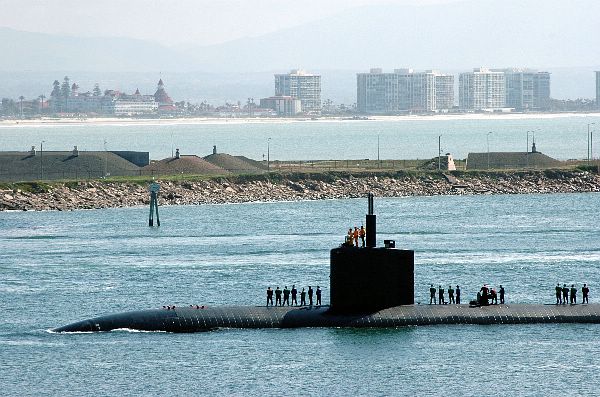
USS Jefferson City (SSN-759)
USS Jefferson City (SSN-759) – Silent Strength Beneath the Sea
The USS Jefferson City (SSN-759) is a Los Angeles-class nuclear-powered attack submarine in the United States Navy. Named after the capital of Missouri, this formidable vessel embodies the quiet strength, agility, and deterrence capability that has come to define modern American undersea warfare. Commissioned in the early 1990s during the final years of the Cold War, Jefferson City has played a critical role in maintaining maritime dominance, intelligence-gathering, and supporting fleet operations around the globe.
As part of the improved “688i” (Los Angeles-class Improved) group, the Jefferson City includes numerous enhancements over the earlier boats of the class—making her quieter, deeper-diving, and more capable in undersea combat. She is designed to seek and destroy enemy submarines and surface ships, deliver special operations forces, support battle group operations, conduct surveillance, and launch Tomahawk cruise missiles against land targets with surgical precision.
Historical Overview
USS Jefferson City (SSN-759) was built at the Newport News Shipbuilding and Dry Dock Company in Newport News, Virginia. The keel was laid down on September 21, 1987, and she was launched on August 17, 1990. She officially entered service on February 29, 1992. Since then, the submarine has been an active participant in numerous operations, showcasing the United States’ undersea superiority.
Los Angeles-class submarines, especially the 688i variants, formed the core of the U.S. Navy’s attack submarine force throughout the late 20th and early 21st centuries. They remain vital platforms for power projection, sea control, and intelligence gathering.
General Characteristics and Specifications
- Class and Type: Los Angeles-class nuclear-powered attack submarine (Improved 688i)
- Hull Number: SSN-759
- Builder: Newport News Shipbuilding, Newport News, Virginia
- Laid Down: September 21, 1987
- Launched: August 17, 1990
- Commissioned: February 29, 1992
- Homeport: Pearl Harbor, Hawaii (as of latest assignments)
Dimensions
- Length: 360 feet (110 meters)
- Beam: 33 feet (10 meters)
- Draft: 29 feet (8.8 meters)
- Displacement:
- Approx. 6,900 tons (surfaced)
- Approx. 7,100 tons (submerged)
The boat’s size provides enough space for a sophisticated suite of weapons, sensors, and life support systems, while maintaining the agility needed for covert operations in diverse theaters.
Propulsion and Performance
- Propulsion: One S6G pressurized water nuclear reactor powering two steam turbines and a single shaft
- Horsepower: Approx. 35,000 shaft horsepower (26 MW)
- Speed:
- 20+ knots (surfaced)
- 30+ knots (submerged)
- Test Depth: Greater than 800 feet (estimated, classified exact depth)
- Endurance: Virtually unlimited, limited only by onboard food and crew supplies
- Crew: Approximately 130 (12 officers, 118 enlisted)
Thanks to nuclear propulsion, Jefferson City can operate submerged for months at a time, enabling it to deploy globally without surfacing, thus maintaining stealth and strategic unpredictability.
Weapons and Combat Systems
The USS Jefferson City is a formidable warfighting platform. It is equipped with a range of precision weapons for multiple mission types—from anti-ship and anti-submarine warfare to land strike and special operations support.
Torpedo Tubes
- Number: 4 × 21-inch (533 mm) torpedo tubes
- Torpedoes: Mk 48 ADCAP (Advanced Capability) torpedoes
- Capable of targeting both surface ships and submarines
- Wire-guided with active/passive homing systems
Vertical Launch System (VLS)
As an Improved 688i variant, Jefferson City is equipped with a 12-cell vertical launch system located in the bow.
- Missile Capability:
- BGM-109 Tomahawk Land Attack Missiles (TLAM)
- Conventional warheads with precision strike capability
- Ranges up to 1,000 miles (1,600 km) depending on the variant
This capability allows Jefferson City to strike strategic land targets from hundreds of miles offshore, enabling first-strike capability without exposing surface vessels to danger.
Sensor and Sonar Systems
One of the most critical aspects of submarine warfare is situational awareness. Jefferson City carries a highly advanced suite of sonar and detection systems, making it an underwater predator capable of both stealthy observation and aggressive engagement.
- Sonar Systems:
- AN/BQQ-5E sonar suite
- AN/BQS-15 close-range active sonar
- AN/BQR-19 passive towed array (TB-16 or TB-23)
- Fire Control:
- Mk 117 Fire Control System
- Digital integration with sonar and weapons for rapid targeting
- Electronic Support Measures:
- AN/BLD-1 radio direction finder
- Advanced periscopes with imaging, infrared, and communication capabilities
The boat’s sensors allow it to detect and classify contacts at long range, navigate through complex undersea environments, and conduct surveillance undetected.
Special Operations and Mission Flexibility
The USS Jefferson City supports the deployment of Navy SEALs and other special operations forces. While it does not have a dry deck shelter (DDS) like larger platforms such as Ohio-class SSGNs, it can embark SEALs and deploy them via torpedo tubes or lockout trunks for clandestine missions near hostile shores.
Mission sets include:
- Intelligence, Surveillance, and Reconnaissance (ISR)
- Special forces insertion/extraction
- Anti-submarine warfare (ASW)
- Anti-surface warfare (ASuW)
- Strategic land attack
- Carrier and expeditionary group support
Notable Deployments and Operational History
While much of the submarine’s operational history is classified, Jefferson City has completed several notable deployments to key regions, including the Western Pacific, the Indian Ocean, and the Arabian Gulf. She has supported Carrier Strike Groups and joint exercises with allied navies, enhancing interoperability and readiness.
The submarine underwent an Extended Drydocking Selected Restricted Availability (EDSRA) in the late 2010s, which included system upgrades and maintenance to extend her operational life into the 2030s.
Life Aboard the Submarine
Life aboard Jefferson City is characterized by close quarters, discipline, and mission focus. The crew operates in a 24/7 environment with rotating watch shifts, and everyone—from junior sailors to officers—plays a role in ensuring the submarine functions seamlessly.
Facilities include:
- Enlisted and officer berthing
- Mess and galley
- Medical facilities
- Engineering control rooms
- Combat information center
Due to limited space, crew members often share “hot racks,” rotating sleeping shifts as others stand watch. Morale and cohesion are critical components of the submarine community, and Jefferson City’s crew reflects the Navy’s highest standards of professionalism and capability.
Legacy and Strategic Role
The USS Jefferson City is a vital contributor to undersea dominance. As geopolitical tensions evolve and the need for stealth, intelligence, and deterrence becomes more pronounced, submarines like SSN-759 are more critical than ever. While newer Virginia-class boats are joining the fleet, the 688i submarines continue to operate with relevance and potency, thanks to their speed, stealth, and combat versatility.
The boat honors the city of Jefferson City, Missouri, and reflects the strength and pride of middle America, carried forward beneath the sea.
Conclusion
The USS Jefferson City (SSN-759) is more than just a Cold War relic—it is a modern, lethal platform that continues to adapt and operate in today’s dynamic maritime environment. With its blend of stealth, firepower, and sensor capability, it serves as both a sword and a shield beneath the oceans. As a critical node in America’s undersea warfare force, Jefferson City remains ready—silent, watchful, and always lethal.
