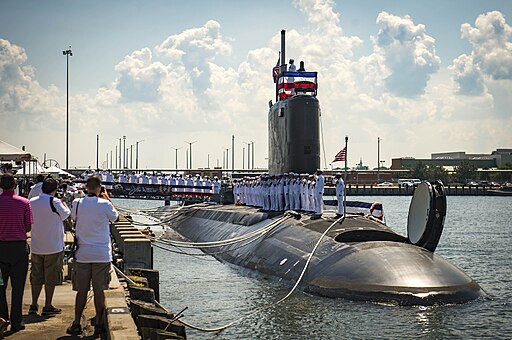
USS John Warner (SSN-785)
USS John Warner (SSN-785): Silent Sentinel of the Deep
The USS John Warner (SSN-785) is one of the most advanced and lethal submarines in the world, a powerful symbol of the United States Navy’s undersea dominance. As the 12th vessel of the Virginia-class and the first of the Block III variant, the John Warner integrates cutting-edge technologies, operational flexibility, and stealth capabilities to address 21st-century threats with unprecedented precision.
Named in honor of Senator John Warner, a former Secretary of the Navy and long-serving U.S. Senator from Virginia, the submarine was commissioned on August 1, 2015. It is the first submarine to be named after a living former senator and the first Virginia-class boat to bear the name of an individual rather than a state. Built by Huntington Ingalls Industries and General Dynamics Electric Boat, the submarine represents a critical component in the evolution of American naval strategy.
Role and Mission
The USS John Warner is a fast attack submarine (SSN), designed for a wide range of undersea operations. These include:
- Anti-submarine warfare (ASW)
- Anti-surface ship warfare (ASuW)
- Strike operations using cruise missiles
- Intelligence, surveillance, and reconnaissance (ISR)
- Special operations support
- Mine warfare
The Virginia class was created to replace the aging Los Angeles-class submarines, with the USS John Warner standing at the forefront of that transition. Its enhanced capabilities allow it to conduct both open-ocean and littoral (near-shore) missions with exceptional versatility and survivability.
General Characteristics
- Class and Type: Virginia-class attack submarine (Block III)
- Hull Number: SSN-785
- Builder: Huntington Ingalls Industries and General Dynamics Electric Boat
- Laid Down: March 16, 2010
- Launched: September 10, 2014
- Commissioned: August 1, 2015
- Homeport: Naval Station Norfolk, Virginia
Dimensions:
- Length: 377 feet (115 meters)
- Beam: 34 feet (10.4 meters)
- Draft: 32 feet (9.7 meters)
- Displacement: Approximately 7,800 tons submerged
These dimensions allow the John Warner to balance interior volume for crew and systems with an exterior profile optimized for stealth and hydrodynamic efficiency.
Propulsion and Power
Like all Virginia-class submarines, the USS John Warner is powered by a nuclear reactor, providing virtually unlimited range and weeks or months of submerged operation.
Propulsion System:
- Reactor: 1 × S9G pressurized water nuclear reactor
- Propulsion: Pump-jet propulsor (replacing traditional propellers for reduced acoustic signature)
- Power Output: Approximately 30 MW
- Speed: 25+ knots (classified)
- Endurance: Limited only by food supply—typically 90 days submerged
- Test Depth: Greater than 800 feet (exact figure classified)
The pump-jet propulsion system significantly reduces the submarine’s acoustic signature, making it harder to detect and enhancing its ability to operate undetected in contested waters.
Crew and Accommodations
- Crew Size: Approximately 132 personnel (15 officers, 117 enlisted)
- Habitability:
- Improved living quarters over older SSNs
- Two crew messes with multi-purpose capability
- Gym and exercise areas
- Modernized galley and food storage systems
Virginia-class submarines were built with sailor comfort in mind. The John Warner includes modular construction and quieter machinery, creating a better quality of life during extended deployments.
Armament and Payload
The USS John Warner carries an arsenal of precision weapons for sea control and land attack, making it a potent asset in both conventional and asymmetric conflicts.
Vertical Launch System:
- 2 × Virginia Payload Tubes (VPTs): Each tube capable of launching 6 Tomahawk cruise missiles
- Total Tomahawk Payload: 12 missiles
The Block III design replaced the older 12 individual vertical launch system (VLS) tubes with two larger payload tubes based on Ohio-class SSGN design, improving maintainability and flexibility.
Torpedo Armament:
- 4 × 21-inch (533 mm) torpedo tubes
- Capable of launching:
- Mk 48 Advanced Capability (ADCAP) torpedoes
- UGM-84 Harpoon anti-ship missiles (if equipped)
Mines and Unmanned Systems:
- Can deploy sea mines and unmanned underwater vehicles (UUVs) for surveillance, reconnaissance, and mine warfare tasks.
Special Operations Support:
- Equipped with a lock-in/lock-out chamber for deploying Navy SEALs and special operations divers
- Compatible with Dry Deck Shelters (DDS) and mini-subs such as the Advanced SEAL Delivery System (ASDS)
This makes the John Warner a strategic platform for covert insertion and extraction in denied environments.
Sensors and Combat Systems
The USS John Warner boasts advanced sonar, sensors, and fire control systems that allow it to detect and engage targets across vast underwater and surface areas.
Sonar Systems:
- Large Aperture Bow (LAB) sonar array (replacing spherical sonar in earlier variants)
- TB-29A towed array sonar
- High-frequency active sonar for under-ice and close-in detection
Combat Management:
- BYG-1 Combat Control System
- Integrated with AN/BYG-1 software
- Real-time data fusion and automated threat tracking
Electronic Warfare and Navigation:
- Advanced periscopes with photonics masts (no hull penetration)
- High-definition cameras and IR sensors
- Inertial Navigation System (INS) and GPS
- Satellite communications and submarine LAN network
The photonics masts replace traditional optical periscopes and include color and infrared cameras, lasers, and electronic warfare sensors. This allows the control room to be located deeper inside the submarine for greater survivability and crew safety.
Operational Service and Deployments
The USS John Warner has already made a significant impact despite being a relatively new asset. In April 2018, it became the first Virginia-class submarine to fire Tomahawk missiles in combat, during joint strikes on Syrian chemical weapons facilities. This marked a milestone in showcasing the capabilities of the class in a real-world operational context.
The submarine has since participated in multiple deployments with the U.S. Sixth Fleet and NATO exercises, and it continues to support intelligence and surveillance operations in high-threat areas.
Technological Edge: Block III Enhancements
Block III of the Virginia-class introduced several major design innovations aimed at improving performance, reducing cost, and increasing mission flexibility:
- Redesigned bow with Large Aperture Bow sonar
- Virginia Payload Tubes (VPTs) replacing legacy VLS
- Improved construction techniques for modular assembly
- Enhanced acoustic quieting and energy efficiency
These upgrades set the foundation for further enhancements in Blocks IV and V, including the Virginia Payload Module (VPM), which will quadruple cruise missile capacity in future boats.
Legacy of Leadership: John Warner
Senator John Warner served as Secretary of the Navy during the Vietnam War and as a U.S. Senator for 30 years. A strong advocate for military readiness and shipbuilding innovation, his legacy lives on through SSN-785’s unwavering performance and service to the nation.
Conclusion
The USS John Warner (SSN-785) represents a new era of undersea warfare—a fusion of stealth, firepower, and versatility that positions the U.S. Navy to maintain undersea dominance well into the future. Whether delivering precise missile strikes, shadowing hostile vessels, or gathering critical intelligence, the John Warner is always present—unseen, unrelenting, and unmatched.
_-_Manning_the_rails.jpg)