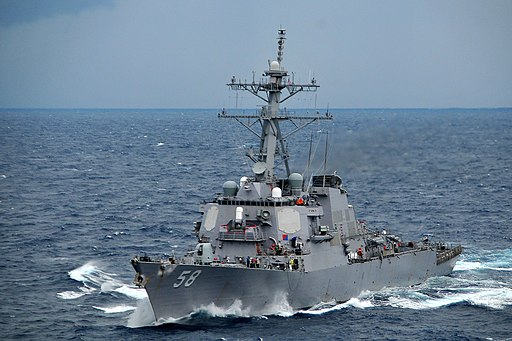
USS Laboon (DDG-58)
USS Laboon (DDG-58) is an Arleigh Burke‑class (Flight I) guided missile destroyer, serving as a mobile command center and multi-threat combat platform in the United States Navy. In service since 1995, Laboon plays a vital role in protecting carrier strike groups and U.S. interests at sea. Named in honor of Father John Francis Laboon—a chaplain who exemplified courage and honor in naval service—this vessel carries a proud legacy and is a prime example of modern naval engineering.
History and Development
Naming and Historic Tribute
USS Laboon is named after Father John Francis Laboon (1921–1988), a revered figure in the Navy Chaplain Corps who was awarded the Silver Star for his valor during World War II. The naming of the vessel pays homage not only to his personal heroism but also to the enduring tradition of honoring individuals whose lives have inspired generations of service members.
Construction and Commissioning
Ordered on December 13, 1988, USS Laboon’s keel was laid down on March 23, 1992, at the historic Bath Iron Works. Launched on February 20, 1993, and commissioned on March 18, 1995, the ship has since maintained a reputation for operational readiness and innovation. Her construction utilized advanced modular techniques and high-strength materials that ensure both durability and a reduced radar cross-section—a necessity in today’s contested maritime environments.
Design and Construction Overview
Hull Design and Structural Integrity
USS Laboon belongs to the Arleigh Burke‑class of destroyers, a design noted for its combination of speed, versatility, and resilience. The vessel’s hull is built with high-strength steel and is optimized for both hydrodynamic efficiency and low observability. With a finely sculpted profile, Laboon’s design minimizes acoustic and radar signatures, allowing her to operate discreetly during high-tempo operations.
Integration of the Aegis Combat System
A cornerstone of USS Laboon’s capabilities is the integrated Aegis Combat System. Centered on the AN/SPY-1D phased array radar, the system provides 360-degree detection and tracking of airborne, surface, and subsurface threats. The fusion of sensor data with sophisticated command and control software allows Laboon to execute rapid, precise countermeasures—turning potentially overwhelming threats into manageable tactical challenges.
Propulsion and Performance Systems
Powered by four General Electric LM2500 gas turbines driving two shafts, USS Laboon produces approximately 100,000 shaft horsepower (shp). This robust propulsion system propels the vessel to speeds exceeding 30 knots while ensuring high maneuverability and a low acoustic profile. The engineering behind Laboon’s propulsion not only supports high-speed operations but also enables extended deployments with a range of about 4,400 nautical miles at 20 knots.
Technical Specifications
General Characteristics and Dimensions
The following table summarizes USS Laboon’s key specifications:
| Specification | Value |
|---|---|
| Class/Type | Arleigh Burke‑class (Flight I) Guided Missile Destroyer |
| Displacement | Light: ~6,800 long tons; Full: ~8,900 long tons |
| Length | 505 ft (154 m) |
| Beam | 59 ft (18 m) |
| Draft | 31 ft (9.4 m) |
| Propulsion | 4 × General Electric LM2500 gas turbines; 2 shafts; ~100,000 shp |
| Maximum Speed | In excess of 30 knots |
| Range | Approximately 4,400 nautical miles at 20 knots |
| Complement | Roughly 280–300 personnel (including officers and enlisted) |
Propulsion System and Performance
Laboon’s propulsion system is a model of efficiency and reliability. The four LM2500 gas turbines ensure rapid acceleration and sustained high-speed transit. Designed for extended patrols, this propulsion configuration allows her to operate continuously over vast expanses of ocean—maintaining presence where strategic deterrence is essential.
Sensors, Processing, and Combat Systems
Central to the ship’s operational excellence is its advanced sensor suite and combat systems. Key components include:
- AN/SPY-1D Radar: A passive electronically scanned array (PESA) radar that forms the heart of the Aegis Combat System, capable of tracking hundreds of targets simultaneously.
- AN/SPG-62 Fire-Control Radar: Provides high-precision targeting data for naval guns and missile engagements.
- Sonar Systems: Integrated sonar arrays offer both passive and active acoustic detection, essential for anti-submarine warfare (ASW).
- Data Processing and Command Systems: High-speed computational resources process incoming data from multiple sensors, enabling real‑time threat evaluation and decision-making.
These systems collectively ensure that USS Laboon remains aware of her environment at all times—allowing for rapid, coordinated responses in an ever-evolving threat landscape.
Armament and Offensive Systems
Laboon’s offensive capabilities are diverse, enabling her to engage threats across multiple domains. Her armament configuration is divided among several key systems.
Missile Systems
USS Laboon is equipped with a sophisticated Mk 41 Vertical Launching System (VLS) composed of two modules:
- 29-cell module and 61-cell module, totaling 90 missile cells.
- The VLS can launch a range of missile types, including:
- RIM-66M Surface-to-Air Missiles (SAMs): For medium-to-long-range air defense.
- RIM-156 Standard Missiles: Enhancing layered air defense.
- BGM-109 Tomahawk Cruise Missiles: For precise land-attack missions.
- RUM-139 Vertical Launch ASROC: Providing anti-submarine capability.
Naval Guns and Close-In Weapon Systems
Laboon carries a suite of rapid-fire guns and defense systems:
- 1 × 5-inch (127 mm) Mk 45 Gun: A lightweight naval artillery system used for shore bombardment and engaging surface targets.
- Phalanx CIWS: Two 20-mm close-in weapon systems that deliver fast, automated responses to missile and close-range threats.
- Secondary Gun Systems: Additional 25-mm Mk 38 machine guns and .50-caliber small arms further enhance the ship’s close-defense proficiency.
Torpedo Systems
For countering underwater adversaries, USS Laboon is equipped with:
- 2 × Mk 32 Triple Torpedo Tubes: Capable of launching Mk-46, Mk-50, or Mk-54 lightweight torpedoes, providing a robust defense against enemy submarines.
Aircraft Capability
Laboon also supports helicopter operations:
- 1 × Sikorsky MH-60R Seahawk: This embarked helicopter significantly extends the vessel’s surveillance and anti-submarine warfare reach, allowing for dynamic responses to emerging threats.
Operational Role and Mission Profile
Multi-Domain Threat Engagement
USS Laboon is designed to operate in multi-threat environments. Her capabilities allow her to:
- Defend Carrier Strike Groups: By providing a layered missile defense shield against airborne and ballistic threats.
- Counter Surface and Subsurface Threats: Through a combination of torpedoes, ASROC, and anti-ship missile systems.
- Conduct Land-Strike Missions: Using Tomahawk cruise missiles for precision engagement of critical targets.
- Maintain Maritime Dominance: With integrated sensor fusion and command-and-control systems, Laboon exemplifies the ability to detect, track, and neutralize threats across vast areas of the ocean.
Sustained Operations and Strategic Presence
Her long-range and high-endurance capabilities enable Laboon to undertake extended patrols across strategic regions. These patrols serve as both a deterrent and a reassurance measure, underscoring the Navy’s commitment to maintaining a forward presence in global hotspots.
Modernization and Future Upgrades
System Enhancements and Network Integration
Like many vessels of the Arleigh Burke‑class, USS Laboon has benefited from periodic upgrades to maintain technological parity with emerging threats. Recent and planned modernization initiatives include:
- Enhanced Combat Systems: Upgrades to the Aegis system and integration with next‑generation missile interceptors to broaden tactical flexibility.
- Stealth and Signature Reduction: Continuous improvements in materials and coatings to further reduce radar and infrared signatures.
- Cyber and Data Link Modernization: Enhancing secure communications and data fusion capabilities ensures Laboon remains an integral node in network‑centric warfare environments.
Operational Flexibility for the 21st Century
As naval warfare evolves with the advent of new unmanned systems and advanced missile technologies, USS Laboon’s modular design and robust systems allow her to incorporate future technologies without compromising her core combat capabilities. This ensures that the ship will remain a critical asset in the U.S. Navy’s arsenal for decades to come.
Conclusion
USS Laboon (DDG-58) is a testament to the blend of tradition, cutting-edge technology, and modern naval strategy. From her distinguished namesake and historic construction to her formidable suite of sensors, weapons, and propulsion systems, Laboon exemplifies the multi-mission flexibility of the Arleigh Burke‑class destroyers. Whether tasked with air defense, surface warfare, anti-submarine operations, or precision land strikes, she performs her mission with the agility and resilience that are the hallmarks of U.S. naval power.
_pulls_alongside_the_Nimitz-class_aircraft_carrier_USS_Carl_Vinson_(CVN_70)_during_a_refueling-at-sea.jpg)