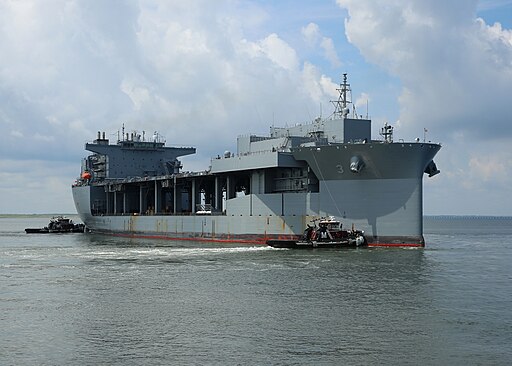
USS Lewis B. Puller (ESB-3)
USS Lewis B. Puller (ESB-3): A New Era in Expeditionary Mobile Base Vessels
The USS Lewis B. Puller (ESB-3) stands at the forefront of modern naval innovation as the first purpose-built expeditionary mobile base vessel in the United States Navy. Combining robust construction with advanced engineering and versatile operational capabilities, this vessel plays a pivotal role in supporting naval missions ranging from humanitarian assistance to special operations. Named in honor of Marine Corps Lieutenant General Lewis Burwell “Chesty” Puller—a symbol of courage and leadership—the ship embodies a legacy of dedication while paving the way for future maritime strategies .
Introduction and Historical Background
Namesake and Heritage
The vessel bears the name of one of the Marine Corps’ most storied figures, Lieutenant General Lewis B. Puller. Known affectionately as “Chesty,” his extraordinary record of valor and leadership during multiple conflicts has inspired generations of service members. With this naming, the Navy not only commemorates a legacy of heroism but also signals its commitment to excellence and adaptability in an ever-changing geopolitical landscape .
Evolution of the Expeditionary Mobile Base Concept
Designed to extend the Navy’s reach beyond traditional port facilities, the expeditionary mobile base concept was developed in response to evolving operational needs. Unlike traditional combatants, USS Lewis B. Puller is engineered to serve as a floating staging base—providing logistical support, command and control, and even acting as a platform for deploying special operations forces. This strategic innovation allows higher-value combat ships to focus on direct engagements while the ESB-3 assumes versatile support roles across the globe .
Design and Construction
Building a Modern Support Vessel
Constructed by the National Steel and Shipbuilding Company (NASSCO) in San Diego, California, the USS Lewis B. Puller was conceived with flexibility and durability in mind. The ship’s construction timeline is a testament to modern naval engineering:
- Laid Down: November 5, 2013
- Launched: November 6, 2014
- Commissioned: August 17, 2017
This carefully orchestrated development process ensured that every design element— from the robust hull and integrated propulsion systems to the specialized aviation facilities—was optimized for long-duration operations under challenging maritime conditions .
A Symbol of Modern Naval Ingenuity
The vessel’s design incorporates a distinctive raised flight deck, twin smoke funnels, and spacious internal arrangements that support a wide array of mission modules. Its construction reflects a fusion of traditional maritime resilience with cutting-edge technology, marking a significant evolution in the way the Navy approaches expeditionary support and logistical flexibility .
Technical Specifications Overview
The USS Lewis B. Puller (ESB-3) is engineered to excel in multiple domains, combining impressive dimensions, innovative propulsion, and advanced operational systems.
Displacement and Dimensions
- Full-Loaded Displacement: Approximately 90,000 long tons (100,000 short tons)
- Length: 764 feet (233 meters)
- Beam: 164 feet (50 meters)
- Draft: 25.5 feet (7.8 meters)
The vessel’s enormous displacement and substantial size afford it the stability and space needed to serve as a mobile base. These dimensions optimize onboard capacity for crew accommodations, cargo storage, and extensive aviation and command facilities, making the ESB-3 a formidable platform for a wide range of operations .
Propulsion and Power
- Propulsion System: Integrated Diesel-Electric Propulsion (IEP)
- Engine Technology: Developed by General Electric
- Propellers: Two operable screws
The integrated propulsion system is designed to offer both efficiency and flexibility over long-range deployments. The diesel-electric configuration drives the vessel steadily at operational speeds while also providing the robust power necessary for maneuvering in challenging sea states. This system’s reliability is critical for a vessel expected to travel up to 9,500 nautical miles without external support .
Speed and Range
- Top Speed: Approximately 15 knots
- Operational Range: 9,500 nautical miles
Although the ESB-3 is not built for high-speed chases, its measured pace supports sustained, fuel-efficient operations over vast distances. This endurance is essential for fulfilling its role as a forward staging base, ensuring that it can remain on station and support expeditionary missions in remote or hostile regions .
Crew and Accommodation
- Operating Complement: Typically around 145 personnel
- Maximum Mission Support: Up to 298 personnel (including a mix of Navy personnel and civilian mariners)
The ship is designed with a dual-crew concept. Under standard conditions, a smaller, dedicated team manages daily operations. However, when needed for extended or specialized missions, the vessel can accommodate an expanded crew to support additional operational tasks, such as loading and deploying equipment for special operations or humanitarian missions. This flexibility is a key element of the ESB-3’s modular design philosophy .
Armament and Defensive Systems
- Primary Defensive Armament: Up to 12 × 12.7 mm Browning M2HB heavy machine guns
- Additional Defense Measures: Incorporation of passive fire protection systems
While the USS Lewis B. Puller is not designed as a front-line combatant, its self-defense capabilities are robust enough to deter potential threats during expeditionary operations. The strategic placement of defensive gun mounts throughout the vessel ensures that it can protect itself in hostile environments, complementing its overall support mission without escalating into direct combat roles .
Aviation and Support Capabilities
- Helicopter Facilities: Flight deck and hangar available
- Aircraft Capacity: Up to 4 heavy-lift transport helicopters (e.g., CH-53 Super Stallion)
- Additional Operations: Capability for tilt-rotor aircraft such as the CV-22 Osprey
One of the standout features of the ESB-3 is its expansive aviation suite. The vessel’s flight deck and hangar enable it to host multiple helicopters simultaneously, freeing up other amphibious and combat vessels for frontline operations. The ability to support diverse aircraft types underscores the ship’s role as a self-sufficient mobile base capable of rapid personnel and equipment deployment .
Operational Capabilities and Mission Roles
A Multi-Role Expeditionary Platform
The USS Lewis B. Puller is designed to operate as a highly adaptable expeditionary mobile base. It functions effectively in a variety of operational theaters, providing essential support for amphibious assaults, humanitarian relief, and special operations. The vessel’s layout and operational systems enable it to act as a command center, logistical hub, and deployment platform—all from a single, versatile vessel .
Special Operations Support
In addition to its logistical and command functions, the ESB-3 is outfitted to support special forces and unconventional warfare missions. Its design includes secure areas for equipment storage, rapid insertion and extraction capabilities, and integrated communications systems that allow for seamless coordination with other naval and ground forces. This versatility ensures that the ship can adapt as missions evolve, whether responding to crises or operating in contested maritime domains .
Future Outlook and Strategic Significance
Modularity and Upgrade Potential
The future of naval warfare demands platforms that can evolve alongside emerging technologies. The USS Lewis B. Puller’s modular design provides ample room for upgrades in areas such as unmanned systems, cyber defense, and electronic warfare. As global security challenges become increasingly complex, this vessel can be reconfigured or enhanced with new technologies, ensuring its relevance for decades to come .
A Symbol of Modern Naval Innovation
More than just a support vessel, the ESB-3 represents a shift in naval strategy—one that emphasizes operational flexibility and cost-effective force distribution. By serving as a floating base that can relay logistical support and command functions, the USS Lewis B. Puller enables frontline combat vessels to focus exclusively on direct engagements. This separation of roles not only optimizes resource allocation but also enhances overall fleet readiness in an era of rapid technological and tactical evolution .
Conclusion
The USS Lewis B. Puller (ESB-3) is a landmark achievement in maritime engineering, encapsulating a forward-thinking approach to support and expeditionary operations. With its impressive dimensions, integrated diesel-electric propulsion, expansive aviation facilities, and adaptive design, the vessel is perfectly poised to meet the multifaceted challenges of modern naval warfare. It stands as a tribute to the legacy of “Chesty” Puller and as a beacon guiding the Navy’s strategic pivot toward multi-domain operational excellence.
.jpg)